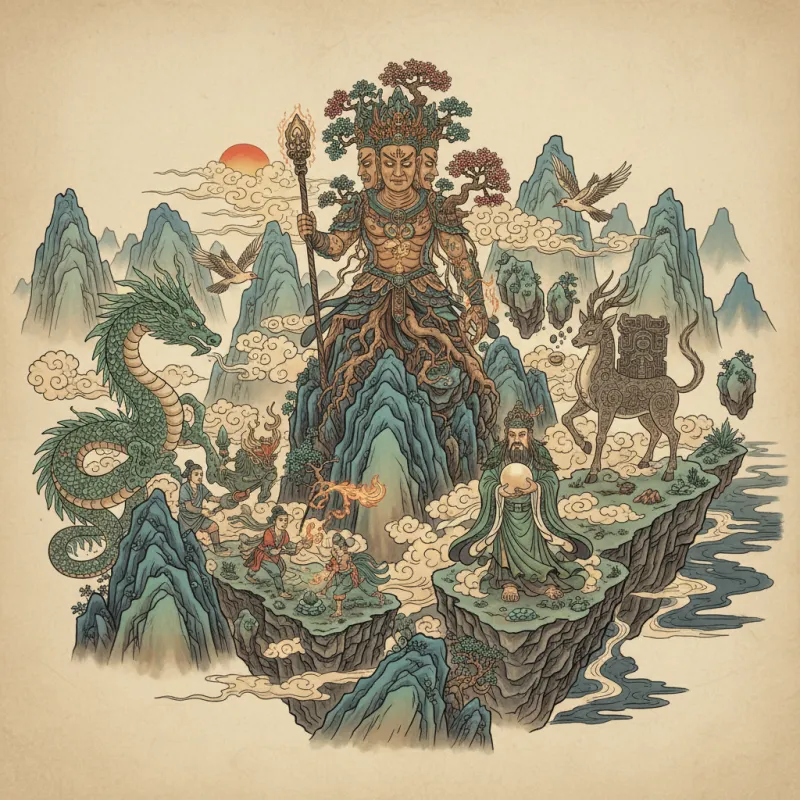
Every mountain in ancient China had a face. Not carved into the rock—the mountain was the face. When you climbed, you walked on divine skin. When you mined, you drew divine blood. And when the earth shook, the god was turning in its sleep.
The Shanhaijing (山海经, Shān Hǎi Jīng) doesn't theorize about this. It simply records it, mountain by mountain, god by god, as if compiling a census of the divine. The five Mountain Classics (山经, Shān Jīng) that open the text read like a bureaucratic survey: "The god of this mountain looks like this, requires these offerings, and will respond in this way." No poetry, no metaphysics—just data. And the data reveals something startling: these mountain gods (山神, shān shén) weren't a unified pantheon. They were a chaotic collection of local tyrants, each ruling their own stone kingdom with absolute authority and zero accountability.
Bodies of Stone and Flesh
The physical descriptions in the Shanhaijing are unsettling because they're so specific. The god of Mount Gouwu (钩吾之山, Gōuwú zhī Shān) has a human face and a single arm. The god of Mount Tai (泰山, Tài Shān)—yes, that Mount Tai, the most sacred peak in China—appears as a human with a pig's tail. The god of Mount Guishan (鬼山, Guǐ Shān) has one head but ten bodies.
These aren't symbolic representations. The text treats them as literal anatomical facts, the way a field guide describes bird plumage. And this matters because it means the ancient Chinese weren't worshipping abstract mountain spirits—they were negotiating with specific, embodied beings who could be recognized, tracked, and potentially avoided if you knew what to look for.
The most common form is the human-animal hybrid: human face with snake body, human body with bird head, human torso with multiple animal limbs. It's as if the mountain gods existed at the evolutionary boundary between human and beast, or perhaps represented a time before that boundary solidified. Some scholars argue these descriptions preserve memories of totemic clan symbols, but that feels too tidy. The Shanhaijing's gods are too weird, too inconsistent, too specific to be mere tribal emblems.
The Offering Economy
Here's where it gets transactional. Nearly every mountain god entry in the Shanhaijing includes a ritual prescription: what to sacrifice, how to present it, what to expect in return. The god of Mount Zhongqu (中曲之山, Zhōngqǔ zhī Shān) requires a jade burial with millet wine. The god of Mount Fuyou (浮游之山, Fúyóu zhī Shān) demands a ram sacrifice with rice wine, no jade.
This isn't worship—it's contract law. You give X, you get Y. Fail to deliver, and the consequences are explicit: drought, plague, landslides, crop failure. The mountain gods operated on a strict reciprocity principle, and they kept accounts.
What's fascinating is the variation. Some gods accept simple grain offerings. Others require elaborate jade burials. A few demand animal sacrifice. The god of Mount Guishan wants a white dog and white jade, presented with specific ritual gestures. There's no standardization, no central religious authority dictating proper procedure. Each mountain had its own contract terms, and travelers had to know the local requirements or risk divine retaliation.
This created a practical problem: how do you remember the ritual requirements for hundreds of mountains? The Shanhaijing itself might have functioned as a ritual manual, a reference guide for merchants, officials, and travelers moving through unfamiliar territory. Don't know what the god of Mount Qingqiu (青丘之山, Qīngqiū zhī Shān) wants? Check the text. Your life might depend on it.
Territorial Powers and Divine Jurisdiction
The mountain gods weren't just residents of their peaks—they were the peaks, and their power extended across the surrounding territory. The god controlled the weather, the water sources, the mineral deposits, the animal populations. Everything that happened on or near the mountain fell under divine jurisdiction.
This created a landscape of overlapping divine territories, each with its own rules and ruler. Travel in ancient China meant crossing invisible borders, entering and exiting divine kingdoms. You might pass through a dozen different jurisdictions in a single journey, each requiring different offerings, different protocols, different levels of caution.
Some mountain gods were benevolent, associated with abundant harvests and healing herbs. The god of Mount Zhongshan (钟山, Zhōng Shān), for instance, presided over a region rich in jade and medicinal plants. Others were actively hostile. The god of Mount Guishan brought pestilence. The god of Mount Yuwu (羽舞之山, Yǔwǔ zhī Shān) caused madness in those who approached without proper offerings.
The Shanhaijing doesn't moralize about this. It doesn't call the benevolent gods "good" or the hostile ones "evil." It simply reports their nature and effects, the way you'd report that one river has drinkable water and another is poisonous. The mountain gods weren't moral agents—they were natural forces with personalities.
The Great Hierarchy That Wasn't
Later Chinese religious traditions tried to organize the mountain gods into neat hierarchies. Daoism assigned them ranks and titles. Buddhism incorporated them as dharma protectors. The imperial cult designated certain mountains as official state sacrifices, with the god of Mount Tai eventually becoming something like a divine prime minister.
But the Shanhaijing knows nothing of this. Its mountain gods don't report to anyone. They don't form councils or alliances. They don't have a king. Each god is sovereign within its territory, and that's the end of it. The text presents a radically decentralized divine landscape, more like feudal Europe than imperial China.
This might reflect the political reality of the Warring States period (475-221 BCE), when the Shanhaijing was likely compiled. China was fragmented into competing kingdoms, each with its own rulers, laws, and customs. The mountain gods mirror this fragmentation—hundreds of local powers, each supreme in its own domain, none acknowledging a higher authority.
The later unification under the Qin and Han dynasties brought political centralization, and religious thought followed. The mountain gods were gradually incorporated into bureaucratic pantheons, given official titles, assigned to departments. The wild, autonomous gods of the Shanhaijing were domesticated into civil servants. But the original text preserves an earlier vision: a China where divine power was local, specific, and utterly ungovernable.
Living Mountains in Modern Memory
The mountain gods haven't entirely disappeared. Travel through rural China today, and you'll still find shrines at mountain passes, offerings left at cave entrances, local legends about peaks that must be approached with respect. The specific rituals have changed, the theological framework has shifted, but the basic intuition remains: mountains are not inert geology. They're alive, aware, and potentially dangerous.
This isn't superstition—it's a different way of relating to landscape. When you treat a mountain as a divine being, you approach it differently. You pay attention. You notice patterns. You develop a relationship. The mountain becomes a presence in your life, not just a feature on a map.
The Shanhaijing's mountain gods might seem alien to modern readers, but they represent something profound: a worldview in which the natural world is fully animate, where every significant landscape feature has agency and personality. We've lost that worldview, mostly. We've gained geological science and topographical precision. But we've also lost the sense that the land itself might be watching, judging, responding to how we treat it.
The ancient Chinese knew their mountains by name, by face, by temperament. They knew what each god wanted and what would happen if you failed to deliver. They lived in a world where geography was theology, where every journey was a negotiation with divine powers. The Shanhaijing preserves that world—not as mythology, but as a practical guide to navigating a landscape that was, quite literally, alive.
The Ritual Texts and Regional Variations
The mountain god entries in the Shanhaijing follow a remarkably consistent formula, which suggests they were drawn from existing ritual texts or oral traditions. Each entry typically includes: the mountain's name and location, a description of the god's appearance, the required offerings, and the expected benefits or dangers. This formulaic structure makes the text function almost like a database—searchable, cross-referenceable, practical.
But within this structure, the regional variations are striking. The gods of the southern mountains tend toward snake and bird forms, reflecting the region's ecology. The northern mountain gods often have more mammalian features—bears, wolves, pigs. The western mountains, bordering the steppes and deserts, host gods with more abstract or composite forms, as if the landscape itself was less defined, more liminal.
These variations suggest the Shanhaijing compiled information from multiple sources, each reflecting local traditions and observations. It wasn't written by a single author with a unified vision—it was assembled from fragments, reports, travelers' accounts, regional ritual manuals. The result is a text that feels less like scripture and more like an encyclopedia, preserving diversity rather than imposing uniformity.
This makes the Shanhaijing invaluable for understanding pre-imperial Chinese religion. Before the state standardized worship, before Confucianism and Daoism codified proper ritual, there was this: hundreds of local cults, each centered on a specific mountain, each with its own god, its own requirements, its own story. The text captures Chinese religion in its wild, undomesticated state—before anyone tried to organize it into a system.
Related Reading
- Sacred Mountains: The Five Great Peaks
- Kunlun Mountain: Home of the Immortals
- Mountain Spirits of the Shanhaijing: The Gods Who Live in Peaks
- Mountain Spirits and Local Worship
- Discovering the Enigmatic Hybrid Creatures of Shanhaijing
- Exploring the Enigmatic Mythical Creatures and Lands of Shanhaijing
- How Shanhai Jing Inspired Modern Fantasy Art and Design