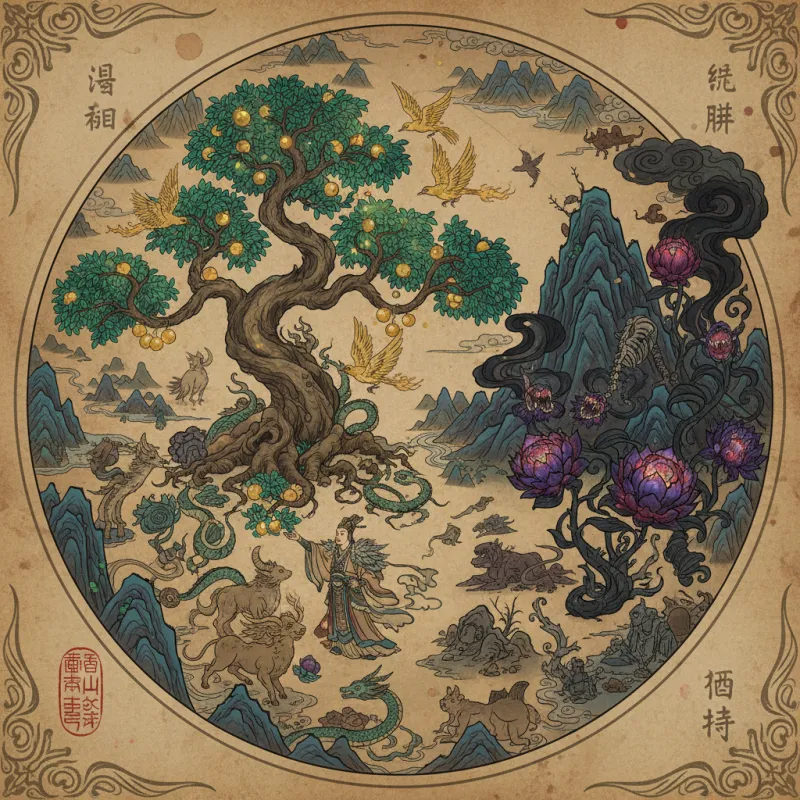
The Jianmu tree grows at the center of the world, its branches reaching into heaven and its roots penetrating the underworld. No mortal has ever tasted its fruit and lived to tell about it — because those who eat from the Jianmu don't die. This is the promise and the terror of the Shanhaijing's botanical catalog: plants so powerful they rewrite the fundamental rules of existence, and flowers so deadly that even their shadows are toxic.
The Geography of Power
The Shanhaijing (山海经 Shānhǎi Jīng, "Classic of Mountains and Seas") doesn't scatter its miraculous flora randomly across the landscape. These plants cluster in specific locations, and the pattern reveals something crucial about how ancient Chinese cosmology understood power itself. The most potent life-giving plants grow on Kunlun Mountain (昆仑山 Kūnlún Shān), the axis mundi where heaven and earth connect. The deadliest specimens flourish in the liminal spaces — swamps, cave mouths, the borders between kingdoms — where cosmic qi (气 qì) becomes unstable and dangerous.
This isn't metaphor. The text treats these locations as literal coordinates, complete with distance measurements and directional markers. Mount Kunlun sits 800 li northwest of the Central Kingdom, guarded by the deity Lu Wu (陆吾 Lù Wú), who has a tiger's body and nine tails. The immortality-granting plants don't grow there by accident. They grow there because that's where the world's life force concentrates most intensely.
The same principle applies in reverse. The Shanhaijing places its most lethal plants in regions where qi stagnates or corrupts — marshlands in the far south, volcanic regions in the west, the lightless forests of the extreme north. These aren't just dangerous neighborhoods. They're places where the fundamental energy of existence has curdled into something toxic.
The Immortality Arsenal
Let's be specific about what "immortality" means in these texts. The Shanhaijing describes at least seven distinct plants that grant some form of extended life, and they don't all work the same way. The differences matter.
The Jianmu tree (建木 Jiànmù) offers the most complete transformation. Its fruit doesn't just extend your lifespan — it fundamentally alters your nature, transforming you from a mortal being into something else entirely. The text is frustratingly vague about what that "something else" is, but later Daoist texts suggest it means becoming a xian (仙 xiān), an immortal who can traverse between the mortal and celestial realms. The catch? The Jianmu grows only at the world's center, and the Queen Mother of the West (西王母 Xī Wángmǔ) guards it personally.
More accessible is the herb called buxiu (不朽 bùxiǔ, literally "not-decay"). It grows on Mount Zhongshan in the west, and the Shanhaijing claims that eating it prevents aging but doesn't make you immune to injury or disease. You can still die — you just won't die of old age. This is a significantly less attractive form of immortality, and it explains why the text mentions buxiu almost casually, without the elaborate descriptions reserved for more powerful plants.
The most interesting case is the sweet herb (甘草 gāncǎo) that grows on Mount Shaoshan. The text claims it "cures all diseases" and "extends life without limit," but archaeological evidence suggests this might be a reference to actual licorice root, which was used extensively in traditional Chinese medicine. If so, the Shanhaijing is doing something fascinating: taking a real medicinal plant and amplifying its properties to mythical proportions. The line between medicine and magic becomes genuinely unclear.
The Killing Garden
The Shanhaijing's toxic plants are, if anything, more varied than its healing ones. The text catalogs flowers that kill through fragrance, trees whose sap dissolves flesh, vines that strangle anything they touch, and mushrooms that cause madness before death. Some of these descriptions are clearly mythical. Others sound disturbingly plausible.
Consider the duanchang grass (断肠草 duànchángcǎo, "intestine-severing grass"). The Shanhaijing places it in the southern marshlands and claims that merely touching it causes the intestines to rupture. This sounds like pure fantasy until you learn that duanchang grass is a real plant — Gelsemium elegans — and it's genuinely lethal. The symptoms of gelsemium poisoning include severe abdominal pain and intestinal paralysis. The ancient text wasn't exaggerating by much.
The same pattern appears with the jianchou tree (见愁树 jiànchóu shù, "see-sorrow tree"). The Shanhaijing claims its flowers produce a fragrance that causes immediate depression and, with prolonged exposure, suicidal despair. Modern botanists have identified several candidates for this plant, including certain species of Datura that produce tropane alkaloids capable of causing severe psychological disturbances. Again, the mythology has roots in observable reality.
But then there's the heiyao flower (黑药花 hēiyào huā), which supposedly kills through its shadow. Stand in the shade of a heiyao bloom, and you'll be dead within three breaths. This is clearly mythical — no plant kills through shadow — but it reveals something about how the Shanhaijing understands toxicity. Poison isn't just a chemical property. It's a manifestation of corrupted qi, and qi can transmit through proximity, through air, through the mere presence of a thing.
The Dosage Problem
Here's where the Shanhaijing gets genuinely sophisticated. The text repeatedly emphasizes that the difference between healing and harm is often just a matter of quantity. The same plant that cures disease in small amounts causes death in large ones. This isn't a modern pharmacological insight — it's a principle the Shanhaijing states explicitly and repeatedly.
The text describes the lingzhi mushroom (灵芝 língzhī), which grows on Mount Wushan and grants longevity when consumed in tiny amounts over many years. But eat too much at once, and the same mushroom causes violent convulsions and death. The mechanism, according to the text, is that lingzhi concentrates qi so intensely that the human body can only process it gradually. Flood your system with too much concentrated life force, and it becomes as destructive as poison.
This principle extends to the immortality plants as well. The Shanhaijing warns that eating too much fruit from the Jianmu tree doesn't make you "more immortal" — it causes your body to dissolve into pure qi, effectively erasing you from physical existence. Immortality requires balance, not excess.
The Knowledge Barrier
The Shanhaijing makes clear that these plants are dangerous primarily because most people don't know how to use them. The text repeatedly mentions that certain deities, immortals, and shamans possess the knowledge to harvest, prepare, and administer these botanical wonders safely. Everyone else is gambling with their life.
This creates a fascinating power dynamic. The plants themselves are neutral — they're just concentrations of qi in botanical form. But access to the knowledge of how to use them becomes a form of social and spiritual capital. The Queen Mother of the West doesn't just guard the Jianmu tree physically; she guards the knowledge of how to consume its fruit without being destroyed by it.
The text describes elaborate preparation rituals for many of these plants. The buxiu herb must be harvested at midnight during a new moon, dried for exactly 49 days, and ground with jade tools. Use metal tools, and the herb becomes toxic. Skip any step, and at best it becomes inert; at worst, it kills you. This isn't superstition — it's a sophisticated understanding that the power of these plants depends on context, timing, and method.
The Modern Echo
Walk through any traditional Chinese medicine shop today, and you'll see echoes of the Shanhaijing's botanical catalog. Ginseng, goji berries, lingzhi mushrooms — these are the domesticated descendants of the text's mythical flora. They no longer grant immortality, but they're still sold as life-extending tonics, and the language used to describe them often mirrors the Shanhaijing's terminology almost exactly.
This continuity is remarkable. The Shanhaijing was compiled over 2,000 years ago, yet its basic framework for understanding medicinal plants — that they concentrate qi, that dosage matters, that preparation is crucial, that knowledge is power — still structures how millions of people think about herbal medicine today. The mythology has become practical wisdom, even as the most extreme claims have been quietly abandoned.
But maybe not entirely abandoned. There are still Daoist practitioners who claim to know the locations of the Shanhaijing's legendary plants, still herbalists who insist that the true lingzhi — not the cultivated variety sold in shops — grows only in remote mountains and grants genuine longevity. Whether these claims are true is almost beside the point. The Shanhaijing created a framework for thinking about plants as vessels of cosmic power, and that framework has proven remarkably durable.
The Dual Nature Revisited
The Shanhaijing's division of plants into life-givers and life-takers reflects a deeper principle in Chinese cosmology: power is never neutral. The same forces that create also destroy. The same qi that animates life can, in different configurations, end it. This isn't a bug in the system — it's the fundamental nature of existence.
This explains why the text places immortality-granting plants and lethal poisons in such close proximity. On Mount Kunlun, the peach trees of immortality grow within sight of the duanchang grass. This isn't poor urban planning. It's a statement about the nature of power itself. You can't have creation without destruction, healing without harm, life without death. They're not opposites — they're different expressions of the same underlying force.
The Shanhaijing's botanical catalog is ultimately a map of power in its rawest form. These plants are dangerous not because they're evil, but because they're potent. They offer immortality and death with equal indifference, and the difference between the two outcomes depends entirely on the knowledge, skill, and intentions of the person who approaches them. In this sense, the Shanhaijing's plants are less like organisms and more like tools — or weapons. They amplify whatever purpose you bring to them.
For more on the creatures that guard these mythical plants, see Divine Beasts of Mount Kunlun. The relationship between these botanical wonders and the Elixirs of Immortality in later Daoist tradition reveals how the Shanhaijing's mythology evolved into practical alchemical systems.
Related Reading
- Unearthing the Mythical Flora in Shanhaijing: A Journey Through Legendary Plants
- The Bizarre Plants of the Shanhaijing: Trees That Cure Death and Fruits That Grant Flight — Shanhai Perspective
- Magical Plants of the Shanhai Jing: Trees That Grant Immortality — Shanhai Perspective
- Lingzhi: The Mushroom of Immortality from Myth to Medicine — Shanhai Perspective
- The Peaches of Immortality: The Most Famous Fruit in Chinese Mythology — Shanhai Perspective
- Unraveling the Mysteries of Shanhaijing: Mythical Creatures and Enigmatic Lands
- Unraveling the Mysteries of Shanhaijing: Myths, Creatures, and Fantastic Realms
- Mystical Fish of Shanhaijing: Exploring Legendary Creatures and Enchanted Waters