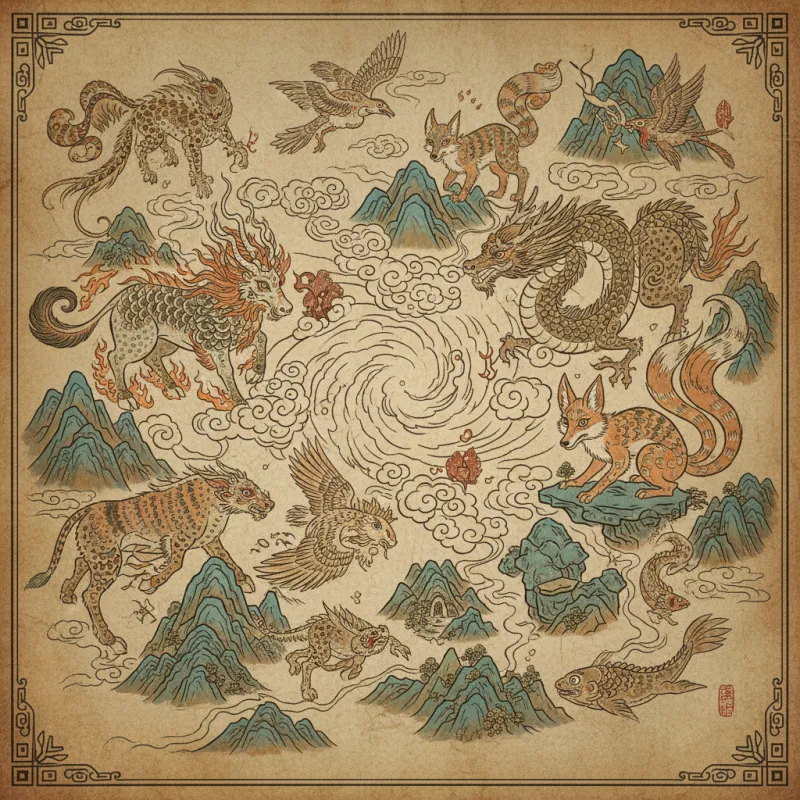
There's a book written over two thousand years ago that describes a world where mountains are guarded by gods with human faces and snake bodies, where birds with nine heads drink from rivers of fire, where a giant named Xingtian (刑天, Xíng Tiān) keeps fighting even after his head is cut off — using his nipples as eyes and his navel as a mouth. That book is the Shanhai Jing (山海经, Shānhǎi Jīng) — the Classic of Mountains and Seas — and it's one of the strangest, most imaginative, and most influential texts in world literature.
Part bestiary, part geography, part mythology, part fever dream, the Shanhai Jing catalogues hundreds of mountains, rivers, creatures, gods, and peoples across a landscape that doesn't quite match any real place on Earth. It's been called China's first encyclopedia, its oldest mythology collection, and a Bronze Age atlas of the impossible. For over two millennia, it has shaped how Chinese culture imagines the divine, the monstrous, and the unknown.
What Exactly Is the Shanhai Jing?
The Shanhai Jing is a compilation of eighteen sections divided into five major books: the Classic of Mountains (Shan Jing, 山经) in five parts, and the Classic of Seas (Hai Jing, 海经) in thirteen parts. Together, they describe 447 mountains, 258 rivers, 277 creatures, and countless gods, spirits, and strange peoples. The text follows a methodical structure — almost bureaucratic in its precision — listing each location's distance from the previous one, what minerals can be found there, what animals inhabit it, and what rituals should be performed.
But here's where it gets weird: nobody knows who wrote it, when exactly it was compiled, or whether it was meant to be taken literally. Traditional scholarship attributes parts of it to Yu the Great (大禹, Dà Yǔ), the legendary flood-tamer and founder of the Xia Dynasty, around 2200 BCE. His assistant Boyi (伯益, Bó Yì) supposedly recorded their travels. Modern scholars are more cautious, dating the earliest sections to the Warring States period (475-221 BCE) and the latest to the early Han Dynasty (206 BCE - 9 CE).
The text we have today was compiled and annotated by Guo Pu (郭璞, Guō Pú) in 370 CE, a Jin Dynasty scholar who added his own commentary trying to make sense of descriptions that were already ancient and mysterious by his time. His annotations are often as baffling as the original text — he'll confidently identify a creature with nine heads and a human face as "probably a type of owl."
The Geography of Impossibility
The Shanhai Jing presents itself as a geographical survey, and in some ways it is. Many of the mountains and rivers it describes can be tentatively identified with real locations in ancient China. Mount Tai (泰山, Tài Shān) in Shandong appears. The Yellow River and Yangtze River are there. But then you'll read about mountains made of jade that float in the sky, or rivers that flow upward, or a country where people have holes through their chests and carry poles through them.
The Classic of Mountains section follows a relatively coherent pattern, moving through five mountain ranges in a systematic survey. Each entry follows a formula: "Another 300 li to the east is Mount X. On its summit grows much jade. The Y River originates here and flows south into the Z River. In it are many A fish, which look like B but have C. Eating them cures D."
But the Classic of Seas section abandons this orderly approach for something far stranger. Here we find the Kunlun Mountains (昆仑山, Kūnlún Shān), the axis mundi of Chinese cosmology, home to the Queen Mother of the West (西王母, Xī Wángmǔ) and her garden of immortality peaches. We find countries of one-eyed people, three-headed people, people with wings, people who never die. The geography becomes increasingly fantastical, describing lands that seem to exist in mythological space rather than physical space.
Some scholars have tried to map the Shanhai Jing onto real geography, with varying degrees of success. Others argue it describes a ritual or cosmological landscape — a map of the sacred rather than the physical. The truth is probably somewhere in between: a text that began as genuine geographical knowledge, passed through generations of oral transmission, mixed with mythology, shamanic visions, and pure imagination, until the real and the fantastic became impossible to separate.
The Menagerie of Monsters
If you're reading the Shanhai Jing for the first time, you're reading it for the creatures. And what creatures they are.
There's the Zhuque (朱雀, Zhūquè), the Vermillion Bird, one of the Four Symbols that would become central to Chinese cosmology. There's the Qilin (麒麟, Qílín), the chimeric creature with a dragon's head, deer's body, ox's tail, and horse's hooves that appears only in times of great peace or to herald the birth of a sage. There's the Jiuwei Hu (九尾狐, Jiǔwěi Hú), the nine-tailed fox that would become one of the most enduring figures in East Asian folklore — though in the Shanhai Jing, eating one simply prevents you from being poisoned, with no mention of the seductive shapeshifters they'd later become.
But the real treasures are the creatures that never made it into mainstream mythology. The Zheng (狰, Zhēng), which looks like a red leopard with five tails and one horn, and whose cry sounds like striking stones. The Feiyu (飞鱼, Fēiyú), a fish with one head and ten bodies. The Lushu (鹿蜀, Lùshǔ), which has a horse's body, white head, tiger stripes, and a red tail, and wearing its hide will bring you many descendants.
Many creatures in the Shanhai Jing are explicitly medicinal or magical. Eating this one cures jealousy. Wearing that one's skin prevents you from getting lost. This one's cry predicts floods. That one appears before great droughts. The text treats them with the same matter-of-fact tone it uses for everything else: "There is a beast here. It looks like a sheep with nine tails and four ears, and its eyes are on its back. Its name is Bai Gao. Wearing it prevents fear."
The creatures reflect a worldview where animals aren't just animals — they're omens, medicines, spiritual beings, and manifestations of cosmic forces. This is a world where the boundary between human, animal, and divine is constantly shifting, where transformation is always possible, where eating the right creature might make you immortal or immune to fire or able to understand the speech of all things.
Gods, Heroes, and Headless Warriors
The Shanhai Jing's pantheon is vast and strange, populated by deities who don't quite fit the orderly hierarchies of later Daoist or Buddhist cosmology. Many have animal features — human faces with snake bodies, bird heads with human hands, multiple heads, extra limbs, or bodies covered in scales or feathers.
The most famous is probably Xingtian (刑天, Xíng Tiān), the headless warrior who fought the Yellow Emperor (黄帝, Huángdì) for supremacy. After the emperor decapitated him, Xingtian refused to die. He made his nipples into eyes and his navel into a mouth, picked up his axe and shield, and kept fighting. The image of Xingtian dancing with his weapons, his chest-face grimacing in eternal defiance, has inspired countless poems, paintings, and modern adaptations. He represents something essential about the Shanhai Jing's worldview: the refusal to accept limits, even the limit of death itself.
Then there's Nüwa (女娲, Nǚwā), the goddess with a human head and snake body who created humanity and repaired the sky when it cracked. The Shanhai Jing gives us one of the earliest written references to her, though her role here is less developed than in later texts. She's described simply as a goddess in the wilderness, one of many divine beings inhabiting the landscape.
The Queen Mother of the West (西王母, Xī Wángmǔ) appears as a far more fearsome figure than her later incarnation as a gracious immortal. In the Shanhai Jing, she has a human face, leopard's tail, tiger's teeth, and wild hair held by a jade ornament. She excels at whistling and controls the plagues and punishments of heaven. Only later would she be domesticated into the elegant hostess of the Peaches of Immortality banquet that appears in Journey to the West.
How the Shanhai Jing Shaped Chinese Culture
You can't understand Chinese mythology, literature, or visual culture without understanding the Shanhai Jing. It's the source code, the original database from which countless later works drew their material.
The Four Symbols (四象, Sì Xiàng) — Azure Dragon, Vermillion Bird, White Tiger, and Black Tortoise — that became fundamental to Chinese cosmology, feng shui, and martial arts all have their origins in creatures described in the Shanhai Jing. The concept of the Kunlun Mountains as the axis mundi, the center of the world where heaven and earth meet, comes from here. The nine-tailed fox that appears in everything from ancient poetry to modern K-dramas started here.
During the Han Dynasty, the Shanhai Jing was treated as a serious geographical and natural history text. Scholars cited it as evidence for the existence of distant lands and strange peoples. By the Tang Dynasty, it was being read more as mythology and literature, though still with the assumption that it contained some kernel of truth. The Song Dynasty saw the first illustrated editions, with artists attempting to visualize the impossible creatures described in the text.
The Ming and Qing dynasties produced numerous commentaries and illustrated editions. The most famous is probably the 1597 edition with illustrations that have become iconic — stylized, almost whimsical depictions of creatures that look like they wandered out of a particularly vivid dream. These images have been endlessly reproduced, adapted, and referenced in modern Chinese visual culture.
Modern Chinese fantasy literature and games draw heavily from the Shanhai Jing. The creatures appear in everything from video games like Honor of Kings to novels like The Three-Body Problem. Contemporary artists like Xu Bing have created installations based on the text. It's become a symbol of Chinese cultural identity, a reminder of a time when Chinese imagination ranged freely across impossible landscapes.
Reading the Shanhai Jing Today
So should you actually read the Shanhai Jing? That depends on what you're looking for.
If you want a coherent narrative with plot and character development, you'll be disappointed. The Shanhai Jing doesn't tell stories in the conventional sense. It lists. It catalogues. It describes. Reading it straight through is like reading an encyclopedia or a field guide — fascinating in small doses, potentially tedious in large ones.
But if you approach it as a collection of fragments, a sourcebook of wonders, a glimpse into how ancient Chinese people imagined the world beyond their borders, it's endlessly rewarding. Dip into it randomly. Read an entry or two. Let your imagination fill in the gaps. Picture the nine-headed bird. Imagine the country where people have holes through their chests. Wonder what it would be like to eat a creature that prevents jealousy.
The best English translation is probably Anne Birrell's 1999 version, which includes helpful annotations and doesn't try to rationalize away the text's strangeness. Richard Strassberg's 2002 illustrated translation is also excellent, reproducing many of the traditional Chinese illustrations alongside the text.
Reading the Shanhai Jing requires a certain mindset. You have to accept that you won't understand everything, that some passages are probably corrupted or mistranslated, that the text is deliberately obscure in places. You have to be comfortable with ambiguity, with descriptions that don't quite make sense, with a worldview that's fundamentally different from modern rationalism.
But that's also what makes it valuable. In an age of Google Maps and satellite imagery, when every corner of the Earth has been photographed and catalogued, the Shanhai Jing reminds us that there was a time when the world was full of genuine mystery. When the next mountain range might contain gods or monsters or peoples who lived entirely differently from you. When eating the right creature might grant you immortality or the ability to fly.
The Enduring Mystery
More than two thousand years after it was compiled, the Shanhai Jing remains fundamentally mysterious. We still don't know who wrote it, why they wrote it, or how much of it was meant to be believed. We don't know if it's a corrupted geography text, a shamanic vision, a political allegory, or something else entirely.
And maybe that's appropriate. The Shanhai Jing is a book about mystery, about the unknown, about the edges of the map where the familiar world gives way to something stranger. It's a reminder that not everything needs to be explained, rationalized, or made to fit our modern categories.
The creatures in the Shanhai Jing aren't just monsters or mythological beings. They're possibilities. They're what-ifs. They're the products of human imagination encountering the unknown and trying to make sense of it through the only tools available: observation, analogy, and wonder.
When you read about a bird with nine heads drinking from a river of fire, you're not just reading about a mythological creature. You're reading about how ancient Chinese people processed the strange and the unfamiliar. You're reading about how they tried to map not just physical space but conceptual space — the space of the possible, the dangerous, the divine.
The Shanhai Jing has survived for over two millennia because it speaks to something fundamental in human nature: our need to imagine what lies beyond the horizon, our desire to believe that the world is stranger and more wonderful than it appears, our hope that somewhere out there, impossibility becomes possible.
In that sense, the Shanhai Jing isn't just an ancient text. It's a living document, constantly being reinterpreted and reimagined for new generations. As long as humans wonder what lies beyond the edge of the map, the Classic of Mountains and Seas will have something to teach us.
Related Reading
- Pangu and the Cosmic Egg: The Chinese Creation Myth
- Kunlun Mountain: The Axis of the Chinese Cosmos
- Exploring Shanhaijing: Mythical Creatures and Ancient Lands of Chinese Cosmology
- Nüwa Repairs the Sky: Saving the World
- The Four Divine Beasts: Guardians of the Compass
- Hetu and Luoshu: The Cosmic Diagrams
- Unraveling the Mysteries of Shanhaijing: Mythical Creatures and Enigmatic Lands
- Exploring the Enigmatic Mountains and Creatures of the Shanhaijing