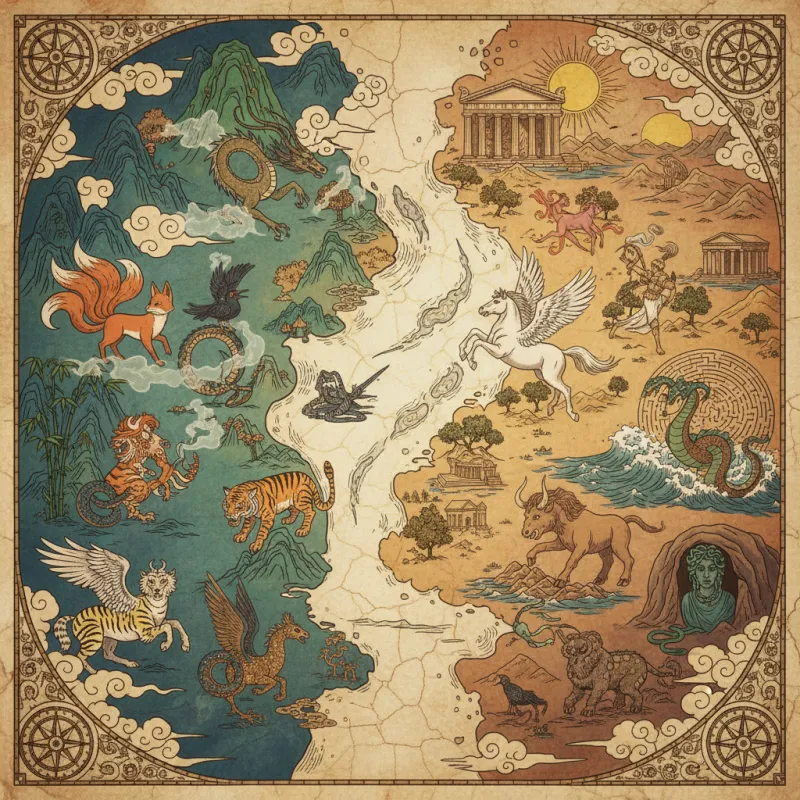
Picture a scholar in ancient China, brush in hand, carefully recording: "Three hundred li to the east, there is a creature with the body of a sheep and nine tails." Now picture a Greek bard, lyre at his side, singing: "And then the hero thrust his sword into the beast's heart." Same impulse — documenting the impossible — but entirely different philosophies. The Shanhai Jing (山海经 Shānhǎi Jīng, "Classic of Mountains and Seas") and Greek mythology both gave us bestiaries that still captivate us today, but they're playing completely different games.
The Field Guide vs. The Epic
Here's the fundamental split: Greek monsters exist to be defeated. Shanhai Jing creatures exist to be cataloged.
When you read Greek mythology, creatures appear as obstacles in a hero's journey. The Minotaur (牛头怪 Niútóu Guài) lives in the labyrinth specifically so Theseus can prove his worth by killing it. Medusa grows snakes for hair so Perseus has something dramatic to behead. The Hydra sprouts multiple heads so Heracles can demonstrate his strength and cleverness. These aren't creatures — they're plot devices with teeth.
The Shanhai Jing, compiled roughly between the 4th and 1st centuries BCE, takes a radically different approach. It reads like a naturalist's field notes from a fever dream. "Three hundred li to the northeast, there is a mountain called Gouwu. On it lives a beast that looks like a sheep with nine tails and four ears. Its eyes are on its back. Wearing its hide will banish fear." No story. No hero. Just documentation. The creature called Qiongqi gets described with the same matter-of-fact tone you'd use for a deer.
This isn't a flaw — it's a feature. The Chinese text operates like an encyclopedia, a geographical survey, a pharmacological reference, and a bestiary all rolled into one. It tells you where creatures live, what they look like, what they eat, and often what medicinal or magical properties they possess. Greek mythology tells you how to kill them.
Purpose and Function
Why the difference? Context matters enormously.
Greek mythical creatures served the oral storytelling tradition. Bards needed memorable antagonists. Audiences wanted heroes who could overcome impossible odds. The creatures had to be threatening enough to make victory meaningful but defeatable enough to allow for triumph. They existed in a moral universe where monsters represented chaos, hubris, or divine punishment. The Sphinx posed riddles because the Greeks valued cleverness. The Chimera breathed fire because heroes needed to be tested by the impossible.
The Shanhai Jing emerged from a different intellectual tradition entirely. It's part of the Chinese impulse to catalog and systematize the world — the same impulse that gave us detailed agricultural manuals, astronomical charts, and medical encyclopedias. The text claims to describe the geography of the known world and beyond, listing mountains, rivers, minerals, plants, and yes, creatures both mundane and fantastic. Whether the compilers believed these creatures literally existed is debatable, but they treated them with scholarly seriousness.
Some scholars argue the Shanhai Jing served as a practical guide for travelers, officials, and traders navigating China's vast and varied landscape. Others see it as a cosmological text, mapping not just physical space but spiritual and mythological geography. Either way, its creatures aren't there to be conquered — they're there to be understood, avoided, or utilized.
Creature Design Philosophy
Look at how the two traditions construct their monsters, and you'll see the philosophical divide.
Greek creatures tend toward the hybrid — human intelligence combined with animal power. The Centaur blends human torso with horse body. The Harpy merges woman and bird. The Satyr mixes man and goat. These combinations create moral ambiguity. Centaurs can be wise teachers like Chiron or drunken rapists like Nessus. The hybrids occupy an uncomfortable middle ground between civilization and wilderness, reason and instinct.
Shanhai Jing creatures favor multiplication and recombination. Nine-tailed foxes. Six-legged beasts. Fish with bird wings. Snakes with human faces. The text describes the Feiyi (飞翼 Fēiyì), a snake with six legs and four wings. It documents the Lushu (鹿蜀 Lùshǔ), which has a horse's body, a white head, tiger stripes, and a red tail. These aren't moral symbols — they're variations on natural forms, as if the compilers were documenting what happens when nature experiments with different body plans.
The Greek approach creates creatures that can participate in human drama. The Shanhai Jing approach creates creatures that expand the catalog of what's possible in the natural world. One is theatrical. The other is taxonomical.
The Role of Heroes
Greek mythology is hero-centric. Monsters exist to be overcome, and overcoming them proves heroic virtue. Heracles earns immortality partly by completing twelve labors, most of which involve killing or capturing dangerous creatures. Perseus becomes legendary by beheading Medusa. Bellerophon achieves fame by slaying the Chimera while riding Pegasus. The creatures are supporting cast in human stories.
The Shanhai Jing has no heroes. It has no protagonists at all. Creatures appear, get described, and the text moves on to the next mountain or river. Occasionally it notes that eating a particular creature will cure disease or that wearing its hide provides protection, but there's no narrative of brave warriors hunting these beasts. The human relationship to these creatures is observational, not confrontational.
This reflects deeper cultural differences. Greek culture celebrated the agon — the contest, the struggle, the proving of worth through conflict. Chinese philosophy, particularly as expressed in texts like the Daodejing, often emphasized harmony with nature, understanding natural patterns, and working with rather than against the world's fundamental forces. You don't conquer the Taotie — you understand it, avoid it, or find a way to coexist with it.
Moral Dimensions
Greek monsters frequently embody moral lessons or divine punishment. The Minotaur exists because King Minos refused to sacrifice a sacred bull to Poseidon — the creature is literally the consequence of human arrogance. Medusa became monstrous after being raped in Athena's temple, transformed by the goddess's rage. Arachne was turned into a spider for the hubris of challenging Athena to a weaving contest. These creatures carry moral weight. They're warnings, punishments, or tests of character.
Shanhai Jing creatures are morally neutral. They're dangerous or beneficial, but not good or evil. The text might note that a creature's appearance signals coming disaster — "When it appears, there will be great drought in the world" — but this is predictive, not punitive. The creature isn't causing the drought as punishment for human sin; it's simply correlated with it, like a barometer predicting weather.
This distinction matters. Greek monsters exist in a universe governed by gods who care deeply about human behavior and punish transgressions. Shanhai Jing creatures exist in a universe that operates according to patterns and correspondences, where understanding the signs allows you to navigate reality more effectively.
Practical Applications
Here's where the Shanhai Jing gets really interesting: its creatures have uses.
The text regularly notes medicinal or magical properties. "Eating its flesh prevents jealousy." "Wearing its hide wards off poison." "Its call sounds like a human crying; hearing it means flood will come." These aren't just monsters — they're resources, omens, and tools. The Zhuyan, a creature that looks like an ape with a white head and red feet, signals war when it appears. The Bi Fang (毕方 Bì Fāng), a one-legged bird that appears like a crane with red markings, signals fire.
Greek creatures occasionally have useful parts — Medusa's blood can heal or kill, depending on which side of her body it came from — but this is incidental to their narrative function. They're primarily obstacles or symbols, not resources to be harvested or signs to be interpreted.
The practical orientation of the Shanhai Jing suggests it served real-world purposes, even if we're skeptical about the literal existence of nine-tailed foxes. It taught readers to observe their environment carefully, to note correlations between unusual sightings and subsequent events, to understand the properties of rare animals and plants. It's a survival manual disguised as a bestiary.
Geographic Specificity
The Shanhai Jing obsesses over location. Every creature gets placed precisely: "Two hundred li to the south, there is a mountain called Qingqiu..." Greek myths are geographically vague. The Minotaur lives in Crete, yes, but the labyrinth is more symbolic space than real location. Many Greek monsters inhabit undefined wildernesses or mythical islands that exist outside normal geography.
This reflects the Shanhai Jing's origins as a geographical text. It's mapping the world, and creatures are part of that map. The text moves systematically through regions, cataloging everything notable — minerals, plants, animals, and impossible beasts all get the same treatment. Geography grounds the fantastic in the real.
Greek mythology cares less about where monsters live than what they represent or what heroes do to them. The location matters only as setting for the story. The Shanhai Jing makes location primary — the creature is defined by where it lives as much as by what it looks like.
Legacy and Influence
Both traditions have profoundly influenced their respective cultures and beyond.
Greek monsters became templates for Western fantasy. Dragons, griffins, and chimeras populate medieval bestiaries, Renaissance art, and modern fantasy novels. The hero-versus-monster narrative structure dominates Western storytelling from Beowulf to superhero movies. We inherited the Greek assumption that monsters exist to be fought.
The Shanhai Jing influenced Chinese literature, art, and philosophy for over two millennia. Its creatures appear in poetry, painting, and fiction. The text shaped how Chinese culture thinks about the relationship between the known and unknown, the natural and supernatural. Its encyclopedic approach influenced later Chinese natural history texts and geographical surveys.
Interestingly, as these traditions encounter each other in our globalized world, we're seeing hybrid approaches. Modern fantasy increasingly features creatures that are documented and studied rather than simply fought. Video games create bestiaries that catalog monster properties and habitats. We're learning to appreciate both the narrative power of Greek monsters and the taxonomical richness of the Shanhai Jing.
What We Can Learn
These two approaches to impossible creatures reveal fundamentally different ways of relating to the unknown.
The Greek approach says: the unknown is dangerous, but human courage and cleverness can overcome it. Monsters are challenges to be met, chaos to be ordered, threats to be eliminated. This worldview empowers human agency but also positions us in constant conflict with the world's mysteries.
The Shanhai Jing approach says: the unknown is vast, strange, and worth documenting. Creatures are phenomena to be observed, patterns to be understood, resources to be utilized or avoided. This worldview emphasizes knowledge and adaptation over conquest.
Neither approach is superior — they serve different purposes and reflect different values. But understanding both enriches how we think about the fantastic, the unknown, and our place in a world that still contains mysteries. The Greek hero and the Chinese scholar both have something to teach us about encountering the impossible.
When you read about the Minotaur, you're reading about human courage. When you read about the nine-tailed fox, you're reading about the world's infinite strangeness. Both are true. Both matter. And both continue to haunt our imagination, reminding us that reality has always been stranger than we think, and that how we catalog that strangeness says as much about us as it does about the creatures themselves.
Related Reading
- Strange Creatures of the Shanhaijing: A Field Guide to the Impossible
- 10 Most Fascinating Creatures from the Classic of Mountains and Seas
- Hundun: The Chaos Creature at the Beginning of Everything
- Taotie: The Glutton Beast That Devoured Ancient Chinese Art
- The Shanhaijing's Strange Creatures: A Field Guide to the Impossible
- Flood Myths: Noah vs Gun-Yu
- Exploring the Myths of Serpents in the Shanhaijing: Creatures of Power and Mystery
- The Nine-Tailed Fox: From Divine Beast to Demonic Seductress