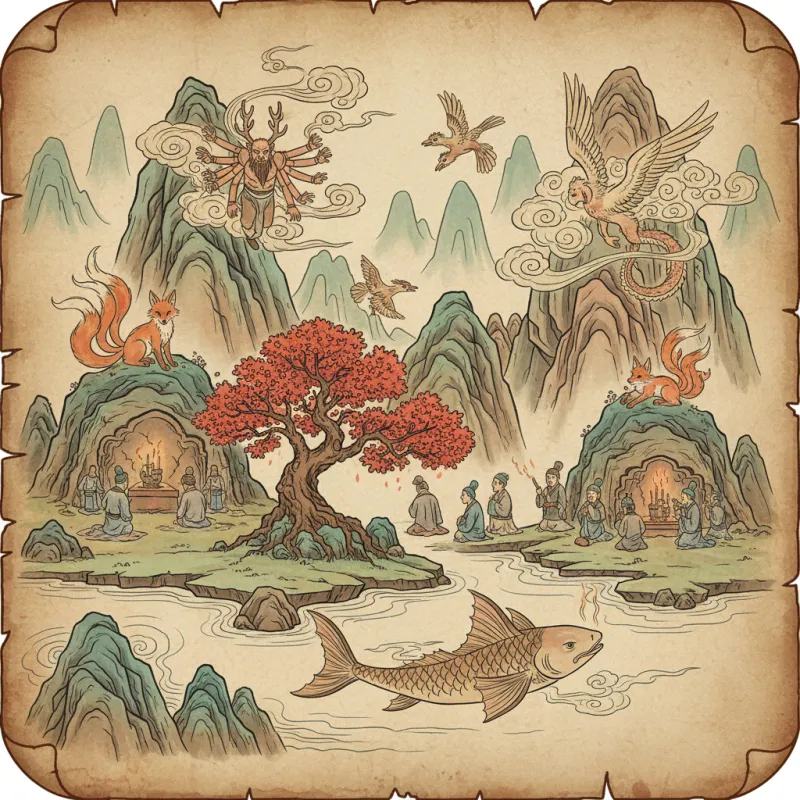
There's a shrine on a mountain path in Guizhou province that I've never been able to forget. It's not in any guidebook. It's not on any map. It's a flat stone under a tree, with three oranges, a cup of rice wine, and a stick of incense that someone had lit that morning. No name on the shrine. No statue. No inscription. Just offerings to something. Some spirit of that particular mountain, that particular path, that particular tree. A spirit so local that its worship extends maybe a kilometer in any direction.
This is the real mountain worship of China. Not the grand temples of Mount Tai or the famous monasteries of Mount Song, but thousands of unnamed shrines on unnamed mountains, tended by people who couldn't tell you the spirit's name but know exactly when to leave offerings and what those offerings should be.
The Shanhaijing's Silent Majority
The Classic of Mountains and Seas catalogs hundreds of mountains, and for nearly every one, it provides a ritual formula. "Sacrifice with a jade disc and grain" for one mountain. "Offer a white dog and grain wine" for another. "Bury a jade tablet and use a black bull" for a third. The text is obsessive about these details, dedicating sometimes more space to the sacrifice protocol than to describing the mountain itself.
What the text doesn't tell you is who these spirits are. Most mountains in the Shanhaijing have no named deity, no mythology, no personality. They're just... there. Powerful. Requiring propitiation. The text assumes you understand that mountains have spirits the way it assumes you understand that water flows downhill.
This is radically different from how we usually think about Chinese mythology. We're used to named gods with elaborate backstories — the Jade Emperor, Guanyin, the Eight Immortals. But the Shanhaijing reveals an older layer: a world where every geographical feature has its own numinous presence, and most of them are anonymous.
The mountain spirit (山神, shānshén) isn't a character in a story. It's a fact of the landscape.
What Makes a Mountain Sacred
Not all mountains are equal in the spirit hierarchy. The Shanhaijing makes distinctions that seem arbitrary until you spend time in actual mountains. Some mountains are described as having "many spirits" (多神, duō shén). Others are noted for having "no spirits" (無神, wú shén), which is remarkable — the text bothers to tell you when a mountain is spiritually inert.
What determines a mountain's spiritual potency? The text gives us clues. Mountains with unusual minerals or rare plants tend to be more spiritually active. Mountains where strange animals are seen. Mountains with peculiar weather patterns. Mountains that are difficult to climb or dangerous to traverse.
There's a logic here that modern people have mostly forgotten: the sacred isn't separate from the natural. A mountain is sacred because it's powerful — because it has resources you need, weather that can kill you, terrain that demands respect. The spirit isn't something added to the mountain. The spirit is the mountain's power personified.
This is why mountain deities in Chinese tradition are so often described as territorial and jealous. They're not abstract moral authorities. They're the concentrated essence of a specific place, and they care about that place the way you care about your own body.
The Ritual Economy of Mountains
Here's what the Shanhaijing teaches you if you read it carefully: mountain worship is transactional. You give the mountain spirit something, and in return, you get safe passage, good weather, successful hunting, or protection from the mountain's dangers.
The offerings specified in the text are revealing. Jade and grain are common — jade because it's precious and comes from mountains themselves, grain because it represents human cultivation and civilization. You're giving the mountain something of value from the human world.
But some mountains demand blood sacrifice. The text specifies animals: dogs, pigs, bulls, sheep. A few mountains require buried offerings — jade tablets or silk that will never be recovered, a pure loss to demonstrate sincerity. The more dangerous or important the mountain, the more costly the offering.
This isn't primitive superstition. It's a sophisticated system of risk management. You're investing in your relationship with a powerful entity that can help or harm you. The villagers who maintain that unnamed shrine in Guizhou aren't being irrational. They're maintaining a relationship with their environment that has worked for generations.
Local Spirits vs. State Cults
By the Tang Dynasty (618-907 CE), the imperial government had developed an official hierarchy of mountain spirits. The Five Sacred Mountains (五岳, Wǔyuè) received state-sponsored temples and official titles. Their spirits were incorporated into the bureaucratic structure of heaven, with ranks and responsibilities.
But this official religion existed alongside — not instead of — the local cults. The farmer who made offerings to the Five Sacred Mountains also made offerings to the hill behind his village. The official cult was about political legitimacy and cosmic order. The local cult was about survival.
The tension between these two systems runs through Chinese religious history. The state wanted to standardize and control mountain worship, to make it legible and useful for governance. Local communities wanted to maintain their specific relationships with their specific mountains.
The Shanhaijing predates this tension. It's a text from before the imperial standardization, when every mountain had its own cult and its own requirements. Reading it now feels like looking at a snapshot of Chinese religion before it was organized into a system.
The Unnamed and the Unknowable
Most mountain spirits in the Shanhaijing have no names. This isn't an oversight. It's a feature.
Naming a spirit gives you power over it. It makes the spirit knowable, categorizable, controllable. An unnamed spirit remains wild, unpredictable, genuinely other. You can propitiate it, but you can't command it. You can't invoke it in rituals or appeal to its known characteristics.
This is why local mountain cults often resist naming their spirits. The spirit of that mountain in Guizhou doesn't need a name. Everyone who uses that path knows which spirit they're addressing. Naming it would only make it smaller, more defined, less powerful.
Compare this to the elaborate mythologies that developed around famous mountains. Mount Kunlun (昆仑山, Kūnlún Shān) became the home of the Queen Mother of the West (西王母, Xī Wángmǔ), with detailed stories about her palace and her peaches of immortality. The mountain's spirit was transformed into a character with a personality, desires, and a role in cosmic drama.
But most mountains never got that treatment. They remained what they always were: powerful presences that demanded respect but offered no stories, no explanations, no comfort of understanding.
The Persistence of Local Practice
Walk through rural China today, and you'll still find those unnamed shrines. They're often at boundaries — between villages, at mountain passes, where cultivated land meets wilderness. They mark the edge of human control and the beginning of the spirit world.
The offerings have changed. Oranges and manufactured incense instead of jade and grain. Sometimes plastic flowers. Sometimes a bottle of baijiu instead of rice wine. But the logic is the same: you're maintaining a relationship with the power of place.
This is what the Shanhaijing was documenting — not a dead religion, but a living practice of negotiating with the landscape. The text's dry ritual formulas ("sacrifice with a jade disc and grain") are instructions for a relationship that people still maintain, even if the specific offerings have evolved.
The Communist government tried to eliminate "feudal superstition" during the Cultural Revolution. Shrines were destroyed, rituals banned. But the shrines came back. Not all of them, and not everywhere, but enough to show that the impulse to acknowledge the power of mountains runs deeper than ideology.
What We've Lost and What Remains
Modern people tend to see mountains as scenery or recreational resources. We've lost the sense that mountains are entities with their own agency, their own power, their own requirements. We've made the landscape safe and knowable, or at least we pretend we have.
But anyone who spends serious time in mountains knows better. Mountains still kill people. Weather still changes without warning. Trails still disappear. The mountain doesn't care about your GPS or your emergency beacon. It remains fundamentally indifferent to human concerns.
The old mountain cults understood this. They didn't worship mountains because they were beautiful or inspiring. They worshipped mountains because mountains were powerful and dangerous, and it was wise to maintain good relations with powerful, dangerous things.
The Shanhaijing preserves this older understanding. Its mountains aren't metaphors or symbols. They're real places with real spirits that require real offerings. The text doesn't explain why this is necessary. It assumes you already know.
That assumption is what makes the text so alien to modern readers. We've forgotten how to read a landscape as populated with spirits. We've forgotten that divine mountains aren't just tall — they're alive in a way that demands acknowledgment.
But the shrines remain. The offerings continue. Somewhere in Guizhou, someone will light incense at that unnamed shrine tomorrow morning, maintaining a relationship with a mountain spirit that has no name, no story, no mythology — just presence, power, and the expectation of respect.
Related Reading
- The Mountain Gods of Ancient China
- Kunlun Mountain: Home of the Immortals
- Mountain Spirits of the Shanhaijing: The Gods Who Live in Peaks
- Sacred Mountains: The Five Great Peaks
- Lingzhi: The Mushroom of Immortality from Myth to Medicine — Shanhai Perspective
- Exploring the Enigmatic Seas of the Shanhaijing: Mythical Creatures and Realms
- Kuafu Chases the Sun: The Giant Who Ran After Light