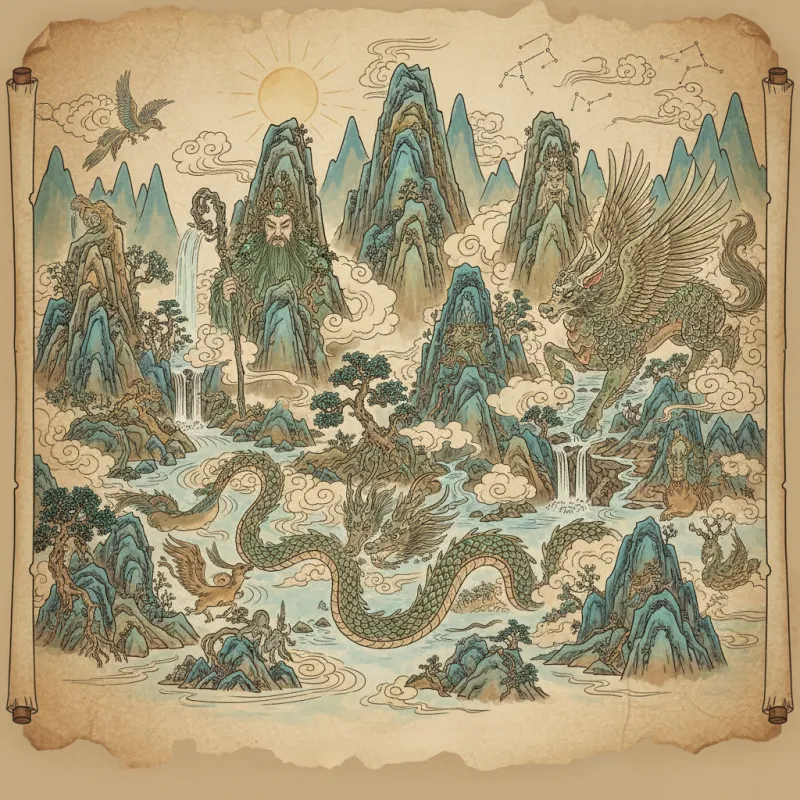
The ancient Chinese understood something modern hikers often forget: mountains are not empty. They are inhabited, governed, and fiercely protected by beings who were old when human civilization was young. Open the Shanhaijing (山海经, Shānhǎijīng) — the Classic of Mountains and Seas — and you'll find not a poetic metaphor but a practical field guide to the spirits who rule every peak, valley, and ridge across the known world.
Every Peak Has Its Keeper
The Shanhaijing catalogs hundreds of mountains across its eighteen chapters, and the pattern is unmistakable: nearly every mountain has a presiding deity called a shānshén (山神). These are not vague nature spirits or philosophical abstractions. They are specific entities with documented forms, territories, and temperaments. The text treats them with the same matter-of-fact precision it uses to describe mineral deposits and water sources.
Take Mount Guishan in the Western Mountains section. Its spirit has a human face but the body of a dragon. Mount Changwu's deity appears as a human with four horns. The spirit of Mount Yingshan manifests as a horse with a human face, tiger stripes, and bird wings. These descriptions aren't flights of fancy — they're identification markers, as practical as knowing which mushrooms are poisonous.
The hybrid forms encode information. A spirit with serpent features often indicates water sources or flood dangers. Bird characteristics suggest high winds or important migration routes. Tiger markings warn of predatory animals in the region. The ancients compressed ecological and meteorological data into memorable divine forms, creating a system where knowing the god meant understanding the mountain.
The Precision of Offerings
What separates the Shanhaijing from later, more literary mythology is its obsessive specificity about ritual requirements. This isn't theology — it's a survival manual. Each mountain spirit demands particular offerings, and the text records them with bureaucratic exactness.
The spirit of Mount Qingqiu requires a rooster sacrifice with jade and millet. Mount Zhongshan's deity accepts only white dogs. The god of Mount Fuyu demands a ram with jade offerings buried in the earth. Mount Jishan's spirit prefers a combination of grain alcohol and jade pendants. The variations aren't arbitrary — they reflect what resources were available in each region and what the local communities could sustainably provide.
Consider the practical wisdom embedded here. A traveler approaching Mount Qingqiu would need to plan ahead, bringing a rooster from the lowlands. This forced preparation, this moment of conscious intention before entering the mountain, likely saved lives. It made people think about the journey, check their supplies, and approach the wilderness with appropriate caution. The gods demanded respect, and respect meant preparation.
The jade component appears repeatedly across different mountains, which tells us something important: these weren't offerings to appease angry spirits but transactions with territorial authorities. Jade represented wealth, effort, and cultural value. You were essentially paying a toll, acknowledging that you were entering someone else's domain and needed permission to pass safely.
Hierarchies Among the Heights
Not all mountain spirits hold equal rank. The Shanhaijing reveals a complex divine bureaucracy that mirrors human political structures. Some spirits govern single peaks; others oversee entire mountain ranges. The text occasionally mentions "great spirits" (大神, dàshén) who command multiple lesser deities.
Mount Kunlun stands at the apex of this hierarchy. Its presiding deity isn't just another mountain god but Xiwangmu (西王母), the Queen Mother of the West, who governs all the western mountains and possesses the peaches of immortality. Her mountain serves as a cosmic axis, connecting earth to heaven. Lesser mountain spirits in the western ranges effectively serve under her authority.
This hierarchical structure had practical implications for travelers and officials. If you needed to conduct major engineering projects — diverting rivers, cutting roads through mountain passes — you couldn't just appease the local mountain spirit. You needed to perform rituals that acknowledged the entire chain of divine command, much like a modern construction project requires permits from multiple government levels.
The Shanhaijing occasionally notes when mountain spirits are related to each other, creating divine family networks across geographical regions. These relationships probably reflected ancient tribal alliances and migration patterns, preserved in mythological form long after the human politics had been forgotten.
When Gods Appear to Humans
The text records specific instances when mountain spirits manifested to humans, and these encounters follow recognizable patterns. Mountain gods rarely appear without reason. They emerge during natural disasters, before major political changes, or when their territories face violation.
During the Xia Dynasty, the spirit of Mount Song appeared as a man with three heads to warn of impending floods. The spirit of Mount Hua manifested during the Zhou Dynasty to protest the construction of a road that would damage sacred groves. These weren't random visions — they were diplomatic interventions, moments when the divine order felt compelled to communicate directly with human authorities.
The appearances often carried specific messages encoded in the spirit's form or behavior. A mountain god appearing with weapons suggested military conflict ahead. One manifesting with agricultural tools indicated famine or harvest concerns. The symbolic language was consistent enough that trained priests and officials could interpret these encounters and advise rulers accordingly.
What's striking is how the Shanhaijing treats these manifestations as historical events, not legends. The text provides dates, locations, and witnesses with the same documentary style it uses for geographical descriptions. Whether these encounters "really happened" misses the point — they were real enough to shape policy and influence how communities interacted with their landscape.
The Ecology of the Sacred
Modern readers often miss how the mountain spirit system functioned as environmental protection. By declaring mountains sacred and their spirits demanding, ancient Chinese culture created de facto nature reserves. You couldn't casually log a sacred mountain or hunt its animals without risking divine retribution — which, in practical terms, meant social punishment from your community.
The divine beasts associated with each mountain reinforced this protection. Many mountains hosted creatures that served the resident deity, and harming these animals was considered a direct offense against the god. Mount Tai's sacred deer, Mount Hua's divine monkeys, Mount Heng's celestial birds — these weren't just wildlife but members of the divine household.
The system worked because it aligned spiritual belief with ecological necessity. Communities that over-exploited their mountains faced landslides, floods, and resource depletion — consequences easily attributed to angry spirits. The mythology provided a framework for sustainable resource management that didn't require modern scientific understanding of ecosystems.
The Fading of the Mountain Lords
By the Han Dynasty, the relationship between humans and mountain spirits had begun to shift. As Confucian bureaucracy expanded and Daoist philosophy formalized, the specific, idiosyncratic mountain gods of the Shanhaijing were gradually absorbed into more standardized pantheons. The Five Sacred Mountains (五岳, Wǔyuè) emerged as official state cult sites, their spirits receiving imperial recognition and regular sacrifices.
This standardization meant loss of detail. The weird, specific hybrid forms gave way to more dignified anthropomorphic deities. The precise offering requirements became generalized rituals. The mountain spirits transformed from territorial lords with distinct personalities into interchangeable representatives of abstract principles.
Yet the old beliefs persisted in local practice. Village communities continued to maintain shrines to their specific mountain spirits, preserving traditions the official state religion had simplified or forgotten. Even today, hikers in China's remote mountains occasionally encounter small shrines and offering sites that echo the ancient practices recorded in the Shanhaijing.
Living With the Heights
The mountain spirit tradition of the Shanhaijing represents something more sophisticated than primitive animism. It's a system for encoding geographical knowledge, managing resources, and maintaining respectful relationships with dangerous landscapes. The gods were real because the mountains were real, and the mountains demanded respect.
Modern environmental ethics struggles to articulate why we should protect wilderness areas beyond utilitarian arguments about ecosystem services or future resources. The ancient Chinese had a simpler answer: because the mountains have masters, and those masters have rights. It's a framework that granted legal and moral standing to the natural world without requiring complex philosophical justification.
When you read the Shanhaijing's endless catalogs of mountain spirits — their forms, their offerings, their territories — you're not reading superstition. You're reading a civilization's attempt to live sustainably in a landscape it recognized as inhabited by powers greater than itself. The gods of the peaks were never meant to be believed in the way we believe in abstract theological concepts. They were meant to be respected, negotiated with, and never, ever taken for granted.
The mountains are still there. Whether their spirits remain is perhaps the wrong question. The right question is whether we've lost something essential by forgetting how to see them.
Related Reading
- Kunlun Mountain: Home of the Immortals
- Mountain Spirits and Local Worship
- The Mountain Gods of Ancient China
- Sacred Mountains: The Five Great Peaks
- Unearthing the Cursed Beings of Shanhaijing: Myths, Creatures, and Lands
- Exploring the Enigmatic Mountains and Creatures of the Shanhaijing
- Mystical Beasts of the Shanhaijing: A Journey Through Myth and Geography