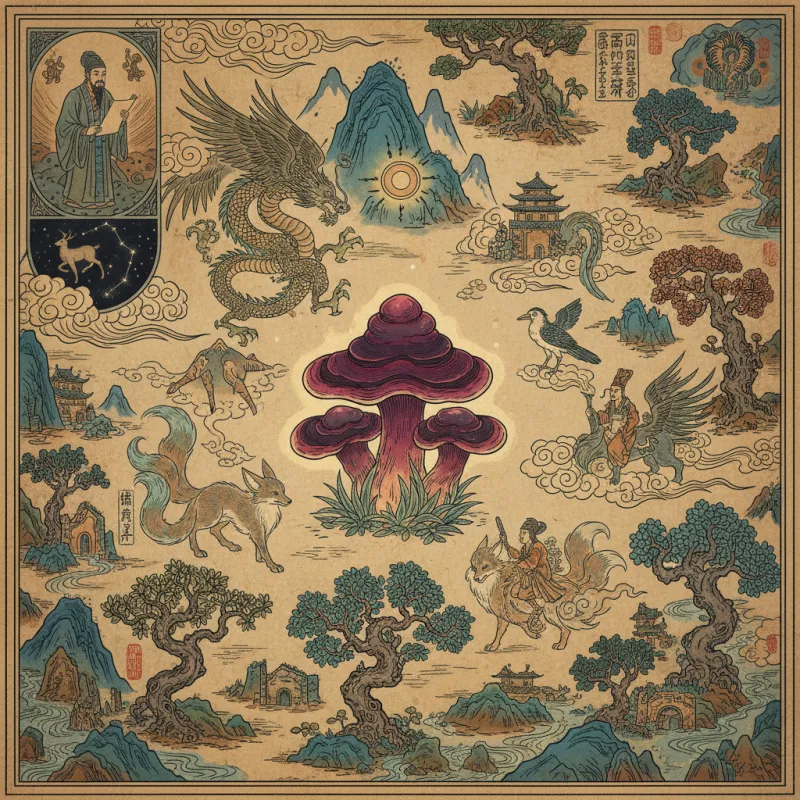
The first emperor of China, Qin Shi Huang, sent hundreds of young men and women across the Eastern Sea in search of a mushroom. They never returned. Some say they founded Japan. Others say they found the mushroom but kept it for themselves. Either way, the emperor died at 49, and the Lingzhi (灵芝 língzhī) — the "spirit mushroom" — remained forever just out of reach.
This is the paradox of the Lingzhi: it's simultaneously the most accessible and most elusive of all immortality substances in Chinese tradition. Unlike the Peaches of Immortality that grow only in the Queen Mother of the West's garden, or the Jade Dew that falls once every thousand years, Lingzhi actually exists. You can buy it dried, powdered, or in capsules at any Chinese pharmacy. Yet the mythological Lingzhi — the one that grants true immortality — has never been found.
The Shanhaijing's Fungal Geography
The Shanhaijing doesn't just mention Lingzhi once or twice. It obsesses over magical fungi, cataloging them with the same meticulous attention it gives to three-headed birds and mountains that float in the sky. The text describes fungi growing on specific mountains, each with distinct properties and guardian creatures.
On Mount Sanwei (三危山 Sānwēi Shān), the Classic records a mushroom that "makes one immune to all poisons." On Mount Kunlun (昆仑山 Kūnlún Shān), the cosmic axis itself, grows a fungus that "extends life without limit." The text is frustratingly specific about locations but maddeningly vague about identification. How do you recognize the immortality mushroom? The Shanhaijing essentially says: you'll know it when you see it.
This vagueness wasn't accidental. The authors understood something modern readers often miss — the Lingzhi wasn't meant to be found easily. Its rarity was the point. In a worldview where immortality required both moral cultivation and material substances, the difficulty of obtaining Lingzhi served as a natural filter. Only the worthy would find it, and only the prepared could use it.
From Myth to Materia Medica
By the Han Dynasty (206 BCE - 220 CE), Lingzhi had made the jump from mythology to medicine. The Shennong Bencao Jing (神农本草经 Shénnóng Běncǎo Jīng), China's foundational pharmacological text, categorizes six types of Lingzhi by color: red, black, blue, white, yellow, and purple. Each color corresponded to different organs and offered different benefits.
But here's where it gets interesting: the Shennong Bencao Jing still treats Lingzhi as fundamentally magical. It's listed in the "superior" category of medicines — substances that can be taken indefinitely without harm and that "lighten the body and prolong life." The text doesn't distinguish between therapeutic effects and immortality. For Han Dynasty physicians, these existed on a spectrum, not in separate categories.
This medical-magical fusion persisted for centuries. The great Tang Dynasty physician Sun Simiao (孙思邈 Sūn Sīmiǎo), who allegedly lived to 141, prescribed Lingzhi for everything from insomnia to memory loss. But he also wrote that it "opens the spirit" and "connects one to the divine." Was he describing pharmacology or mysticism? The answer is both.
The Daoist Sacrament
While physicians were cataloging Lingzhi's medical properties, Daoists were incorporating it into their immortality practices. In Daoist internal alchemy (内丹 nèidān), Lingzhi served as both a physical substance and a spiritual symbol. Practitioners would consume it while performing breathing exercises, meditation, and visualization techniques designed to transform the body into an immortal vessel.
The Daoist approach reveals something crucial about how pre-modern Chinese culture understood substances like Lingzhi. They weren't passive medicines you simply ingested. They were active partners in transformation, requiring the right mental state, the right practices, and the right timing to unlock their full potential. Eating Lingzhi without cultivation was like having a key without knowing which door it opened.
This is why Daoist texts are full of elaborate preparation methods for Lingzhi. Some required harvesting at specific lunar phases. Others demanded that the mushroom be found naturally, never cultivated. Still others insisted it be consumed in combination with other rare substances — cinnabar, jade powder, gold flakes — in precise ratios. The complexity wasn't superstition; it was technology, just not the kind we recognize today.
Imperial Obsessions
Chinese emperors had a complicated relationship with Lingzhi. On one hand, they desperately wanted it — immortality is the ultimate luxury good. On the other hand, the search for it made them look foolish and vulnerable.
Qin Shi Huang's failed expedition is the most famous example, but he wasn't alone. Emperor Wu of Han (汉武帝 Hàn Wǔdì) spent enormous sums on alchemists who promised to produce Lingzhi or find its growing locations. The Tang Dynasty emperor Xuanzong (唐玄宗 Táng Xuánzōng) received Lingzhi as tribute from distant provinces, each specimen carefully documented and preserved.
The Ming Dynasty took imperial Lingzhi obsession to new heights. The Yongle Emperor (永乐帝 Yǒnglè Dì) established official bureaus to search for rare medicinal substances, with Lingzhi at the top of the list. Court records show that when a particularly large or unusually shaped Lingzhi was found, it was treated as an auspicious omen, a sign of Heaven's favor toward the dynasty.
This created a perverse incentive structure. Local officials, knowing the emperor's obsession, would "discover" Lingzhi with suspicious frequency. Some were genuine. Many were not. The line between authentic rare mushroom and politically convenient fungus grew increasingly blurred.
The Symbolism Industry
Somewhere between the Tang and Ming dynasties, Lingzhi underwent a transformation from substance to symbol. It began appearing everywhere in Chinese art: carved into jade, painted on porcelain, embroidered on silk robes, sculpted into furniture. The mushroom's distinctive kidney-shaped cap and lateral stem became instantly recognizable motifs.
But these artistic Lingzhi weren't meant to be realistic. They were stylized, idealized, often growing in impossible configurations. Artists depicted them in the hands of immortals, sprouting from rocks in paradise gardens, or held by deer (themselves symbols of longevity). The message was clear: this isn't about the actual mushroom anymore. It's about what the mushroom represents.
This symbolic Lingzhi became detached from its botanical reality. People who had never seen a real Lingzhi mushroom could recognize its artistic representation instantly. The symbol became more real than the thing itself — a very Chinese kind of transformation, where the ideal form supersedes the material instance.
Modern Science Meets Ancient Myth
Here's where the story takes an unexpected turn: modern research suggests the ancients might have been onto something. Lingzhi (scientifically known as Ganoderma lucidum) contains polysaccharides and triterpenes that show genuine immunomodulatory effects. Studies have documented anti-inflammatory, antioxidant, and potential anti-cancer properties.
Does this mean Lingzhi grants immortality? Obviously not. But it does mean that centuries of empirical observation weren't entirely wrong. The mushroom has measurable biological effects, even if those effects fall short of eternal life.
This creates a fascinating interpretive problem. How do we read the ancient texts now? Were they describing real pharmacological effects in mythological language? Or were they projecting mythological hopes onto a real mushroom? The answer is probably both, simultaneously, in ways that resist clean separation.
Modern Traditional Chinese Medicine practitioners prescribe Lingzhi for immune support, fatigue, and stress — conditions that ancient texts would have described as "deficiency of qi" or "weakness of spirit." The language has changed, but the underlying observation remains: this mushroom does something beneficial to human health.
The Mushroom You Can Buy
Walk into any Chinese pharmacy today and you'll find Lingzhi in multiple forms: dried slices for making tea, concentrated extracts, capsules, tinctures. It's affordable, accessible, and completely ordinary. This is both wonderful and slightly disappointing.
The democratization of Lingzhi means that what was once reserved for emperors and immortality-seekers is now available to anyone with twenty dollars. But it also means the mushroom has lost its mystique. When something becomes common, it stops being magical — even if it was never truly magical to begin with.
Yet perhaps this ordinariness is the real lesson of Lingzhi. The ancients were right that it's beneficial, wrong about the mechanism and degree. The emperors were right to value it, wrong to think it could be monopolized. The Daoists were right that it requires proper use, wrong about the specific rituals.
The Lingzhi mushroom has completed a full circle: from mythological substance to medical reality, from imperial treasure to health food store staple. It didn't grant immortality, but it has achieved a kind of immortality itself — surviving thousands of years of cultural transformation while remaining fundamentally itself: a mushroom that's good for you, nothing more, nothing less.
And maybe that's enough. Maybe the real magic of Lingzhi isn't that it extends life indefinitely, but that it connects us to thousands of years of human hope, observation, and the persistent belief that nature holds secrets worth discovering. The mushroom Qin Shi Huang's expedition never found is sitting on a shelf in your local Chinatown, waiting. Not for the worthy or the prepared, but for anyone curious enough to try it.
Related Reading
- Mythical Plants of the Shanhaijing: Trees That Grant Immortality and Flowers That Kill — Shanhai Perspective
- Unearthing the Mythical Flora in Shanhaijing: A Journey Through Legendary Plants
- The Bizarre Plants of the Shanhaijing: Trees That Cure Death and Fruits That Grant Flight — Shanhai Perspective
- Magical Plants of the Shanhai Jing: Trees That Grant Immortality — Shanhai Perspective
- Mystical Fish of Shanhaijing: Exploring Legendary Creatures and Enchanted Waters
- Unearthing the Cursed Beings of Shanhaijing: Myths, Creatures, and Lands
- The Four Dragon Kings: Rulers of China's Mythological Oceans