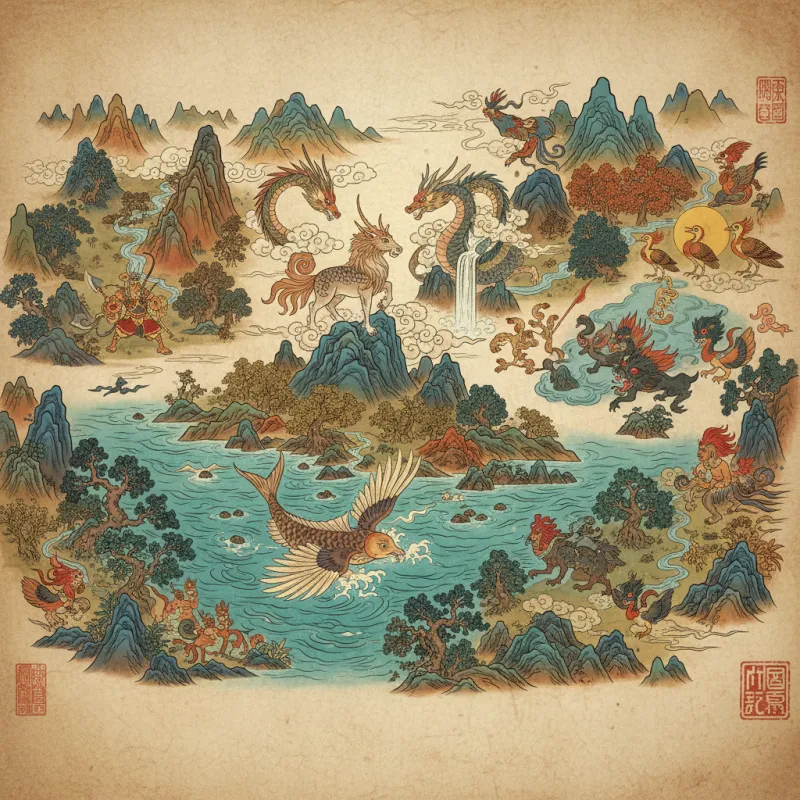
Picture this: a land where nine-tailed foxes prowl sacred mountains, where fish with human faces swim through rivers that flow upward, and where a headless giant uses his nipples as eyes. This isn't fever-dream fantasy—it's the Shanhaijing 山海经 (Shānhǎijīng, Classic of Mountains and Seas), and it's been confounding and captivating readers for over two millennia. Compiled between the 4th century BCE and 1st century CE, this bizarre geographical encyclopedia doesn't just catalog mythical creatures—it maps an entire alternate reality where the boundaries between the natural and supernatural dissolve completely.
The Text That Defies Classification
Here's what makes the Shanhaijing so maddeningly fascinating: nobody quite knows what to do with it. Is it mythology? Geography? Natural history? The answer is yes, all of the above, and that's precisely the point. The text systematically describes 550 mountains, 300 waterways, and over 400 creatures with the same matter-of-fact tone you'd use to describe your morning commute. "Three hundred li to the east is Mount Qingqiu, where the nine-tailed fox dwells," it states, as casually as if discussing a particularly interesting species of deer.
This genre-defying quality reflects something profound about ancient Chinese thought—the refusal to separate the mythical from the geographical, the spiritual from the material. When Han dynasty scholars like Liu Xiang 刘向 (Liú Xiàng) and his son Liu Xin 刘歆 (Liú Xīn) edited and compiled the text around 1st century BCE, they weren't creating fiction. They were documenting what they believed to be genuine knowledge about the world's edges, where civilization faded into mystery.
A Bestiary of the Impossible
The creatures in the Shanhaijing aren't just random monsters—they're a window into ancient Chinese anxieties, aspirations, and attempts to make sense of the unknown. Take the Zhuque 朱雀 (Zhūquè), the vermillion bird of the south, which appears in various forms throughout the text. Or consider the Qiongqi 穷奇 (Qióngqí), a winged tiger that punishes the virtuous and rewards the wicked—a creature that embodies the ancient fear that cosmic justice might be inverted.
But my favorite has to be the Xing Tian 刑天 (Xíng Tiān), the headless warrior who fought the Yellow Emperor and lost. After his decapitation, he didn't die—he simply repurposed his body, using his nipples as eyes and his navel as a mouth, continuing to brandish his weapons in eternal defiance. This isn't just creative monster design; it's a meditation on persistence, rebellion, and the refusal to accept defeat even when logic says you should be dead.
The text describes creatures with unsettling specificity. The Lushu 鹿蜀 (Lùshǔ) has a horse's body, white head, tiger stripes, and a red tail—and wearing its hide supposedly grants you male descendants. The Bi Fang 毕方 (Bì Fāng) is a one-legged bird whose appearance heralds fire. These aren't vague descriptions; they're detailed enough that Ming and Qing dynasty artists could create elaborate illustrated editions, each trying to visualize these impossible beings.
Mountains as Cosmic Architecture
The Shanhaijing organizes its world through mountains, and this isn't arbitrary. In ancient Chinese cosmology, mountains were axis mundi—cosmic pillars connecting heaven and earth. The text describes five major mountain systems (Wuyue 五岳, Wǔyuè), each with its own ecological and mythological character. The Eastern Mountains section alone catalogs 4,140 li of territory (roughly 1,700 kilometers), listing minerals, plants, creatures, and the spirits that govern each peak.
What strikes me most is how the text treats distance and direction with quasi-scientific precision while describing utterly fantastical content. "Three hundred li to the northeast" it might say, before describing a mountain where stones scream and trees bear jade fruit. This juxtaposition creates a peculiar cognitive dissonance—the format suggests empirical observation, but the content defies it entirely.
The mythical geography described in the Shanhaijing influenced Chinese spatial imagination for centuries. When Tang dynasty poets wrote about distant lands, when Song dynasty painters depicted mountain landscapes, they were often channeling the Shanhaijing's vision of a world where every mountain concealed mysteries.
The Pharmacological Imagination
One of the most overlooked aspects of the Shanhaijing is its obsession with utility. Nearly every creature and plant comes with a note about its practical applications—usually medicinal or magical. Eat this creature's flesh to cure jealousy. Wear that one's hide to prevent fear. This plant grants immunity to poison; that mineral ensures many sons.
This reflects the ancient Chinese concept of wu xing 五行 (wǔ xíng, five phases), where everything in the universe possesses inherent properties that can be harnessed. The Shanhaijing is essentially a massive materia medica for a world that doesn't exist—or perhaps for a world that exists on a different plane of reality. The Bencao Gangmu 本草纲目 (Běncǎo Gāngmù), Li Shizhen's famous 16th-century pharmacological encyclopedia, still references Shanhaijing creatures, treating them as legitimate (if rare) medicinal sources.
Cultural Echoes Through the Dynasties
The Shanhaijing's influence on Chinese culture is impossible to overstate. When Qu Yuan 屈原 (Qū Yuán) wrote his hallucinatory poem Tianwen 天问 (Tiānwèn, Heavenly Questions) around 340 BCE, he was drawing from the same mythological well. When the Journey to the West 西游记 (Xīyóu Jì) was written in the 16th century, its author Wu Cheng'en borrowed creatures and geography directly from the Shanhaijing.
The nine-tailed fox (jiuwei hu 九尾狐, jiǔwěi hú) that appears in countless Chinese, Korean, and Japanese stories? First systematically described in the Shanhaijing. The Kunpeng 鲲鹏 (Kūnpéng), the massive fish-bird that transforms between forms and inspired Zhuangzi's famous parable? Shanhaijing origin. Even modern Chinese fantasy literature and games constantly mine this text for creatures and concepts.
What's remarkable is how the text's influence extends beyond literature into visual culture. The illustrated editions from the Ming dynasty, particularly the 1597 version with woodblock prints, created a visual vocabulary for these creatures that persists today. When contemporary Chinese artists depict mythological beings, they're often working within an iconographic tradition that traces back to these early illustrated Shanhaijing editions.
The Problem of Interpretation
Modern scholars have tied themselves in knots trying to "explain" the Shanhaijing. Some argue it's a corrupted geographical text where real animals got distorted through repeated copying. Others suggest it records genuine encounters with unfamiliar species—maybe the "dragons" were crocodiles, the "phoenixes" were exotic birds. The Jesuit missionary Martino Martini, writing in the 17th century, tried to reconcile Shanhaijing geography with actual Chinese topography, with limited success.
But here's my contrarian take: maybe we're asking the wrong questions. Perhaps the Shanhaijing isn't meant to be decoded or rationalized. Maybe it's doing something more sophisticated—creating a parallel world that comments on the real one through mythological metaphor. The creatures aren't distorted animals; they're embodied concepts. The impossible geography isn't failed cartography; it's psychological and spiritual mapping.
The text's resistance to interpretation might be its greatest strength. It remains genuinely alien, genuinely strange, even after 2,000 years of commentary and analysis. In an age where we've mapped every square meter of Earth's surface, the Shanhaijing preserves a sense of genuine mystery—not the mystery of "what does this mean?" but the deeper mystery of "what if the world were fundamentally stranger than we imagine?"
Reading the Shanhaijing Today
If you're approaching the Shanhaijing for the first time, abandon any expectation of narrative coherence. This isn't a story with a beginning, middle, and end. It's more like wandering through an infinite museum where each exhibit is equally bizarre and equally matter-of-fact. The best translations (I recommend Anne Birrell's 1999 English version) preserve this strange, catalog-like quality.
What you'll discover is that the text operates on dream logic—associations and juxtapositions that feel meaningful without being explicitly explained. A mountain that produces jade sits next to a river where fish have human faces, which sits next to a description of a tree whose fruit grants immortality. The connections aren't causal; they're poetic, spatial, mythological.
The Shanhaijing also rewards reading alongside other ancient Chinese texts. Compare it with the cosmological systems described in other classics, or trace how specific creatures appear in later literature. The text becomes richer when you see it as part of a larger conversation about the nature of reality, the limits of the known world, and the creatures that inhabit the spaces beyond human understanding.
The Enduring Mystery
What keeps me returning to the Shanhaijing isn't its answers but its questions. What kind of culture produces a text like this? What does it mean to systematically catalog the impossible? How do we read a text that refuses to distinguish between the real and the mythical?
The Shanhaijing reminds us that ancient peoples weren't naive or primitive—they were working with different epistemological frameworks, different ways of knowing and categorizing the world. The text's creatures aren't failures of observation; they're successes of imagination. Its impossible geography isn't ignorance; it's a sophisticated mapping of psychological and spiritual space onto physical terrain.
In our contemporary moment, when AI generates endless variations of mythical creatures and fantasy worlds proliferate across media, the Shanhaijing stands as a reminder that the truly strange isn't just novel combinations of familiar elements. It's the genuinely alien, the thing that resists easy interpretation, the world that operates by rules we can sense but never quite grasp. That's the gift this ancient text still offers—not answers, but an invitation to imagine a world far stranger and more wonderful than the one we think we know.
Related Reading
- Penglai Island: The Legendary Isle of Immortals — Shanhai Perspective
- The Fusang Tree: Where the Suns Rise and the World Begins — Shanhai Perspective
- The Ruomu Tree: Where the Suns Set
- Kunlun Mountain: The Paradise at the Center of the World — Shanhai Perspective
- Mythical Lands of the Shanhaijing: Places That Should Not Exist
- Unearthing the Cursed Beings of Shanhaijing: Myths, Creatures, and Lands
- How to Read the Shanhai Jing: A Beginner's Guide
- Unraveling the Mysteries of Shanhaijing: Myths, Creatures, and Fantastic Realms