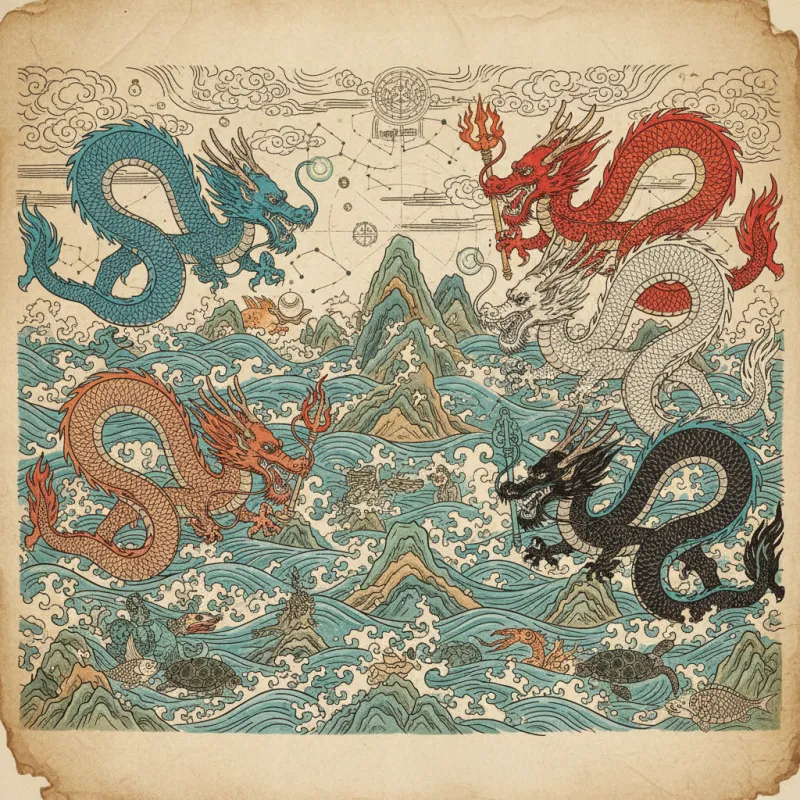
Four brothers stand at the edge of the world, each commanding an ocean. When they argue, typhoons rage. When they celebrate, fishermen haul in nets so heavy they nearly capsize. The Sihai Longwang (四海龙王 Sìhǎi Lóngwáng) — the Four Dragon Kings — aren't just mythological figures. They're the operating system of China's ancient hydrological worldview, the divine administrators who made sure rain fell, rivers flowed, and the cosmic order didn't collapse into chaos.
The Geography of Divine Waters
Ancient Chinese cosmology divided the world into a central landmass surrounded by four seas: East, South, West, and North. This wasn't metaphorical. Scholars genuinely believed these oceans formed the boundaries of the known world, and each required a sovereign to maintain order. The Dragon Kings weren't elected or appointed — they simply were, as fundamental to the universe as the five elements or the cycle of yin and yang.
Each king ruled from a crystal palace (水晶宫 shuǐjīng gōng) beneath his respective sea, complete with coral throne rooms, pearl-studded halls, and armies of shrimp soldiers and crab generals (虾兵蟹将 xiā bīng xiè jiàng). The bureaucracy was staggering. Every river, lake, and well had its own minor dragon deity reporting up the chain of command. Miss your rain quota for the quarter? Expect a strongly worded memo from the Eastern Sea.
Ao Guang: The Eastern Overlord
Ao Guang (敖广 Áo Guǎng), Dragon King of the Eastern Sea, holds the most prestigious position. In Chinese directional symbolism, east represents spring, renewal, and the rising sun — all auspicious associations. His palace supposedly lay beneath the waters off modern-day Zhejiang Province, and he commanded the largest territory and the most powerful military force among his brothers.
Journey to the West (西游记 Xīyóu Jì), written by Wu Cheng'en in the 16th century, gives us our most vivid portrait of Ao Guang. When the Monkey King Sun Wukong barges into his palace demanding a weapon worthy of his abilities, Ao Guang tries diplomacy first, offering increasingly impressive armaments. Nothing satisfies the monkey until he spots the Ruyi Jingu Bang (如意金箍棒) — the magical staff that once stabilized the ocean depths. Ao Guang's horror at losing this treasure is palpable. It's not just a weapon; it's infrastructure. Without it, his entire domain becomes unstable.
This scene reveals something crucial about the Dragon Kings: they're powerful but not invincible, dignified but not untouchable. They can be bullied, tricked, or outmaneuvered by sufficiently audacious heroes. Much like the Kun Peng, whose transformation from fish to bird defied cosmic categories, the Dragon Kings occupy an ambiguous space between absolute authority and surprising vulnerability.
Ao Qin, Ao Run, and Ao Shun: The Other Three
Ao Qin (敖钦 Áo Qīn) rules the Southern Sea from waters near Guangdong. His domain is associated with summer, fire energy, and the monsoon season that makes or breaks agricultural cycles across southern China. Farmers prayed to him specifically during the critical weeks when rice paddies needed flooding.
Ao Run (敖闰 Áo Rùn), Dragon King of the Western Sea, governs the most mysterious territory. The western ocean in Chinese cosmology often blurred into the mythical Kunlun Mountains, home to the Queen Mother of the West and the peaches of immortality. Ao Run's realm thus became associated with autumn, metal element, and the boundary between the mortal world and the divine.
Ao Shun (敖顺 Áo Shùn) commands the Northern Sea, linked to winter, water element, and the dark yin forces. His territory was considered the coldest and most dangerous, home to ice demons and frozen wastes. Northern Sea dragons in folklore tend to be more severe, less forgiving of human transgressions.
The four brothers appear together most famously in Investiture of the Gods (封神演义 Fēngshén Yǎnyì), a 16th-century novel about the transition from the Shang to Zhou dynasty. When Nezha, the bratty child deity, kills Ao Guang's son Ao Bing, all four Dragon Kings unite to demand justice. Their combined assault on Nezha's family demonstrates both their collective power and their ultimate subordination to higher celestial authorities — the Jade Emperor intervenes to prevent catastrophe.
The Weather Bureau of Heaven
Here's what makes the Dragon Kings fascinating from a cultural perspective: they're not just mythological set dressing. They represent a sophisticated understanding of hydrology dressed in divine costume. Ancient Chinese farmers knew that weather patterns were interconnected, that ocean temperatures affected rainfall hundreds of miles inland, that seasonal cycles followed predictable patterns. The Dragon Kings gave this knowledge a face, a personality, a bureaucratic structure you could petition.
During droughts, emperors performed elaborate rituals to summon the Dragon Kings. The Qing Dynasty (1644-1912) maintained official Dragon King temples in Beijing where state-sponsored prayers occurred during water crises. These weren't quaint superstitions — they were state policy. The emperor's legitimacy depended partly on his ability to maintain cosmic harmony, which meant keeping the Dragon Kings satisfied.
The rituals were specific. You didn't just ask for rain; you filed the proper paperwork. Offerings included whole roasted pigs, silk banners, incense, and formal memorials written in classical Chinese explaining exactly how much rain was needed and when. The Dragon Kings, like all Chinese deities, appreciated proper protocol.
Dragons in the Family Tree
The Dragon Kings' influence extended beyond weather management into genealogy and social status. Numerous Chinese families claimed descent from dragon spirits, particularly in coastal regions. These weren't metaphorical claims — lineage records seriously documented alleged draconic ancestors, usually involving a story about a fisherman's daughter who married a handsome stranger who turned out to be a dragon prince in disguise.
The most famous example is the legend of Liu Yi (柳毅 Liǔ Yì), a Tang Dynasty scholar who encounters a weeping woman while traveling. She's actually a dragon princess being abused by her husband, a river god. Liu Yi agrees to deliver her message to her father, the Dragon King of Dongting Lake (a subordinate of Ao Qin). The story ends with Liu Yi marrying the princess, becoming semi-divine himself, and living in underwater luxury. It's a social mobility fantasy wrapped in mythology — the scholar class could literally marry into divine bureaucracy.
Similar to how the Jiaolong represents a dragon in transition, not yet fully ascended to celestial status, these half-dragon descendants occupied an ambiguous social position. They claimed supernatural heritage but lived mortal lives, forever caught between two worlds.
The Dragon Kings in Popular Culture
The Four Dragon Kings never disappeared. They simply adapted. Modern Chinese television dramas regularly feature them, usually played by actors in elaborate costumes with CGI-enhanced transformations. The 1986 Journey to the West TV series gave Ao Guang a memorably pompous portrayal that became iconic — an elderly dragon in green robes, perpetually exasperated by Sun Wukong's antics.
Video games love them too. In Genshin Impact, the Liyue region draws heavily on Dragon King imagery. Black Myth: Wukong, the 2024 action game, features an entire chapter set in Ao Guang's palace, rendered in stunning detail with bioluminescent coral and schools of fish swirling through throne rooms.
What's interesting is how these modern interpretations maintain the bureaucratic aspect. The Dragon Kings aren't just powerful — they're administrators. They hold meetings, file reports, worry about budgets. This resonates with contemporary Chinese audiences who understand institutional hierarchy intimately. The Dragon Kings are relatable precisely because they're cosmic middle management, powerful within their domain but answerable to higher authorities.
Why Four? Why Dragons?
The number four appears constantly in Chinese cosmology: four seasons, four directions, four sacred animals (dragon, phoenix, tiger, tortoise). It represents completeness, the full cycle, the enclosed world. Four Dragon Kings meant total coverage — no ocean left unmanaged, no corner of the world beyond divine oversight.
But why dragons specifically? Because Chinese dragons (龙 lóng) are fundamentally water creatures. Unlike their European counterparts, they don't breathe fire or hoard gold in mountain caves. They live in rivers, lakes, and oceans. They control rain, fog, and storms. Making them ocean kings wasn't a creative leap — it was obvious. Who else would rule the seas?
The dragon's association with imperial power added another layer. The emperor was the "dragon throne," his robes featured dragon embroidery, his face was the "dragon countenance." By making dragons the rulers of the four seas, mythology reinforced the idea that legitimate authority — whether celestial or terrestrial — naturally took draconic form.
The Enduring Appeal
Walk through any Chinatown during Lunar New Year and you'll see dragon dances, dragon decorations, dragon everything. Much of that imagery traces back to the Four Dragon Kings and their kin. They represent power tempered by responsibility, authority balanced by duty. They're not tyrants or monsters — they're civil servants with scales.
In an era of climate anxiety, there's something almost comforting about the Dragon King mythology. It suggests that someone, somewhere, is managing the water cycle. That weather isn't random chaos but administered by beings who can be petitioned, reasoned with, or at least blamed when things go wrong. The ancient Chinese knew that nature was powerful and often destructive, but they preferred to imagine it as organized, hierarchical, and theoretically negotiable.
The Four Dragon Kings endure because they solve a narrative problem: how do you make sense of the ocean's power? You give it a face, a name, four names actually, and a palace address where you can send complaints. It's mythology as cosmic customer service, and somehow, fifteen centuries later, we're still filing tickets.
Related Reading
- Sea Monsters of the Shanhai Jing: Terrors of the Deep
- Leviathans of the Eastern Sea: Giant Sea Creatures in Chinese Myth
- Merfolk in Chinese Mythology: The Shark People and Sea Maidens
- Sea Creatures of the Shanhaijing: Monsters from the Deep
- Exploring Shanhaijing: Mythical Creatures and Ancient Lands of Chinese Cosmology
- Unearthing the Cursed Beings of Shanhaijing: Myths, Creatures, and Lands
- Kunlun Mountain: Home of the Immortals