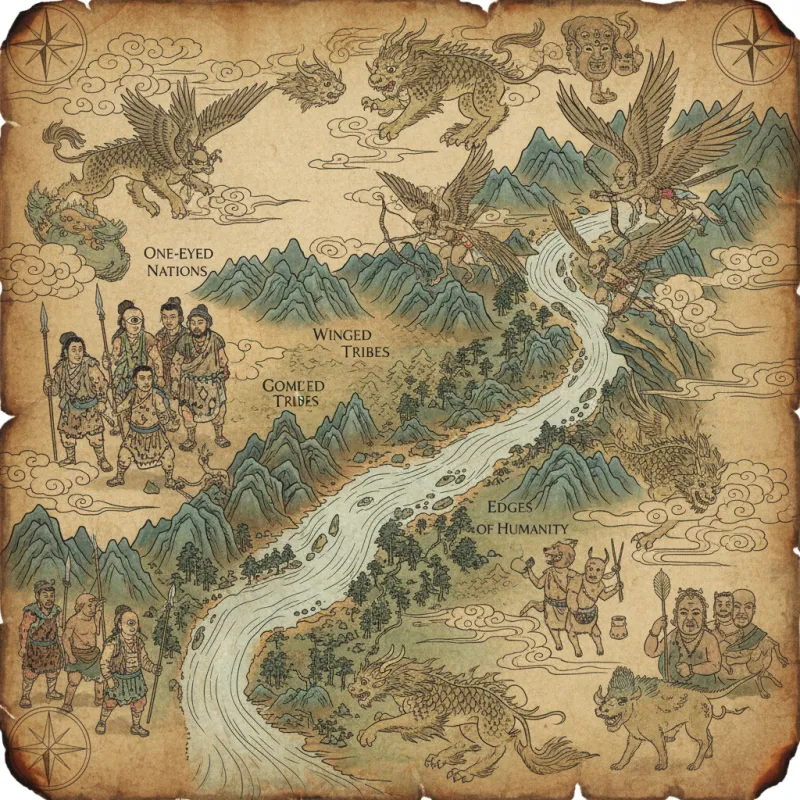
The one-eyed people live beyond the northern wastes, their single eye centered in their foreheads like a third eye that never opened. The winged tribes soar above the eastern seas, feathers sprouting from their shoulders where arms should be. And somewhere in the distant south, a nation of people with holes through their chests thread ropes through their bodies to carry burdens. These aren't fever dreams or fantasy novels — they're careful ethnographic entries in the Shanhaijing (山海经 Shānhǎi Jīng, "Classic of Mountains and Seas"), compiled between the 4th century BCE and 2nd century CE, when Chinese scholars were trying to make sense of a world that seemed to grow stranger the farther you traveled from home.
The Cartography of the Impossible
What makes the Shanhaijing's treatment of foreign peoples so fascinating is its matter-of-fact tone. The text doesn't present these nations as monsters or demons — they're simply people who happen to look different. The One-Eyed Nation (一目国 Yīmù Guó) appears in the Haiwai Beijing (海外北经, "Classic of Regions Beyond the Northern Seas") with the same clinical precision used to describe a mountain range: "The One-Eyed Nation is in the north. They have one eye in the center of their face." No moral judgment. No explanation. Just documentation.
This anthropological approach — however fantastical its subjects — represents something revolutionary for its time. While Greek writers like Herodotus were filling their histories with dog-headed men and gold-guarding griffins, often as moral lessons about barbarian otherness, the Shanhaijing compilers seemed genuinely interested in cataloging diversity. The text describes over sixty distinct foreign nations, each with specific physical characteristics, geographic locations, and sometimes cultural practices. It's ethnography pushed to its logical extreme, where the question isn't "are these people real?" but "what makes a people distinct?"
Nations of Altered Bodies
The physical variations described in the Shanhaijing follow certain patterns. Many involve modifications to the head and face: the One-Eyed Nation, the Three-Headed Nation (三首国 Sānshǒu Guó), the Long-Armed Nation (长臂国 Chángbì Guó) whose arms reach to the ground. Others involve the torso: the Pierced-Chest Nation (贯胸国 Guànxiōng Guó) with holes through their chests, the Feathered People (羽民 Yǔmín) with wings instead of arms.
Some scholars argue these descriptions preserve garbled accounts of real peoples whose customs seemed alien to Chinese observers. The Pierced-Chest Nation might reflect encounters with groups practicing extreme body modification. The Feathered People could be coastal tribes wearing elaborate feathered cloaks. The Long-Eared Nation (长耳国 Cháng'ěr Guó), whose ears hang down to their shoulders, might describe people who practiced ear elongation.
But this rationalization misses something important: the Shanhaijing doesn't seem interested in explaining these differences. It simply records them. The text treats physical variation as a fundamental feature of the world's diversity, as natural as different species of birds or types of jade. In this sense, the impossible peoples of the Shanhaijing aren't really about foreign nations at all — they're about the limits of the human form itself.
The Geography of Difference
The distribution of these nations follows a clear pattern: the farther from the Chinese heartland, the more extreme the variations. The Haiwai Jing (海外经, "Classic of Regions Beyond the Seas") sections, which describe lands beyond the four seas surrounding the known world, contain the most dramatic examples. This isn't random. The text's structure reflects an ancient Chinese cosmological model where civilization radiates outward from a central point, with order gradually giving way to chaos at the edges.
But here's where the Shanhaijing gets interesting: it doesn't treat this progression as a moral hierarchy. The one-eyed people aren't evil. The winged tribes aren't demons. They're simply different, and their difference is tied to their distance from the center. This creates a kind of graduated humanity, where physical form becomes increasingly plastic as you move toward the world's edges. For more on how the Shanhaijing structures its cosmology, see The Four Seas and Beyond: Shanhaijing's Cosmic Geography.
The Small People Nation (小人国 Xiǎorén Guó) appears in multiple locations, sometimes described as being only a few inches tall, other times as merely shorter than average. The Giants (大人国 Dàrén Guó) tower in the east. The Long-Legged Nation (长股国 Chánggǔ Guó) wades through deep waters on impossibly elongated legs. Each nation occupies a specific geographic niche, their bodies seemingly adapted to their environments like the specialized creatures described elsewhere in the text.
The Winged Tribes and the Dream of Flight
Among all the foreign nations, the Feathered People (羽民 Yǔmín) capture the imagination most powerfully. They appear in the Haiwai Nanjing (海外南经, "Classic of Regions Beyond the Southern Seas"): "The Feathered People Nation is in the south. Their people have wings." Later commentaries elaborate: these people have human faces and beaks, with feathers covering their bodies and wings growing from their backs.
The Feathered People became a recurring motif in Chinese literature and art, appearing in everything from Han dynasty tomb murals to Tang poetry. They represented not monstrosity but transcendence — humans who had evolved beyond earthbound limitations. In Daoist texts, they sometimes merge with the concept of xian (仙, immortals), enlightened beings who could fly without wings. The Shanhaijing's winged tribes thus became a bridge between ethnography and spiritual aspiration.
What's remarkable is how the text treats flight as a physical rather than magical attribute. The Feathered People don't fly through supernatural power — they have wings. This biological approach to the impossible appears throughout the Shanhaijing's descriptions of foreign nations. The one-eyed people aren't cursed; they're born that way. The long-armed people don't stretch their limbs through sorcery; that's simply how they're built. The text presents a world where the boundaries of human form are negotiable but still governed by consistent, if alien, biological rules.
The Question of Humanity
The most philosophically provocative aspect of the Shanhaijing's foreign nations is how they challenge the definition of humanity itself. If people can have one eye, three heads, or wings instead of arms, what makes someone human? The text never explicitly addresses this question, but its implicit answer is radical: humanity is defined not by physical form but by social organization.
The Shanhaijing consistently refers to these groups as guo (国, nations or states), the same term used for Chinese kingdoms. They have territories, populations, and presumably some form of governance. The text occasionally mentions their customs: the Gentleman Nation (君子国 Jūnzǐ Guó) is noted for their courtesy and refusal to fight, while the Cannibals (食人国 Shírén Guó) are condemned for eating human flesh. But physical difference alone doesn't exclude a group from the category of "nation" or "people."
This stands in stark contrast to how many ancient civilizations treated physical difference. Greek and Roman sources often used physical abnormality to mark groups as subhuman or monstrous. The Shanhaijing certainly describes some peoples as dangerous or unpleasant, but danger and unpleasantness aren't tied to physical form. The Gentleman Nation, despite their unusual appearance, exemplifies Confucian virtue. The question isn't whether these people are human, but what kind of humans they are.
The Legacy of Impossible Peoples
The foreign nations of the Shanhaijing influenced Chinese literature and art for two millennia. They appear in the Huainanzi (淮南子), a 2nd century BCE philosophical compilation. They populate the margins of medieval maps. They inspire characters in Ming and Qing dynasty novels like Journey to the West and Flowers in the Mirror, where the protagonist visits many of the nations described in the Shanhaijing, finding them both familiar and strange.
But their deepest influence might be conceptual. By treating extreme physical variation as a form of geographic diversity rather than moral corruption, the Shanhaijing created space for thinking about difference without hierarchy. The one-eyed people aren't failed humans — they're a different expression of humanity, adapted to their particular corner of the world. This idea — that human form itself might be contingent rather than fixed — feels remarkably modern, even as it emerges from a text over two thousand years old.
Beyond the Edge of the Map
When medieval European cartographers reached the limits of their knowledge, they wrote "here be dragons." The Shanhaijing does something more interesting: it populates the unknown with people. Strange people, impossible people, but people nonetheless. The one-eyed nations and winged tribes aren't warnings about what lies beyond civilization — they're invitations to imagine how many different ways there are to be human.
Standing at the edge of the known world, looking out at the one-eyed people in their northern wastes, the Shanhaijing asks a question that still resonates: if humanity can take so many forms, what does it mean to be human at all? The text never answers directly. Instead, it simply keeps cataloging, nation after nation, each one stranger than the last, each one undeniably, impossibly, human. For a comprehensive look at all these nations, explore Strange Nations of the Shanhai Jing: A Catalog of Impossible Peoples.
Related Reading
- Giants and Gods: The Titans of the Shanhai Jing
- The Peoples of the Shanhaijing: Foreign Nations at the Edge of the World
- The Feathered People: Winged Humans of the Shanhai Jing
- Mystical Beasts of the Shanhaijing: A Journey Through Myth and Geography
- Houyi the Archer: The Hero Who Shot Down Nine Suns
- The Enigmatic Fish of Shanhaijing: Mythical Creatures of Chinese Lore