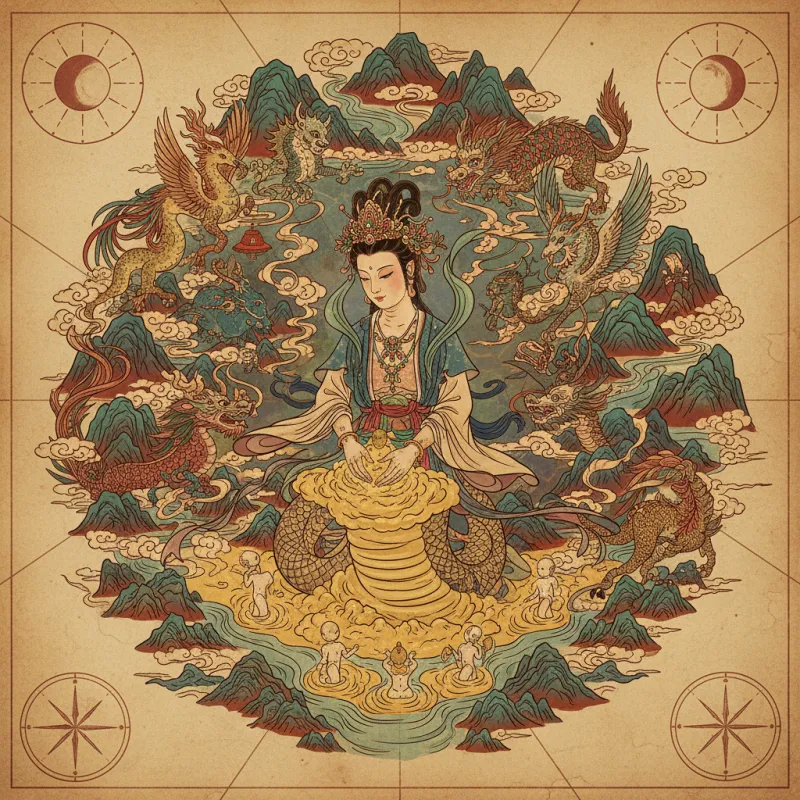
Picture this: a goddess kneeling by a muddy riverbank, her hands caked in yellow clay, carefully shaping tiny figures that will become your ancestors. She's been at this for hours, maybe days, and her back is killing her. So she does what any exhausted creator would do — she grabs a rope, dips it in mud, and starts flinging droplets everywhere. The carefully sculpted figures? Those became nobles. The mud splatters? Commoners. If that sounds unfair, well, welcome to one of the most brutally honest creation myths ever told.
The Goddess Who Got Lonely
Nüwa (女娲 Nǚwā) doesn't fit the mold of distant, unknowable creator deities. She's not speaking worlds into existence from a cosmic void or breathing life into dust with divine proclamation. She's a goddess with dirt under her fingernails and an aching back, solving a problem that's fundamentally relatable: loneliness. After Pangu separated heaven and earth, the world was beautiful but empty. Mountains, rivers, animals — all there. But no one to appreciate it, no one to talk to, no one to witness the work.
The earliest detailed account comes from Ying Shao's (应劭 Yīng Shào) Fengsu Tongyi (风俗通义 Fēngsú Tōngyì, "Comprehensive Meaning of Customs"), written around 195 CE during the Han Dynasty. But references to Nüwa appear much earlier — the Chu Ci (楚辞 Chǔ Cí, "Songs of Chu") from the 4th century BCE mentions her, and the Huainanzi (淮南子 Huáinánzǐ) from the 2nd century BCE describes her repairing the sky. The creation story, though, seems to have crystallized during the Han period, when scholars were actively compiling and systematizing mythology.
Yellow Earth and Divine Hands
The material matters. Nüwa didn't use white marble or celestial light — she used huangtu (黄土 huángtǔ), yellow earth, the same loess soil that covers much of northern China and gives the Yellow River its name. This is the dirt that Chinese farmers have worked for millennia, the soil that built civilizations. There's something profound about a creation myth that says humans are literally made from the land they'll spend their lives cultivating.
She knelt by a river (some versions say the Yellow River itself, others leave it unnamed) and began sculpting. The texts describe her shaping the figures with care — heads, bodies, arms, legs. When she breathed life into them, they stood up, laughed, danced, and scattered across the landscape. Finally, the world had witnesses. Finally, she had company.
But here's where the story gets interesting, and where it diverges sharply from the sanitized versions you might find in children's books.
The Rope Technique and Social Hierarchy
Nüwa got tired. Of course she did — hand-sculpting thousands or millions of individual humans is exhausting work, even for a goddess. So she improvised. She took a rope (some versions say a vine), dipped it in muddy water, and swung it in wide arcs. The mud droplets that flew off became people too. Instant humans, mass-produced.
The Fengsu Tongyi is explicit about what this means: the carefully crafted figures became the wealthy and noble, while the rope-flung mud became the poor and lowly. This isn't a later interpretation or scholarly reading-between-the-lines — it's right there in the text, a creation myth that builds social stratification into the very origin of humanity.
You could read this as deeply cynical, a myth designed to justify inequality by making it cosmically ordained. And maybe it was used that way. But I think there's something else going on too. This is a myth that acknowledges exhaustion, shortcuts, and imperfection in the act of creation itself. Nüwa isn't an all-powerful deity who speaks perfect humans into existence. She's a craftsperson who gets tired, who finds a faster method, who creates a world that's flawed from the start.
The Serpent-Bodied Creator
Most depictions of Nüwa show her with a human upper body and a serpent's tail below the waist. Sometimes she's paired with Fuxi (伏羲 Fúxī), her brother-husband (yes, it's complicated), their serpent tails intertwined. This imagery appears in Han Dynasty tomb art, particularly in the famous stone reliefs from the Wu Liang Shrine in Shandong Province, dated to around 151 CE.
The serpent form connects her to earth, to water, to the primal forces of nature. Snakes shed their skin and are reborn — a perfect symbol for a creator goddess. They move between worlds, above ground and below. In Chinese cosmology, the serpent or dragon form often indicates a being who bridges realms, who operates at the fundamental level of reality itself.
Some scholars argue that Nüwa's serpent body links her to even older, pre-Chinese mythological traditions, possibly from the indigenous peoples of southern China before Han cultural dominance. The Shanhaijing (山海经 Shānhǎijīng, "Classic of Mountains and Seas") mentions various serpent-bodied beings, suggesting this was a widespread motif in ancient Chinese mythology.
Beyond Creation: The Sky-Mender
Creating humanity wasn't Nüwa's only cosmic intervention. The Huainanzi tells how she repaired the sky after the deity Gonggong (共工 Gònggōng) smashed into Mount Buzhou (不周山 Bùzhōu Shān) in a fit of rage, causing the pillars of heaven to collapse. Nüwa smelted five-colored stones to patch the holes, cut off the legs of a giant turtle to prop up the sky, and killed a black dragon to save the people.
This paints a more complete picture: Nüwa isn't just a creator but a maintainer, a fixer, someone who steps in when the cosmic order breaks down. She's both the artist who shapes the clay and the engineer who repairs the infrastructure. The creation of humans and the repair of heaven are two sides of the same impulse — making the world livable, keeping it functional.
The Myth's Evolution and Modern Resonance
By the Tang Dynasty (618-907 CE), Nüwa had been thoroughly incorporated into the official pantheon, though her importance had somewhat diminished compared to male deities. The Duyizhi (独异志 Dúyìzhì), a Tang collection of strange tales, includes versions of her story. Later dynasties continued to reference her, but often in passing, as if everyone already knew the basics.
What's fascinating is how the creation story has been reinterpreted over time. Modern Chinese writers and artists have returned to Nüwa repeatedly, sometimes emphasizing her as a feminist icon (a female creator in a male-dominated pantheon), sometimes focusing on the class implications of the rope technique, sometimes just celebrating the sheer weirdness of a serpent-goddess flinging mud around.
The novelist Lu Xun (鲁迅 Lǔ Xùn) referenced Nüwa in his work, using her as a symbol of Chinese cultural identity. Contemporary fantasy novels like Fengshen Yanyi (封神演义 Fēngshén Yǎnyì, "Investiture of the Gods") adaptations continue to feature her, often expanding her role and powers far beyond the original myths.
What the Mud Tells Us
Here's what I keep coming back to: Nüwa's creation story is fundamentally about making do. She doesn't have a grand plan or a divine blueprint. She's lonely, so she makes companions. She gets tired, so she finds a shortcut. The result is messy, unequal, imperfect — and recognizably human.
Compare this to other creation myths. The Abrahamic God speaks and it is so, perfect and complete. The Greek Prometheus shapes humans from clay too, but it's a more deliberate act, part of a larger divine drama. Nüwa's story has a different flavor — more improvised, more practical, more willing to admit that even cosmic creation involves compromise.
The yellow earth matters. The rope matters. The exhaustion matters. This is a myth that says humans are made from the same stuff as the land we walk on, created by a goddess who got tired and took shortcuts, born into a world that was already broken and needed repair. If that's not a metaphor for the human condition, I don't know what is.
And maybe that's why Nüwa's story has endured for over two millennia. Not because it offers cosmic certainty or divine perfection, but because it offers something more valuable: a creation myth that feels true to the messy, improvised, unequal, beautiful reality of being human. We're all mud from the rope, or mud from the hands, but we're all mud from the same riverbank, shaped by the same lonely goddess who just wanted someone to talk to.
Related Reading
- The Four Divine Beasts: Guardians of the Compass
- The Cosmology of the Shanhaijing: How Ancient Chinese Mapped the Universe
- Shanhaijing Cosmology: How Ancient China Imagined the Universe
- The Complete Guide to Shanhai Jing: China's Book of Mythical Creatures
- Exploring the Enigmatic Creatures and Lands of the Shanhaijing
- Kuafu Chases the Sun: The Giant Who Ran After Light
- The Bizarre Plants of the Shanhaijing: Trees That Cure Death and Fruits That Grant Flight — Shanhai Perspective