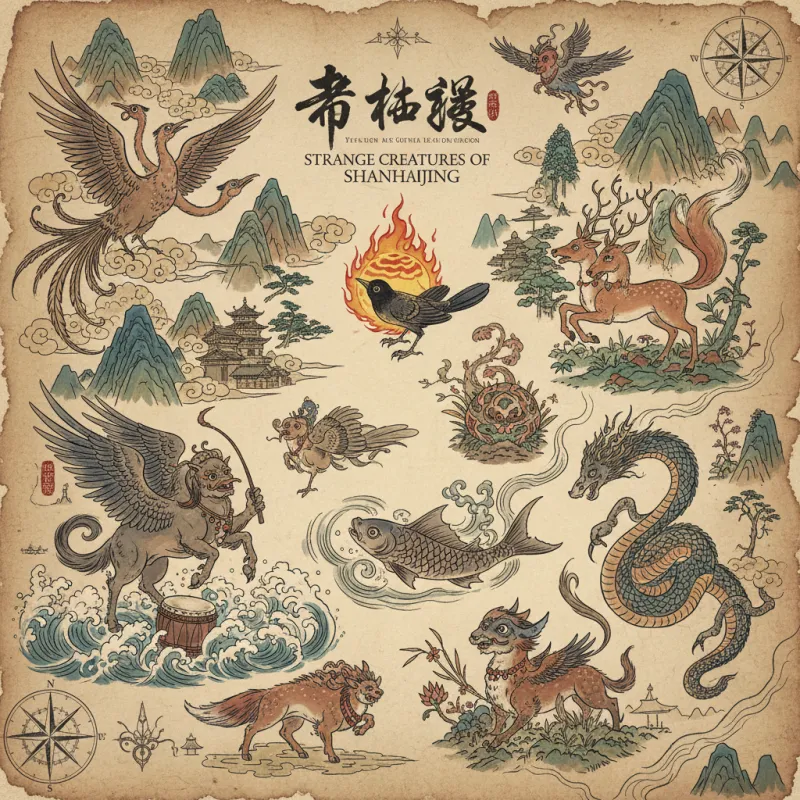
Picture this: You're a Han dynasty traveler clutching a worn copy of the Shanhaijing (山海经, Shānhǎijīng), the "Classic of Mountains and Seas." You've just spotted something in the distance — a horse-sized creature with a white body and a tiger's tail. Do you run? Do you hunt it? Your survival guide says eating its flesh prevents jealousy. The text doesn't explain how this works. It doesn't need to. In the world of the Shanhaijing, the impossible is documented with the same bureaucratic precision as tax records.
When Field Guides Meet Fever Dreams
The Shanhaijing contains descriptions of roughly 450 creatures, and here's what makes it fascinating: the text refuses to acknowledge that anything it describes might be fictional. A nine-headed snake (九头蛇, jiǔtóu shé) gets the same clinical treatment as a deer with unusual antlers. There's no hierarchy of believability, no asterisk saying "this one's probably made up."
Compiled between the 4th century BCE and the 2nd century CE, the text reads like a naturalist's field notes written by someone who's never actually seen the animals they're describing — or perhaps seen them through layers of hearsay, regional folklore, and deliberate exaggeration. Some scholars argue certain creatures are garbled descriptions of real animals: the Qiongqi might be a distorted tiger, filtered through enough retellings that it sprouted wings and hedgehog quills.
But others? There's no explaining those away.
The Practical Bestiary
What sets the Shanhaijing apart from pure mythology is its relentless practicality. These aren't just monsters to fear or gods to worship — they're resources. The text catalogs what you can do with these creatures, as if you might actually encounter them on a Tuesday afternoon.
The Lushu (鹿蜀, lùshǔ) — horse-bodied, white-furred, tiger-tailed — cures jealousy if you eat it. The text doesn't elaborate on preparation methods or serving size. Presumably you figure that out yourself.
The Zhuyin (烛阴, zhúyīn), a thousand-mile-long serpent with a human face, controls day and night by opening and closing its eyes. Not particularly edible, but good to know if you're wondering why it's suddenly dark at noon.
The Feifei (肥遗, féiyí), a yellow snake with a white head, prevents insect infestations. Does this mean you keep it as a pet? Release it in your grain stores? The Shanhaijing assumes you'll work out the logistics.
This utilitarian approach suggests the text served a genuine purpose beyond entertainment. Whether anyone actually believed they'd encounter these creatures is debatable, but the format implies readers might need this information. It's a field guide for a world that doesn't exist — or perhaps for a world that existed only in the collective imagination of ancient China.
The Taxonomy of Strangeness
The creatures fall into rough categories, though the Shanhaijing itself doesn't organize them this way:
Hybrid animals — The most common type. Take two or three real animals, combine their parts in improbable ways, add unusual coloring. The Bi Fang (毕方, bìfāng) is a one-legged crane that causes fires. The Zhu Jian (朱厌, zhūyàn) has an ape's body, a white head, and red feet; its appearance predicts war.
Scaled-up versions of normal animals — The Shanhaijing loves taking ordinary creatures and making them enormous or multiplying their parts. Nine-tailed foxes, six-legged turtles, three-headed birds. It's as if the compilers believed that in distant mountains, everything grew larger and stranger.
Creatures that are definitely gods but described as animals — The text sometimes stumbles into describing deities with the same zoological detachment it uses for weird deer. The Kaiming Beast (开明兽, kāimíng shòu) guards the Kunlun Mountains and has nine human heads on a tiger's body. This is clearly a divine guardian, but the Shanhaijing lists it between descriptions of unusual fish.
Things that might be real animals, badly described — This is where it gets interesting. Some creatures sound like they could be actual animals that got distorted through transmission. Travelers' tales, language barriers, artistic interpretation, and pure exaggeration could transform a pangolin into something unrecognizable.
The Problem of Belief
Did anyone actually believe in these creatures? The question is more complicated than it seems. The Shanhaijing was treated as a legitimate geographical text for centuries. Scholars cited it. Poets referenced it. Artists illustrated it. But "treated as legitimate" doesn't necessarily mean "believed literally."
By the Tang dynasty (618-907 CE), intellectuals were already skeptical. The poet Bo Juyi (白居易, Bái Jūyì) wrote dismissively about the text's more outlandish claims. Yet the Shanhaijing continued to be copied, studied, and referenced. It occupied a strange space — not quite mythology, not quite natural history, but something in between.
Perhaps the better question is: does it matter if they believed? The Shanhaijing functioned as a map of the unknown, a way of organizing the vast territories beyond the Chinese heartland. In regions where no one had traveled, where no reliable information existed, these creatures filled the gaps. They were placeholders for "here be things we don't understand."
The Legacy of the Impossible
The Shanhaijing creatures didn't stay confined to their original text. They leaked into Chinese culture and never left. The nine-tailed fox became a staple of folklore, appearing in everything from Tang dynasty tales to modern video games. The Taotie (饕餮, tāotiè), a gluttonous creature, ended up decorating bronze vessels as a warning against greed.
Modern fantasy draws heavily from this well. Chinese video games, novels, and films mine the Shanhaijing for creature designs, treating it as a public-domain monster manual. The text has become more influential in the 21st century than it probably was in the 3rd century BCE.
What makes these creatures endure isn't their believability — it's their specificity. The Shanhaijing doesn't just say "there are monsters in the mountains." It tells you exactly what they look like, what they do, and what happens if you eat them. That level of detail makes them feel real, even when your rational mind knows they're not.
Reading the Impossible
The Shanhaijing works best when you don't try to explain it away. Modern readers want to rationalize — to identify which real animals inspired which mythical creatures, to find the kernel of truth in each description. But this misses the point.
The text is a record of how ancient Chinese people imagined the unknown. It's a map where the edges aren't marked "here be dragons" but rather "here is a dragon, it has these specific characteristics, and here's what you should do if you meet one." The confidence is what makes it compelling.
These creatures exist in the same way that Sherlock Holmes exists — not as physical beings, but as shared cultural knowledge. Everyone knows what a nine-tailed fox looks like, what it represents, how it behaves. The Shanhaijing created a vocabulary of the impossible that Chinese culture has been speaking for over two thousand years.
The text doesn't ask you to believe. It just asks you to imagine a world where the mountains are taller, the forests deeper, and the creatures stranger than anything you've ever seen. And in that world, you'd better know which ones cure jealousy and which ones predict war. Your life might depend on it.
Related Reading
- The Shanhaijing's Strange Creatures: A Field Guide to the Impossible
- Hundun: The Chaos Creature at the Beginning of Everything
- Shanhai Jing vs. Greek Mythology: Ancient Bestiaries Compared
- Taotie: The Glutton Beast That Devoured Ancient Chinese Art
- 10 Most Fascinating Creatures from the Classic of Mountains and Seas
- Exploring the Enigmatic Creatures and Lands of the Shanhaijing
- Exploring the Enigmatic Creatures and Lands of Shanhaijing: A Cultural Journey
- Sea Monsters of the Shanhai Jing: Terrors of the Deep