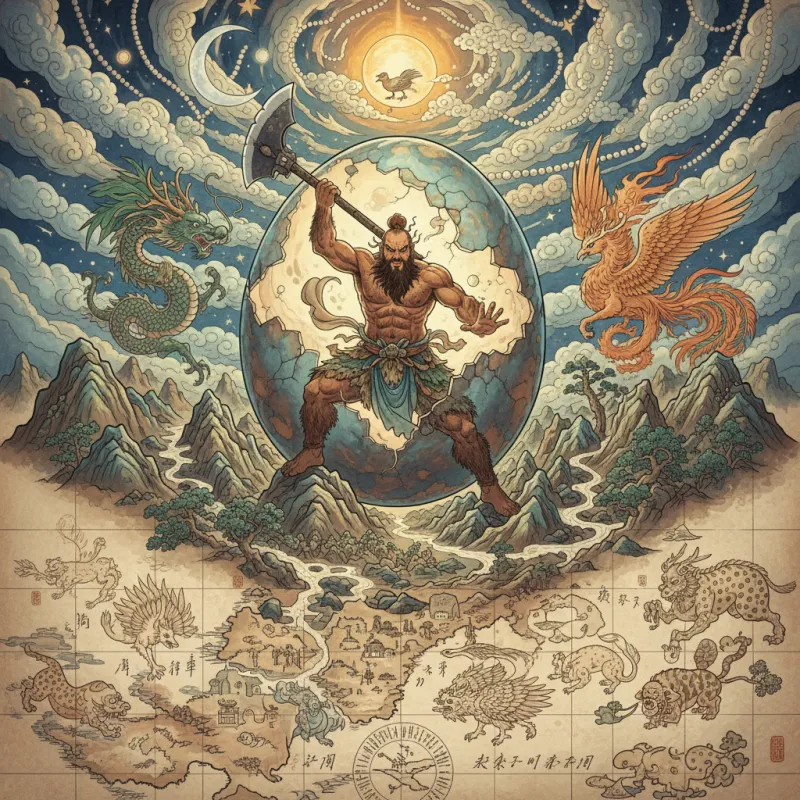
Before there was anything — before sky, before earth, before light or dark or the concept of "before" — there was an egg. And inside that egg, sleeping for eighteen thousand years, was Pangu (盘古 Pángǔ). When he finally woke up, he cracked the universe open with an axe. That's the Chinese creation myth in a nutshell, and it's wilder than most people realize.
The Egg and the Axe
The earliest surviving written version comes from the Sanwu Liji (三五历纪 Sānwǔ Lìjì), compiled by Xu Zheng (徐整 Xú Zhěng) during the Three Kingdoms period (三国 Sānguó, 220–280 CE). The text describes the primordial state as hundun (混沌 hùndùn) — chaos, formlessness, an undifferentiated mass shaped like a chicken's egg.
Inside this cosmic egg, Pangu grew. For eighteen thousand years he slept, and as he slept, the clear yang (阳 yáng) and the turbid yin (阴 yīn) remained mixed together in perfect, suffocating unity. When Pangu finally woke, he found himself trapped in absolute darkness. So he did what any reasonable cosmic being would do: he grabbed an axe and split the egg apart.
The light, pure yang rose to become the heavens. The heavy, turbid yin sank to become the earth. And Pangu stood between them, growing ten feet taller every day, pushing them apart with his body. This went on for another eighteen thousand years. By the time he was done, the sky was impossibly high, the earth impossibly deep, and Pangu himself stood ninety thousand li tall.
The Body Becomes the World
Here's where it gets visceral. When Pangu finally died — exhausted from holding up the sky for eighteen millennia — his body didn't just disappear. It transformed into the physical world we inhabit.
His breath became the wind and clouds. His voice became thunder. His left eye became the sun, his right eye the moon. His four limbs and five extremities became the four cardinal directions and the five sacred mountains (五岳 Wǔyuè). His blood became rivers, his veins became roads. His muscles became farmland, his hair and beard became the stars. His skin and body hair became plants and trees. His teeth and bones became metal and stone. His marrow became jade and pearls. His sweat became rain and dew.
And the parasites on his body? They became human beings.
That last detail appears in some versions but not others, and it's worth sitting with. The idea that humanity originated as cosmic lice is either deeply humbling or darkly funny, depending on your mood. It certainly contrasts with the more dignified creation stories found in texts like the Nüwa myths, where humans are carefully molded from yellow earth.
The Problem of Late Arrival
Here's what's strange: Pangu doesn't appear in any of the ancient classics. Not in the Shanhaijing (山海经 Shānhǎijīng), not in the Shujing (书经 Shūjīng), not in the Shijing (诗经 Shījīng). The first mention we have is from Xu Zheng in the third century CE, which makes Pangu a relative latecomer to Chinese mythology.
Some scholars argue this means the Pangu myth was imported from southern minority groups, possibly the Miao (苗 Miáo) or Yao (瑶 Yáo) peoples, who have similar creation stories involving cosmic eggs and primordial giants. Others suggest it developed independently in southern China and only later spread north. The geographic distribution of Pangu temples and shrines — concentrated in Guangdong, Guangxi, and Hunan provinces — supports a southern origin.
What's undeniable is that by the Tang dynasty (唐朝 Tángcháo, 618–907 CE), Pangu had become firmly embedded in Chinese cosmological thinking. The poet Li Rong (李融 Lǐ Róng) wrote about him, and by the Ming (明 Míng, 1368–1644) and Qing (清 Qīng, 1644–1912) dynasties, Pangu appeared regularly in popular literature and religious texts.
Hundun and the Fear of Formlessness
The concept of hundun deserves its own attention. It's not just "chaos" in the Western sense — not disorder or randomness. It's the state before differentiation, before the ten thousand things (万物 wànwù) separated into distinct categories. It's the cosmic egg, yes, but also the primordial soup, the undifferentiated potential from which everything emerges.
The Zhuangzi (庄子 Zhuāngzǐ) tells a different story about hundun — a being without the seven openings (eyes, ears, nostrils, mouth) that other creatures possess. When his friends tried to help by drilling holes in him, one per day, hundun died on the seventh day. The message: differentiation is both necessary and fatal. Once you crack the egg, you can't put it back together.
Pangu's act of splitting the cosmic egg is therefore both creative and destructive. He brings the world into being, but he also ends the state of perfect, undifferentiated unity. Every creation myth is also a story about loss.
The Giant Who Holds Up the Sky
The image of Pangu standing between heaven and earth, growing taller each day to keep them separated, echoes myths from around the world. The Greek titan Atlas holding up the celestial sphere. The Norse god Ymir, whose body becomes the world. The Egyptian god Shu separating Nut (sky) from Geb (earth).
But Pangu's version has a distinctly Chinese flavor. The emphasis on gradual growth — ten feet per day for eighteen thousand years — reflects a cosmology built on slow, steady transformation rather than sudden divine fiat. The universe isn't spoken into existence; it's grown, cultivated, pushed apart through sustained effort.
This resonates with Daoist ideas about the natural unfolding of the cosmos, the way the Dao (道 Dào) operates through subtle, continuous processes rather than dramatic interventions. Even the numbers are significant: eighteen thousand years of sleep, eighteen thousand years of separation. The number eighteen (十八 shíbā) doesn't have the same mystical weight as three or nine in Chinese numerology, but the doubling creates a sense of cosmic symmetry.
Pangu in Popular Culture
Walk through any Chinese temple complex and you might find Pangu depicted as a hairy giant wielding an axe, sometimes accompanied by a dragon, phoenix, turtle, and qilin (麒麟 qílín) — the four divine creatures. In some images he's shown as a primitive, almost ape-like figure, emphasizing his role as the first being, predating civilization itself.
Modern Chinese science fiction and fantasy have embraced Pangu enthusiastically. He appears in video games, novels, and films as the ultimate origin point, the cosmic ancestor. The 2018 film "Asura" (though troubled in production) featured Pangu-inspired cosmology. The popular game "Honor of Kings" includes Pangu as a playable character.
But perhaps the most interesting modern interpretation comes from Liu Cixin's "The Three-Body Problem" trilogy, where the author plays with the idea of cosmic cycles — universes that expand and contract, die and are reborn. It's not explicitly about Pangu, but the echo is there: the idea that creation requires breaking something open, that every universe begins with an act of violent separation.
What the Myth Reveals
Creation myths tell us how a culture thinks about beginnings, about the relationship between chaos and order, about humanity's place in the cosmos. The Pangu myth suggests several things about Chinese cosmological thinking.
First, creation is physical and embodied. Pangu doesn't speak the world into existence or think it into being. He uses an axe. He pushes with his body. And when he dies, his literal flesh becomes mountains and rivers. There's no separation between spirit and matter here — the cosmos is fundamentally material, and the divine is embedded in physical reality.
Second, creation requires sacrifice. Pangu doesn't retire to some celestial realm after his work is done. He dies, and his death is what makes the world livable. This theme appears throughout Chinese mythology — Nüwa exhausting herself to repair the sky, Gonggong smashing Mount Buzhou in rage, causing cosmic catastrophe. The world we inhabit is built on the bodies of those who came before.
Third, humans are not the point. We're parasites, afterthoughts, the cosmic equivalent of fleas. This is refreshingly honest. We're not made in anyone's image, not given dominion over anything. We're just here, one small part of a vast transformation that began long before us and will continue long after.
The Pangu myth doesn't offer comfort or cosmic significance. It offers something better: a sense of scale, a reminder that we're part of something much larger and stranger than ourselves. Before there was anything, there was an egg. And when that egg cracked open, the universe spilled out — messy, material, and utterly indifferent to our need for meaning.
That's the real power of the myth. Not that it explains where we came from, but that it reminds us how small and recent we are in the grand scheme of things. Pangu slept for eighteen thousand years. He stood between heaven and earth for eighteen thousand more. And we've been here for what — a few thousand years of recorded history? We're barely a footnote in the cosmic story, parasites on the body of a dead giant.
And somehow, that's exactly what we needed to hear.
Related Reading
- The Cosmology of the Shanhaijing: How Ancient Chinese Mapped the Universe
- Nüwa Creates Humanity: Sculpting People from Yellow Earth
- The Four Divine Beasts: Guardians of the Compass
- Kunlun Mountain: The Axis of the Chinese Cosmos
- The Complete Guide to Shanhai Jing: China's Book of Mythical Creatures
- The Great Flood: Why Every Civilization Has a Flood Myth
- Mystical Beasts of the Shanhaijing: A Journey Through Myth and Geography
- Exploring the Enigmatic Creatures and Lands of the Shanhaijing