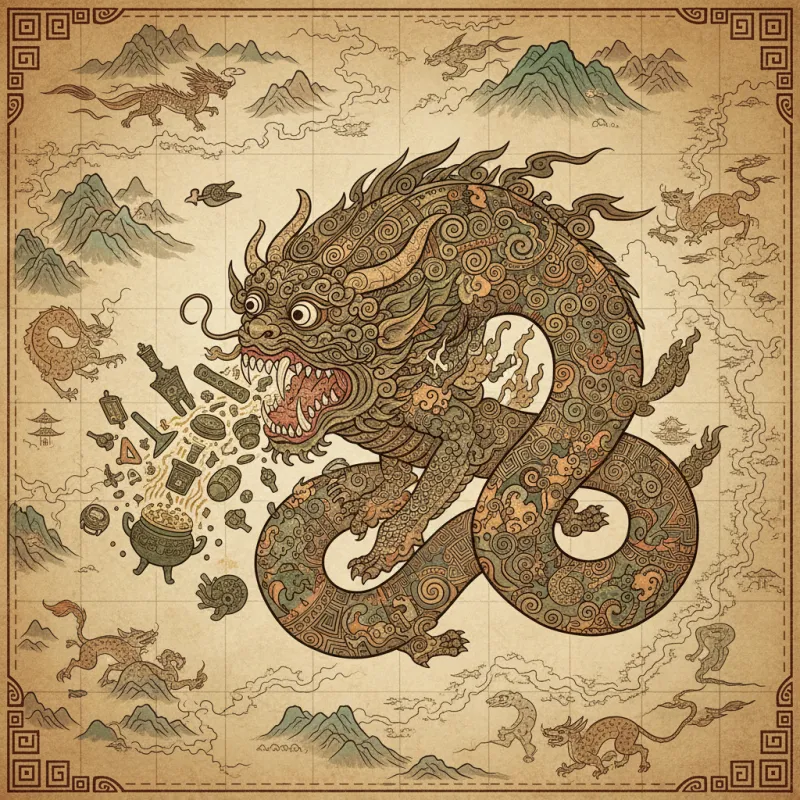
Picture this: You're standing in a museum, staring at a 3,000-year-old bronze vessel. Two bulging eyes glare back at you from the metal surface. Below them, a mouth so enormous it seems to swallow the entire face. No body. No limbs. Just eyes and that terrible, hungry mouth. You've just met the Taotie (饕餮 tāotiè), and it's been watching people like you for three millennia.
The Taotie isn't just another monster from Chinese mythology. It's the face that launched a thousand bronzes — literally. During the Shang (商 Shāng, c. 1600-1046 BCE) and Zhou (周 Zhōu, 1046-256 BCE) dynasties, craftsmen stamped this creature's visage onto ritual vessels with obsessive repetition. Walk through any major museum's Chinese antiquities section, and you'll see it: that symmetrical, staring mask on ding (鼎 dǐng) tripods, gui (簋 guǐ) food vessels, and zun (尊 zūn) wine containers. The Taotie became so ubiquitous that for centuries, scholars simply called these bronze decorations "Taotie patterns" without really understanding what they were looking at.
The Monster That Ate Itself
Here's where it gets weird. The Taotie is a creature made entirely of appetite. According to the Lüshi Chunqiu (呂氏春秋 Lǚshì Chūnqiū), a text compiled around 239 BCE, the Taotie had a body, but it ate so much that it eventually devoured itself, leaving only its head. Other accounts skip the body entirely — the Taotie simply exists as a disembodied face, a mouth with eyes attached.
The Classic of Mountains and Seas mentions a creature in the northern wilderness with a human face, goat's body, eyes under its armpits, and tiger's teeth with human hands. Some scholars link this to the Taotie, though the connection is debated. What's consistent across sources is the emphasis on insatiable hunger. The Taotie doesn't just eat — it consumes compulsively, destructively, without end or purpose.
This makes the Taotie fundamentally different from other Chinese mythological creatures. The Qilin represents benevolence and appears to herald virtuous rulers. The Fenghuang symbolizes harmony and imperial power. But the Taotie? It's pure appetite stripped of meaning, consumption without satisfaction. It's what happens when desire becomes identity.
Bronze Age Branding
The Shang dynasty elite were obsessed with this face. They cast it onto every important ritual object they made. Bronze vessels weren't just containers — they were sacred objects used in ceremonies to communicate with ancestors and spirits. The fact that they chose to decorate these vessels with a monster of pure gluttony tells us something important about Shang religious thought.
Some scholars argue the Taotie face served as a protective symbol, warding off evil spirits with its fierce appearance. Others suggest it represented the power to consume and transform, a necessary quality for vessels that held offerings to the dead. The most intriguing theory? That the Taotie wasn't meant to be protective at all, but rather a warning — a reminder of what happens when appetite goes unchecked.
The design itself is masterfully executed. Shang bronze workers created these faces using a technique called piece-mold casting, which allowed for incredibly intricate details. The Taotie mask is always perfectly symmetrical, split down the middle, with each half mirroring the other. Often, the design incorporates a central ridge or flange that emphasizes this bilateral symmetry. The eyes bulge outward, sometimes on raised bosses. The mouth gapes, revealing fangs or a curled tongue. Horns or ears sprout from the top. The overall effect is hypnotic and unsettling.
From Monster to Metaphor
By the time we get to the Zhou dynasty, people were already starting to moralize the Taotie. The Zuo Zhuan (左傳 Zuǒ Zhuàn), a historical text from the 4th century BCE, describes the Taotie as one of the "Four Perils" — monstrous beings that represented various vices. In this telling, the Taotie was the son of the Jinyun clan who was so greedy and gluttonous that he became a cautionary tale.
This is when "Taotie" started being used as an insult. Call someone a Taotie, and you're saying they're a greedy pig who can't control their appetites. The term appears in classical Chinese literature as shorthand for gluttony and excess. It's the ancient Chinese equivalent of calling someone a glutton, but with 3,000 years of cultural weight behind it.
The irony is delicious: a face that once adorned the most sacred objects of the Shang elite became a symbol of everything refined people should avoid. The same image that represented power and connection to the divine was reinterpreted as a warning against vice. This transformation tells us as much about changing Chinese values as it does about the Taotie itself.
The Face That Forgot Its Name
Here's a plot twist: we don't actually know if the Shang people called this design "Taotie." That name was applied centuries later by scholars trying to make sense of these ancient bronzes. The Shang left no clear records explaining what the face meant or what they called it. We're essentially looking at sacred art from a civilization that left us the objects but not the instruction manual.
Some researchers argue the face isn't even a single creature. Look closely at a Taotie mask, and you might see it's actually composed of two dragons in profile, facing each other. Their bodies form the sides of the face, their heads become the eyes, and the space between them creates the mouth. This "split representation" theory suggests the Taotie is less a monster and more a clever artistic composition — two creatures merged into one terrifying whole.
Other scholars point out that many Taotie designs include small animal figures in the background — dragons, birds, cicadas. Maybe the face isn't the main subject at all, but rather a framework for displaying multiple creatures simultaneously. Or perhaps it's meant to represent a shaman's mask, used in rituals to communicate with the spirit world.
The truth is, we're guessing. And that uncertainty makes the Taotie even more fascinating. It's a face that has stared at humans for three thousand years, and we still don't know what it's trying to tell us.
Appetite in Art and Life
The Taotie's influence didn't end with the Bronze Age. The motif appears throughout Chinese art history, sometimes as direct quotation, sometimes as subtle reference. Ming and Qing dynasty artists incorporated Taotie-inspired designs into furniture, textiles, and architecture. The face shows up on door knockers, roof tiles, and decorative panels — always watching, always hungry.
In modern times, the Taotie has experienced a renaissance. Contemporary Chinese artists use the image to comment on consumer culture and unchecked capitalism. The parallel is obvious: a monster defined by insatiable appetite feels perfectly suited to critique a society built on endless consumption. The Taotie has gone from Bronze Age ritual object to Zhou dynasty moral warning to 21st-century artistic commentary on materialism.
Chinese cuisine even has a term "Taotie feast" (饕餮盛宴 tāotiè shèngyàn), referring to an elaborate banquet with excessive amounts of food. It's meant to be impressive, but there's always a hint of criticism in the phrase — a suggestion that maybe this is too much, that we're feeding the monster instead of ourselves.
The Mouth That Never Closes
What makes the Taotie endure? Why does this face, created by a civilization that vanished three thousand years ago, still resonate today?
Maybe it's because the Taotie represents something universal: the fear that our appetites will consume us. Every culture has stories about the dangers of excess, but the Taotie makes that danger visible. It shows us what we become when desire is all that's left — a face made entirely of mouth, eyes that see only what can be devoured, a hunger that can never be satisfied.
The Taotie ate itself and left only its face. In doing so, it became immortal. That face has outlasted the Shang dynasty, the Zhou dynasty, and every empire that came after. It has survived because it shows us something true about human nature: that appetite, unchecked, becomes identity. That consumption, taken to its extreme, consumes the consumer.
Stand in front of that bronze vessel again. Look at those bulging eyes, that gaping mouth. The Taotie isn't just watching you. It's showing you what happens when hunger becomes everything. And it's been trying to tell us that for three thousand years.
Related Reading
- Strange Creatures of the Shanhaijing: A Field Guide to the Impossible
- Shanhai Jing vs. Greek Mythology: Ancient Bestiaries Compared
- The Shanhaijing's Strange Creatures: A Field Guide to the Impossible
- 10 Most Fascinating Creatures from the Classic of Mountains and Seas
- Hundun: The Chaos Creature at the Beginning of Everything
- The Peoples of the Shanhaijing: Foreign Nations at the Edge of the World
- Unraveling the Mysteries of Shanhaijing: Mythical Creatures and Enigmatic Lands
- Unearthing the Cursed Beings of Shanhaijing: Myths, Creatures, and Lands