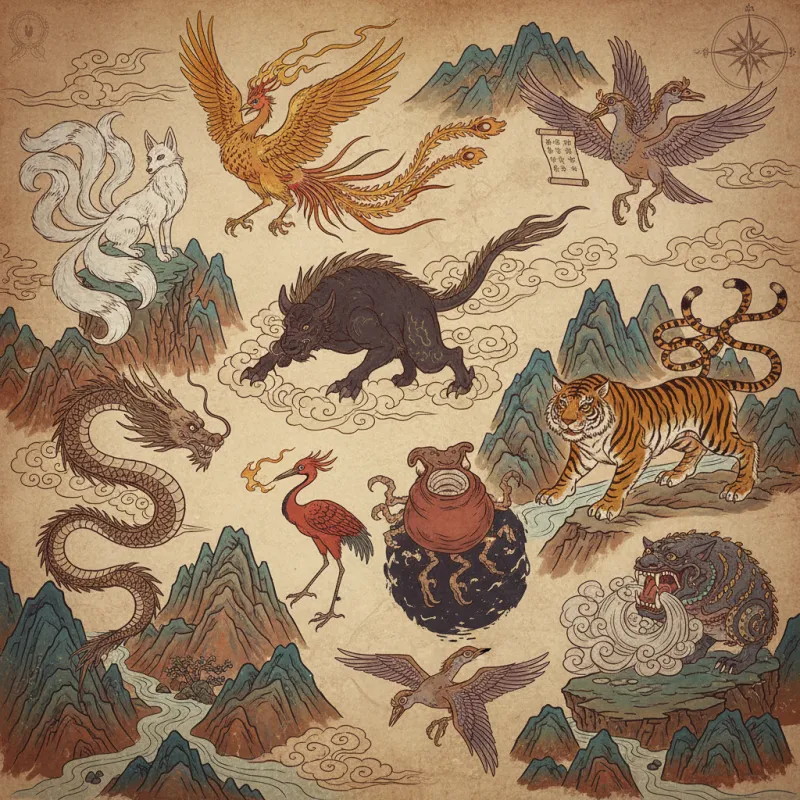
Picture this: you're a Han dynasty scholar unrolling a silk manuscript, and staring back at you is a creature with nine tails, another with human hands growing from its shoulders, and a third that's just... a walking pile of meat with eyes. The Shanhai Jing (山海经, Shānhǎi Jīng) — Classic of Mountains and Seas — isn't your typical bestiary. Compiled between the 4th and 1st centuries BCE, it reads like the fever dream of an ancient geographer who got lost in the mountains and decided to catalog everything weird they hallucinated. But here's the thing: these creatures weren't just entertainment. They were omens, medicines, warnings, and windows into how ancient Chinese people understood their world.
The One-Legged Arsonist: Bifang (毕方)
The Bifang (毕方, Bìfāng) is exactly what happens when you give a bird one leg, paint it blue and red, and tell it to start fires wherever it goes. According to the Xishan Jing (Western Mountains Classic) section, this crane-like creature carries flames in its beak and announces its presence with a sound like its own name — "bi-fang, bi-fang."
What makes Bifang genuinely unsettling isn't just the arson. It's the specificity. The text notes that it appears on Mount Zhang'e, and wherever it shows up, that city experiences a major fire. This wasn't abstract mythology — it was a warning system. Ancient Chinese astronomers associated Bifang with certain celestial phenomena, possibly comets or meteors that preceded drought conditions. The creature became shorthand for "your city is about to burn down, maybe do something about fire prevention."
The Yellow Emperor supposedly captured two Bifang and used them to pull his chariot, which is the ancient equivalent of harnessing nuclear power for your morning commute. Later texts like the Huainanzi (淮南子) expanded on this, suggesting that Bifang emerged from the primordial wood element itself — fire's natural fuel source made manifest.
The Fox That Broke Good: Jiuwei Hu (九尾狐)
Here's where things get interesting. The Nine-Tailed Fox (九尾狐, Jiǔwěi Hú) that modern audiences know as a seductive demon? That's character assassination that took two thousand years to accomplish.
The original Shanhai Jing entry, found in the Nanshan Jing (Southern Mountains Classic), describes a fox-like creature on Mount Qingqiu with nine tails whose cry sounds like an infant. The kicker? "Those who eat it will be protected from venomous insects." This was an auspicious creature, a good omen. Its appearance signaled peace and prosperity during the reign of virtuous rulers.
The nine-tailed fox appears in early Han dynasty art as a companion to the Queen Mother of the West (Xiwangmu, 西王母), one of the most powerful deities in the Chinese pantheon. It wasn't until the Tang and Song dynasties that fox spirits generally — and nine-tailed foxes specifically — got rebranded as dangerous seductresses who drained men's life force. The most famous example is Daji from the Fengshen Yanyi (封神演义, Investiture of the Gods), a Ming dynasty novel that retroactively made the nine-tailed fox responsible for the fall of the Shang dynasty.
But in the Shanhai Jing? It's just a weird fox that's good for you. The transformation says more about changing attitudes toward women and sexuality than it does about the creature itself.
The Eyeball Buffet: Taowu (梼杌)
The Taowu (梼杌, Táowù) is what you get when you cross a tiger with a human face, add boar tusks, give it a tail eighteen feet long, and make it incredibly stupid but also incredibly violent. The Beishan Jing (Northern Mountains Classic) places it on Mount Zhaoyu, and notes that it "delights in fighting."
What's fascinating is that Taowu later became one of the Four Perils (四凶, Sì Xiōng) — legendary monsters that the sage-king Shun exiled to the four corners of the earth. In the Zuo Zhuan (左传), a historical text from the 4th century BCE, Taowu is explicitly identified as the personification of stubbornness and unteachability. It's the physical manifestation of that one person in every meeting who refuses to listen to reason.
The creature's name became synonymous with historical records that documented disasters and failures — a "taowu" was a chronicle of bad things, a warning to future generations. So this tiger-faced monster evolved from a geographical oddity to a moral lesson to a literary genre. That's quite a career trajectory.
The Helpful Abomination: Kaiming Beast (开明兽)
The Kaiming Beast (开明兽, Kāimíng Shòu) guards the garden of the Queen Mother of the West, and it's... a lot. Picture a tiger's body with nine human heads, all facing east. Some versions give it nine tails to match. It stands at the entrance to the Kunlun Mountains, the axis mundi of Chinese cosmology, and serves as the ultimate bouncer.
What's remarkable is that despite its horrifying appearance, Kaiming is explicitly benevolent. It helps worthy humans navigate the treacherous paths to the Queen Mother's paradise. The Dahuang Xijing (Great Wilderness Western Classic) section describes it as having the "face of a human and the body of a tiger," which undersells the nine-heads situation considerably.
The creature's name literally means "opening brightness" or "enlightenment," suggesting it's not just a guard but a guide — something that helps humans transcend their limitations. This is a recurring theme in Shanhai Jing creatures: the most monstrous-looking beings are often the most helpful, while beautiful creatures might eat you. It's almost as if the text is warning against judging by appearances, which is pretty sophisticated for a 2,300-year-old monster manual.
The Walking Meat Mountain: Hundun (混沌)
The Hundun (混沌, Hùndùn) is described in the Xishan Jing as a creature that looks like a yellow sack, red like cinnabar fire, with six feet and four wings, but no face. It's chaos personified — literally, as "hundun" means "primordial chaos" or "confusion."
This faceless blob appears on Mount Tianshan and, according to the text, "knows how to sing and dance." Which raises so many questions. How does it sing without a mouth? How does it see where it's dancing without eyes? The Shanhai Jing doesn't care about your need for logical consistency.
The creature appears in a famous parable from the Zhuangzi (庄子), where the emperors of the North and South Seas decide to repay Hundun's hospitality by giving it the seven orifices that humans have — eyes, ears, nose, mouth. They bore one hole per day, and on the seventh day, Hundun dies. The moral? Some things aren't meant to be "improved" or made to conform to human standards. Chaos has its own perfection.
This philosophical depth is what separates the Shanhai Jing from mere monster catalogs. These creatures aren't just weird — they're teaching tools, thought experiments wrapped in scales and feathers.
The Plague Doctor: Qinyuan (钦原)
The Qinyuan (钦原, Qīnyuán) is a bird that looks like a bee, roughly the size of a mandarin duck, and here's the fun part: anything it stings dies, and any tree or plant it lands on withers. It's basically a flying apocalypse.
Found in the Zhongshan Jing (Central Mountains Classic) on Mount Lun, the Qinyuan represents disease and blight made manifest. But here's where ancient Chinese pragmatism kicks in: the text notes that killing a Qinyuan and wearing its feathers can protect you from plague. It's the principle of fighting poison with poison, using the disease-bringer's own power as a vaccine.
This creature likely emerged from observations of actual insect-borne diseases. Ancient Chinese people noticed correlations between certain insects and illness outbreaks, and the Qinyuan became a way to conceptualize and discuss epidemiology before germ theory existed. It's folk medicine wrapped in mythology, which is exactly what makes the Shanhai Jing so valuable as a historical document.
The Drought Demon: Nuba (女魃)
Nuba (女魃, Nǚbá) is technically a deity rather than a creature, but she appears in the Shanhai Jing's catalog of strange beings, so she counts. She's described as a woman with a green body and no hair, and wherever she goes, drought follows. No rain falls within a thousand li of her presence.
According to the Dahuang Beijing (Great Wilderness Northern Classic), Nuba was originally the daughter of the Yellow Emperor. She helped him defeat the rebel Chiyou by drying up the floods that Chiyou's rain-making magic had created. But afterward, she couldn't return to heaven — her drought-bringing power was too dangerous. So she was exiled to the mortal realm, wandering eternally, bringing water scarcity wherever she went.
This is tragedy on a cosmic scale. Nuba is punished for being too effective at her job, too powerful to be allowed back home. Ancient communities performed rituals to drive her away during droughts, essentially blaming a divine scapegoat for natural disasters. The creature becomes a way to externalize and ritualize the community's anxiety about water scarcity, giving people something concrete to act against when facing the randomness of climate.
The Immortality Fish: Lingyu (鲮鱼)
The Lingyu (鲮鱼, Língyú) is a fish with a human face that makes sounds like a mandarin duck. According to the Nanshan Jing, eating its flesh prevents scabies and other skin diseases. Some versions claim it grants immortality or at least significantly extends lifespan.
This creature appears in the Ying River, and its description suggests it might be based on actual fish species that ancient people observed — possibly a type of carp or catfish with unusual facial features that, through the telephone game of oral tradition, became increasingly anthropomorphized. The medicinal properties attributed to strange creatures in the Shanhai Jing often reflect genuine pharmacological knowledge, even if the creatures themselves are fantastical.
What's particularly interesting is how many Shanhai Jing creatures are explicitly edible and beneficial. The text isn't just cataloging monsters to avoid — it's providing a survival guide for navigating a dangerous world full of potential resources. Eat this, avoid that, wear this creature's skin for protection. It's practical magic.
The Sound of Disaster: Zhuyin (烛阴)
Zhuyin (烛阴, Zhúyīn), also called Zhulong (烛龙, Candle Dragon), is one of the most cosmically significant creatures in the entire text. It's described as a dragon with a human face, red skin, and a body thousands of miles long. When it opens its eyes, day comes. When it closes them, night falls. When it breathes out, summer arrives. When it breathes in, winter comes.
This isn't just a creature — it's a cosmological principle made flesh. Zhuyin lives beyond the Northwest Sea, in a land of eternal darkness, and serves as the mechanism by which time and seasons function. Some scholars identify it with the god Gonggong or suggest it represents an ancient understanding of solar cycles.
The Dahuang Beijing notes that Zhuyin doesn't eat, drink, sleep, or breathe normally — it exists in a state beyond normal biological functions. It's the closest thing the Shanhai Jing has to a creator deity, though it doesn't create so much as regulate. The universe runs on Zhuyin's sleep schedule, which is both terrifying and oddly comforting.
The Omen Bird: Jingwei (精卫)
The Jingwei (精卫, Jīngwèi) is the most tragic creature in the entire Shanhai Jing, and it's just a small bird with a white beak and red claws. According to the Beishan Jing, it was once Nüwa, the daughter of the Flame Emperor (Yandi). She drowned in the Eastern Sea, and her spirit transformed into this bird.
Now, eternally, Jingwei carries stones and twigs in its beak, dropping them into the ocean, trying to fill it up. It's attempting to accomplish the impossible — to take revenge on the sea that killed her by making it cease to exist. The phrase "Jingwei filling the sea" (精卫填海, Jīngwèi tián hǎi) became a Chinese idiom meaning determined perseverance in the face of impossible odds.
This is mythology at its most psychologically sophisticated. Jingwei represents grief that cannot be processed, trauma that transforms into obsessive action, the human need to do something even when nothing can be done. It's a 2,000-year-old meditation on loss and futility and the stubborn refusal to accept either.
Why These Creatures Still Matter
The Shanhai Jing creatures aren't just ancient curiosities — they're a complete worldview. They represent an understanding of nature as fundamentally strange, dangerous, and full of potential. Every mountain might hide a creature that could kill you or cure you. Every river might contain a fish that grants immortality.
Modern readers often approach these texts looking for "real" animals that got exaggerated, but that misses the point. These creatures are real in the way that metaphors are real, in the way that cultural anxieties and hopes take physical form. The nine-tailed fox's transformation from auspicious omen to dangerous seductress tracks changing social attitudes. Nuba's exile reflects ancient communities' helplessness before drought. Jingwei's eternal task embodies grief itself.
The Shanhai Jing doesn't separate the natural from the supernatural, the geographical from the mythological, the practical from the impossible. It's all one continuous landscape where a mountain might be 3,000 li to the west and also home to a one-legged fire bird that predicts urban conflagrations. That's not confusion — that's a different way of mapping reality, one where meaning and matter are inseparable.
These ten creatures are just the beginning. The full text catalogs hundreds more, each stranger than the last, each carrying layers of meaning that scholars are still unpacking. They remind us that the ancient world was weirder, richer, and more imaginative than we usually give it credit for. And maybe, just maybe, our own world is still that strange — we've just stopped paying attention.
Related Reading
- Taotie: The Glutton Beast That Devoured Ancient Chinese Art
- Strange Creatures of the Shanhaijing: A Field Guide to the Impossible
- The Shanhaijing's Strange Creatures: A Field Guide to the Impossible
- Hundun: The Chaos Creature at the Beginning of Everything
- Shanhai Jing vs. Greek Mythology: Ancient Bestiaries Compared
- Chinese Dragons vs European Dragons
- The Nine-Headed Bird: Terror of the Skies
- Exploring the Enigmatic Mountains and Creatures of the Shanhaijing