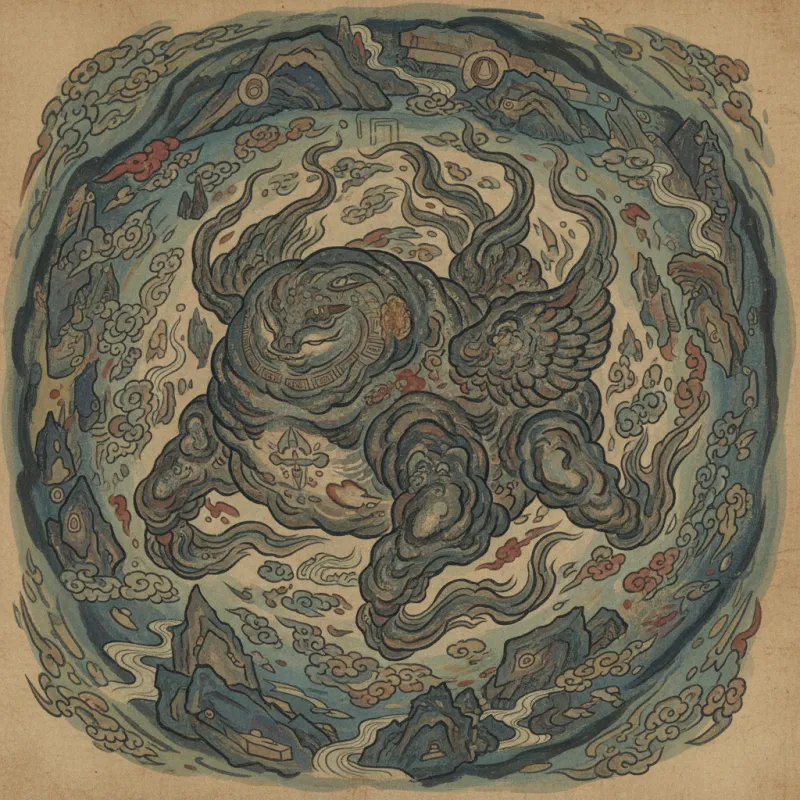
Before heaven and earth split apart, before the first breath of wind stirred the void, there existed something that wasn't quite a thing at all. The ancient Chinese called it Hundun (混沌 hùndùn) — a word that means "chaos" but also "muddled," "confused," "all mixed up." Imagine a cosmic dumpling with no filling and no wrapper, just pure undifferentiated existence. No face, no features, no form. And according to one of philosophy's darkest jokes, that's exactly how it should have stayed.
The Yellow Sack on Tianshan
The Shanhaijing (山海经 Shānhǎi Jīng), that sprawling catalog of geographical oddities and mythical beasts, places Hundun on Tianshan Mountain (天山 Tiānshān) in the Western Wilderness. The text describes it with characteristic bluntness: it looks like a yellow sack, has no face, and possesses six feet and four wings. Despite having no sensory organs, it somehow knows how to sing and dance.
This is the creature version of Hundun — not the primordial cosmic soup, but a specific being you might theoretically encounter if you wandered far enough west. The Shanhaijing treats it matter-of-factly, the way it treats the Qiongqi, another chaos creature, or the Taotie with its insatiable appetite. Just another resident of the mythical landscape, albeit one that embodies the formless state before creation.
Some scholars argue this creature-Hundun is a later folk interpretation of the original cosmic principle, a way of making the abstract concrete. Others suggest the reverse — that the philosophical concept grew from stories about this strange, faceless thing dancing on a mountain. Either way, the image is unsettling: something alive and active, yet fundamentally incomplete.
The Zhuangzi's Devastating Parable
But it's in the Zhuangzi (庄子 Zhuāngzǐ), that masterpiece of Daoist philosophy written around the 4th century BCE, where Hundun's story becomes truly haunting. The parable appears at the end of the "Inner Chapters," and it reads like a fairy tale that curdles into tragedy.
The Emperor of the Southern Sea was called Shu (倏 Shū, "Swift"), the Emperor of the Northern Sea was called Hu (忽 Hū, "Sudden"), and the Emperor of the Center was called Hundun. Shu and Hu would occasionally meet in Hundun's territory, and Hundun always treated them generously.
One day, Shu and Hu decided to repay Hundun's kindness. They noticed that all people have seven openings — two eyes, two ears, two nostrils, one mouth — through which they see, hear, smell, breathe, and eat. But Hundun had none. So they decided to bore holes in him, one opening per day.
On the seventh day, Hundun died.
That's it. That's the whole story. No moral spelled out, no explanation offered. Just the image of two well-meaning emperors killing their friend by trying to make him normal.
What the Parable Actually Means
Zhuangzi rarely explains his parables, preferring to let them work on you like a slow poison. But the Hundun story has generated centuries of interpretation, and most readers agree on the basic thrust: some things are destroyed by the very act of definition and differentiation.
Hundun represents the Dao (道 Dào) itself — the undifferentiated source of all things, the state before distinctions arise. Shu and Hu, with their names meaning "swift" and "sudden," represent the quick, decisive action of human intervention. They see something they perceive as incomplete and rush to fix it. They impose structure, create boundaries, drill holes where there were none.
And in doing so, they kill the very thing they meant to help.
This is Zhuangzi's critique of Confucian social engineering in miniature. The Confucians of his era were obsessed with creating the proper rituals, the correct hierarchies, the right distinctions between ruler and subject, father and son, husband and wife. They wanted to bore seven holes into society, to make everything clear and defined and functional.
Zhuangzi says: you're killing Hundun. You're destroying the natural, undifferentiated state that actually sustains life. Your kindness is violence. Your improvements are murder.
Hundun in Cosmogony
Beyond the parable, Hundun appears in Chinese cosmogonic myths as the primordial state itself. Before Pangu (盘古 Pángǔ) separated heaven and earth, before the Nüwa molded humans from yellow clay, there was only Hundun — a cosmic egg, a formless mass, a state of pure potential.
The Huainanzi (淮南子 Huáinánzǐ), compiled in the 2nd century BCE, describes this primordial chaos: "Before heaven and earth took shape, there was only an amorphous mass. This was called the Great Inception (太初 Tàichū). The Dao began in emptiness and emptiness produced the universe."
This cosmogonic Hundun isn't a creature or even really a being — it's a condition, a state of affairs. It's what exists before existence gets organized into categories. The Chinese philosophical tradition, unlike some Western creation myths, doesn't treat this chaos as evil or as something that needed to be conquered. Chaos isn't the enemy of order; it's the mother of possibility.
The Daodejing (道德经 Dàodéjīng) puts it beautifully: "There was something formless yet complete, born before heaven and earth. Silent and empty, standing alone and unchanging, ever present and in motion. It can be regarded as the mother of all things."
The Faceless Face
What makes Hundun so philosophically rich is precisely what makes it so disturbing: it has no face. In Chinese culture, as in most cultures, the face is the seat of identity, the marker of personhood. We recognize each other by faces. We read emotions in faces. The face is how the inner becomes outer, how the self presents to the world.
Hundun has none of this. It's not that it's hiding its face or that its face is obscured — it simply has no face to begin with. No way to perceive the world, no way to be perceived. No interface between inner and outer because there is no inner and outer, just undifferentiated being.
This is why the parable is so effective. When Shu and Hu bore the seven holes, they're not just adding features — they're creating the very possibility of distinction, of inside versus outside, of self versus other. They're transforming Hundun from pure being into a being-among-beings, from the Dao into a particular thing.
And particular things die.
Hundun in Later Culture
The image of Hundun has echoed through Chinese culture for millennia. In the Ming dynasty novel Journey to the West (西游记 Xīyóu Jì), chaos demons appear as obstacles to enlightenment. In traditional opera, Hundun sometimes appears as a comic figure, a bumbling creature that can't see where it's going.
But the philosophical weight remains. Modern Chinese writers and artists return to Hundun again and again as a symbol of the pre-modern, the pre-rational, the state before Western categories carved up Chinese thought. There's a nostalgia in some of this, a longing for the time before the seven holes were bored.
The poet Bei Dao (北岛 Běi Dǎo) wrote: "We have no road but to walk / We have no voice but to speak." The implication: we are post-Hundun beings, already differentiated, already carved up into sensory organs and social roles. We can't go back to the faceless state, but we can remember it, mourn it, use it as a critique of the world of distinctions we're forced to inhabit.
Living with Seven Holes
Here's what the Hundun story doesn't tell you: what happened to Shu and Hu after their friend died? Did they understand what they'd done? Did they mourn? Or did they move on to the next project, the next improvement, the next act of well-intentioned violence?
Zhuangzi doesn't say, because the parable isn't really about them. It's about us, the readers, who live in a world where the seven holes have already been bored. We can't un-see, un-hear, un-taste. We can't return to undifferentiated chaos, even if we wanted to.
But we can recognize what was lost. We can be suspicious of people who want to bore more holes, create more distinctions, impose more structure. We can remember that before there were categories, there was Hundun — formless, faceless, dancing on a mountain, perfectly content with its own incompleteness.
The Dao that can be spoken is not the eternal Dao, the Daodejing tells us. And the creature that can be improved, the parable suggests, is not the creature that should be.
Hundun died so we could see, hear, taste, and speak. The question Zhuangzi leaves us with is simple and terrible: was it worth it?
Related Reading
- Shanhai Jing vs. Greek Mythology: Ancient Bestiaries Compared
- 10 Most Fascinating Creatures from the Classic of Mountains and Seas
- Taotie: The Glutton Beast That Devoured Ancient Chinese Art
- Strange Creatures of the Shanhaijing: A Field Guide to the Impossible
- The Shanhaijing's Strange Creatures: A Field Guide to the Impossible
- Unraveling the Mysteries of Shanhaijing: Myths, Creatures, and Fantastic Realms
- Bifang: The Fire Bird That Brings Disaster
- Discovering the Guardians of Shanhaijing: Mythical Creatures and Legendary Lands