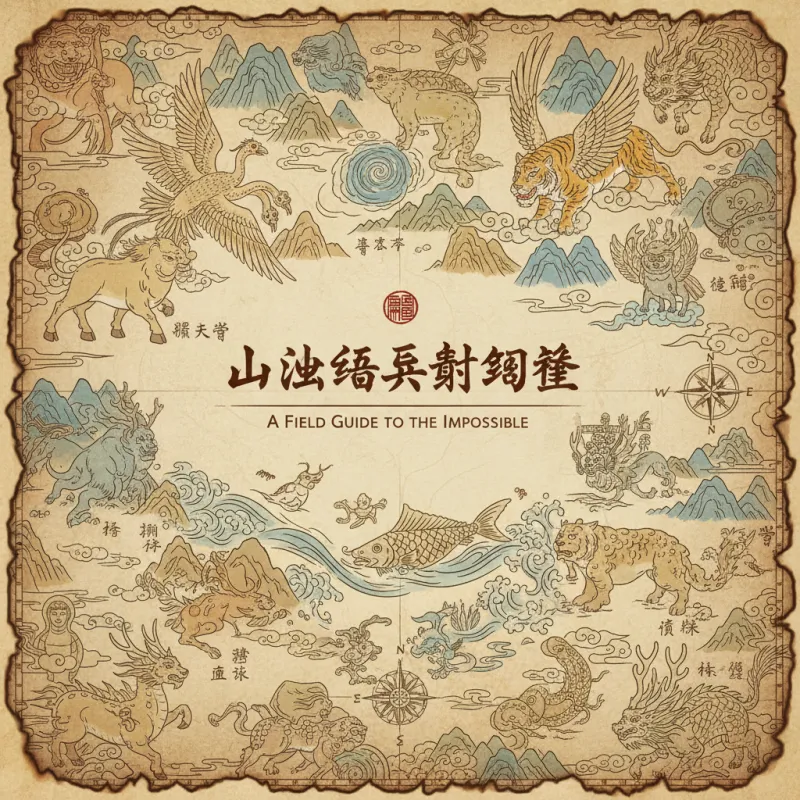
Picture this: you're a Han dynasty scholar, unrolling a silk manuscript that claims to document the geography of the known world. You expect mountains, rivers, maybe some trade routes. Instead, you find a six-legged creature with four wings that screams like a magpie, a fish with a human face that giggles, and a mountain inhabited by a beast that looks like a sheep but has nine tails and four ears. Welcome to the Shanhaijing (山海经, Shānhǎijīng) — the "Classic of Mountains and Seas" — where natural history meets fever dream.
Why These Creatures Matter More Than You Think
The Shanhaijing isn't just ancient China's answer to a cryptozoology handbook. Compiled between the 4th century BCE and the early Han dynasty (around 206 BCE–9 CE), it represents one of humanity's earliest attempts to systematically catalog the natural world. The problem? The compilers didn't distinguish between observation, hearsay, and pure imagination. The result is a bestiary of over 400 creatures that range from "slightly odd" to "physically impossible."
But here's what makes it fascinating: these creatures weren't dismissed as fantasy. For centuries, Chinese scholars, doctors, and officials treated the Shanhaijing as a legitimate geographic and zoological reference. The creatures influenced traditional medicine, inspired countless works of art and literature, and shaped how Chinese culture understood the relationship between the familiar and the strange. When you encounter references to mythical beasts in Chinese novels, paintings, or even modern fantasy games, you're seeing the Shanhaijing's DNA.
The Spectrum of Strangeness
Not all Shanhaijing creatures are created equal. They fall roughly into three categories, each progressively more bizarre.
First, there are the "almost normal" animals — real creatures with exaggerated or slightly modified features. The text describes tigers with human faces, horses with bird wings, or fish with unusual numbers of eyes. These might be based on garbled reports from distant regions, misidentified species, or animals with rare mutations that travelers encountered and embellished.
Then come the chimeras — creatures assembled from parts of multiple animals. The Qiongqi (穷奇, Qióngqí), for instance, has a tiger's body, a hedgehog's spines, and wings. The Lushu (鹿蜀, Lùshǔ) combines a horse's body with a white head, tiger stripes, and a red tail. These feel like the work of someone playing mix-and-match with the animal kingdom, but they follow an internal logic: they're recognizable parts in unexpected combinations.
Finally, there are the creatures that break all rules. These are the ones that make you wonder what the original compilers were thinking — or drinking. They defy anatomy, physics, and common sense. And they're absolutely unforgettable.
The Biyifang: When Biology Becomes Poetry
The Biyifang (比翼鸟, Bǐyìniǎo) has one wing, one eye, and one leg. It cannot fly alone. According to the text, two Biyifang must find each other and join together, combining their single wings into a functional pair, before they can take to the sky.
From a zoological standpoint, this is nonsense. But as a metaphor? It's genius. The Biyifang became one of Chinese culture's most powerful symbols of romantic partnership. The phrase "比翼双飞" (bǐyì shuāngfēi — "flying together on joined wings") appears in Tang dynasty love poetry, on wedding decorations, and throughout classical literature to describe couples who are incomplete without each other. The creature that makes no biological sense became the perfect expression of interdependence and devotion.
The Shanhaijing is full of these moments where impossibility serves a purpose. The creatures aren't just weird for weirdness's sake — they're weird in ways that stick in your memory and invite interpretation.
The Zhuyin: A Creature That Is a Place
Most Shanhaijing creatures inhabit locations. The Zhuyin (烛阴, Zhúyīn) is a location. This serpent-bodied deity lives beyond the Northwest Sea, in a land of perpetual darkness. It has a human face and red skin, and here's the kicker: when it opens its eyes, day comes to that region. When it closes them, night falls. When it exhales, winter arrives. When it inhales, summer returns.
The Zhuyin doesn't just live in the world — it controls fundamental aspects of reality in its domain. Later texts identify it with Zhulong (烛龙, Zhúlóng, "Torch Dragon"), and it becomes associated with cosmological forces. This is the Shanhaijing at its most ambitious: creating creatures that blur the line between animal, deity, and natural phenomenon. It's the kind of concept that influenced how Chinese mythology developed its pantheon of beings who exist on multiple levels simultaneously.
The Practical Impossibilities
Some creatures are strange because of what they do. The Feifei (蜚蜚, Fēifēi) looks like an ox with a white head. Unremarkable, right? Except wherever it appears, plague follows. The text treats this as a simple fact, like saying "this bird eats fish." The creature is a walking epidemic, and the Shanhaijing catalogs it with the same neutral tone it uses for everything else.
The Lushu (鹿蜀, Lùshǔ), mentioned earlier, has an even stranger property: wearing its hide prevents poisoning. The text doesn't explain why or how — it just states it as fact. This is typical of the Shanhaijing's approach. It presents information without justification, leaving readers to figure out whether they're reading natural history, medical advice, or pure invention.
These "practical" creatures — the ones with specific effects or uses — had real influence. Traditional Chinese medicine referenced Shanhaijing creatures for centuries. Doctors prescribed remedies based on creature parts described in the text, even when those creatures probably never existed. The line between pharmacology and mythology was thinner than we might assume.
Why We Can't Visualize Them (And Why That's the Point)
Here's what's genuinely unsettling about many Shanhaijing creatures: they resist visualization. The text gives you details, but the details don't cohere into a stable image. A creature with "a human face, a snake's body, and four wings" sounds specific, but try to actually picture it. Where do the wings attach? How does the human face connect to the snake body? What's the scale?
The Shanhaijing rarely provides these answers. It lists features without explaining spatial relationships or proportions. This isn't a flaw — it's a feature. These creatures exist in a textual space that doesn't require them to make physical sense. They're more like concepts wearing animal parts than actual organisms.
This quality makes them perfect for artistic interpretation. Throughout Chinese art history, painters and sculptors have created wildly different versions of the same Shanhaijing creature, each valid because the text itself is ambiguous. The creatures are templates for imagination rather than blueprints for reconstruction.
The Modern Afterlife
The Shanhaijing creatures never went away. They appear in contemporary Chinese fantasy novels, video games, and films. The mobile game Onmyoji features dozens of them. The animated film Big Fish & Begonia draws heavily on Shanhaijing imagery. Modern Chinese fantasy writers treat the text as a shared cultural resource, mining it for creatures that carry instant recognition and mythological weight.
But something interesting happens in these adaptations: the creatures often get "fixed." Game designers give them coherent anatomies. Animators make them move in physically plausible ways. The productive ambiguity of the original text gets resolved into specific, stable forms. We gain visual clarity but lose some of the original strangeness — that quality of existing just beyond the edge of comprehension.
The best modern interpretations preserve some of that original impossibility. They remind us that these creatures were never meant to be fully understood, only encountered and wondered at. They're field notes from an expedition to a world that exists parallel to our own, where the rules are different and the boundaries between categories — animal, human, deity, natural force — are delightfully, productively blurred.
For more on how these creatures influenced Chinese mythology, see The Nine-Tailed Fox in Chinese Mythology. And if you're curious about the geographic framework that contains these beings, check out The Five Sacred Mountains of Chinese Mythology.
Related Reading
- Shanhai Jing vs. Greek Mythology: Ancient Bestiaries Compared
- Taotie: The Glutton Beast That Devoured Ancient Chinese Art
- Hundun: The Chaos Creature at the Beginning of Everything
- Strange Creatures of the Shanhaijing: A Field Guide to the Impossible
- 10 Most Fascinating Creatures from the Classic of Mountains and Seas
- Sea Creatures of the Shanhaijing: Monsters from the Deep
- The Nine-Tailed Fox: From Divine Beast to Demonic Seductress
- Bifang: The Fire Bird That Brings Disaster