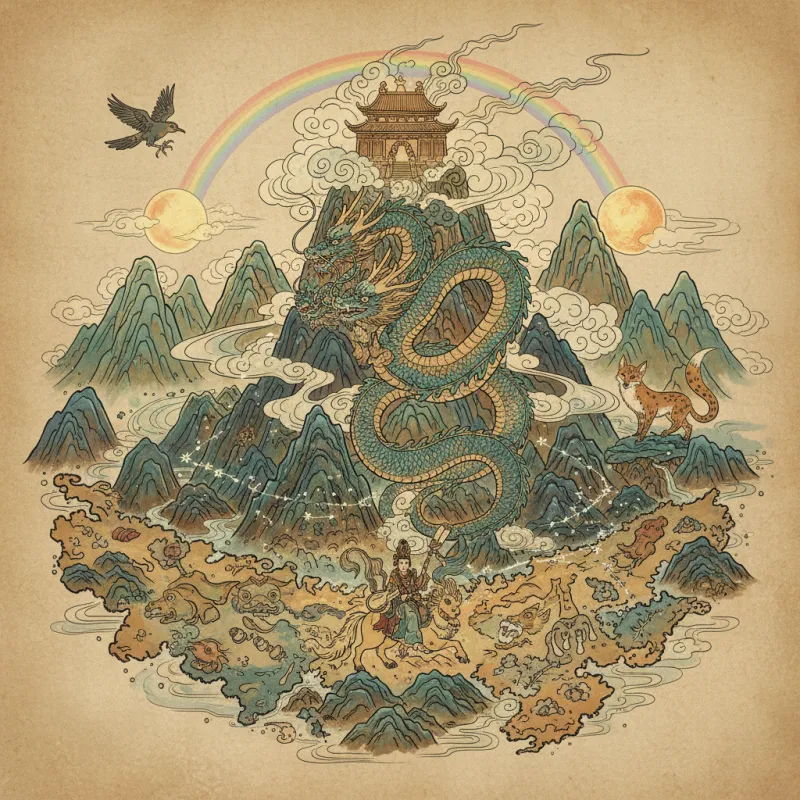
The Queen Mother of the West stands at the edge of a jade pool, watching tigers prowl the terraces below. Above her, the sky isn't sky at all — it's the underside of heaven, close enough to touch. This is Kunlun Mountain (昆仑山 Kūnlún Shān), and if you're reading this from anywhere on earth, you're technically standing on its lower slopes. Because in the cosmology of ancient China, Kunlun isn't just a mountain. It's the mountain. The axis. The pillar holding up everything that matters.
The Geography of Impossibility
Let's get one thing straight: when the Shanhai Jing (山海经 Shānhǎi Jīng, Classic of Mountains and Seas) talks about Kunlun, it's not describing a hiking destination. The text places it somewhere in the far west, beyond the edge of the known world, and describes it as having nine gates, each guarded by the kaiming beast (开明兽 kāimíng shòu) — a creature with nine heads and a human face. The mountain rises in terraces, each level more divine than the last, until you reach the summit where the Jade Pool (瑶池 Yáochí) reflects a sky that mortals will never see.
The real Kunlun Mountains exist, of course. They stretch over 3,000 kilometers across what's now Xinjiang and Tibet, forming one of the longest mountain ranges in Asia. But here's what's fascinating: the mythological Kunlun seems to have absorbed the real mountain range's name sometime during the Han Dynasty (206 BCE - 220 CE), when Chinese explorers pushed west and needed to map their myths onto actual geography. It's like finding out that Mount Olympus is actually in Greece — technically true, but missing the point entirely.
The Architecture of Heaven
The Shanhai Jing describes Kunlun's structure with the precision of a surveyor having a fever dream. The mountain rises 11,000 li (about 5,500 kilometers, which should tell you everything about how literal we're being here). It's divided into three main levels, each with its own ecosystem of the impossible.
The lowest level, the Hanging Garden (悬圃 Xuánpǔ), is where immortals who haven't quite made it to the top tier hang out. Think of it as the suburbs of divinity. The middle level is where things get interesting — this is where the Queen Mother of the West (西王母 Xī Wángmǔ) has her palace, surrounded by gardens that grow the peaches of immortality. These aren't your farmer's market peaches. They ripen once every 3,000 years, and eating one makes you immortal. The waiting list is presumably long.
The summit is where heaven and earth actually connect. This is the axis mundi (世界之轴 shìjiè zhī zhóu), the cosmic pillar that appears in mythologies from Scandinavia to Mesoamerica. But Kunlun's version has a distinctly Chinese flavor — it's not just a connection point, it's a bureaucratic checkpoint. Gods descend here. Mortals (the very, very exceptional ones) ascend here. Everything is regulated, guarded, and probably requires the right paperwork.
The Queen Mother's Domain
If Kunlun is the center of the cosmos, the Queen Mother of the West is its administrator. She shows up in texts from the Shanhai Jing to the Mu Tianzi Zhuan (穆天子传 Mù Tiānzǐ Zhuàn, Biography of King Mu), and her character evolves from something genuinely terrifying to something more refined — though never quite tame.
Early descriptions give her tiger's teeth and a leopard's tail. She commands plagues. She's attended by three blue birds (三青鸟 sān qīngniǎo) that serve as her messengers, and her garden is guarded by creatures that would make a sphinx look friendly. But by the Han Dynasty, she's been gentrified into a more elegant figure, hosting banquets for emperors and dispensing wisdom along with those famous peaches.
The transformation tells you something about how Chinese cosmology evolved. The raw, shamanic power of the early texts gets refined into something more Confucian, more orderly. But the Queen Mother never loses her edge entirely. She's still the gatekeeper of immortality, still the one who decides who gets to ascend and who gets eaten by her tigers.
The Pillar and the Flood
Here's where Kunlun connects to one of China's most important myths: the Great Flood and the work of Gun (鲧 Gǔn) and Yu (禹 Yǔ). When the flood threatened to drown the world, Gun stole the xirang (息壤 xīrǎng) — self-expanding soil — from Kunlun to dam the waters. It didn't work, and Gun was executed for his theft. His son Yu succeeded where his father failed, but through engineering rather than theft, channeling the waters instead of trying to block them.
The detail that matters: the xirang came from Kunlun. The mountain isn't just a cosmic axis; it's a source of primordial materials, substances that don't follow normal physical laws. This makes Kunlun something like a warehouse for the building blocks of reality itself. Need to reshape the world? You'll need to make a trip to Kunlun first.
This connects to the broader concept of the cosmic order in Chinese thought. Kunlun isn't just geographically central; it's ontologically central. It's where the raw stuff of existence is stored and distributed.
The Journey West
By the time we get to the Ming Dynasty (1368-1644) and Wu Cheng'en's Journey to the West (西游记 Xīyóu Jì), Kunlun has been somewhat displaced by other cosmic mountains — notably Mount Sumeru (须弥山 Xūmí Shān) from Buddhist cosmology. But it still shows up, still matters, still represents that original Chinese vision of a world organized around a central peak.
What's interesting is how Kunlun's mythology influenced the development of Daoist immortality practices. The mountain became a template for internal alchemy (内丹 nèidān), where the human body itself is mapped as a cosmic mountain with its own terraces, gates, and divine inhabitants. Cultivating immortality meant, in a sense, building your own Kunlun inside yourself.
This internalization of cosmic geography is quintessentially Daoist. The external mountain becomes a metaphor for internal transformation. But the metaphor only works because everyone knows the original — Kunlun as the actual, literal center of everything.
The Real Mountain's Shadow
Modern visitors to the Kunlun Mountains in Xinjiang and Tibet are walking through a landscape that's been mythologized for over 2,000 years. The peaks are real enough — Liushi Shan reaches 7,167 meters — but they're haunted by their mythological counterpart. Every jade deposit found in the region gets connected back to the Queen Mother's palace. Every unusual rock formation becomes evidence of divine architecture.
This is what happens when mythology and geography collide. The real mountains can never quite live up to the myth, but they don't have to. They serve as a physical anchor for something that was always meant to be more than physical. You can climb the real Kunlun, but you can't reach the Jade Pool. That's not a failure of mountaineering; it's the point.
The Axis Holds
What makes Kunlun endure as a concept isn't its geographical accuracy or even its mythological consistency — the stories contradict each other constantly, as myths do. What makes it endure is its function as a center. Every culture needs a place where the ordinary world touches something beyond itself. The Greeks had Olympus. The Norse had Yggdrasil. The Chinese had Kunlun.
The difference is that Kunlun was never just about gods. It was about order, structure, the idea that the cosmos has an architecture and that architecture has a center. This connects to everything from feng shui principles to imperial city planning. Beijing's Forbidden City was designed as a kind of earthly Kunlun, a place where heaven and earth meet under regulated conditions.
The mountain that holds up the sky isn't just a poetic image. It's a statement about how reality works: hierarchically, with clear levels and boundaries, but also with the possibility of ascent. The gates are guarded, yes, but they're gates. They can be opened. The Queen Mother is terrifying, yes, but she hosts banquets. The peaches ripen slowly, but they do ripen.
Kunlun is still there, in the far west, holding everything up. You can't visit it, but you're standing on it anyway. That's the paradox at the heart of Chinese cosmology, and Kunlun is where that paradox lives.
Related Reading
- The Four Divine Beasts: Guardians of the Compass
- Nüwa Creates Humanity: Sculpting People from Yellow Earth
- Pangu and the Cosmic Egg: The Chinese Creation Myth
- The Cosmology of the Shanhaijing: How Ancient Chinese Mapped the Universe
- Nüwa Repairs the Sky: Saving the World
- Fenghuang: The Chinese Phoenix and Its True Meaning
- Unearthing the Cursed Beings of Shanhaijing: Myths, Creatures, and Lands
- Exploring the Enigmatic Mountains and Creatures of the Shanhaijing