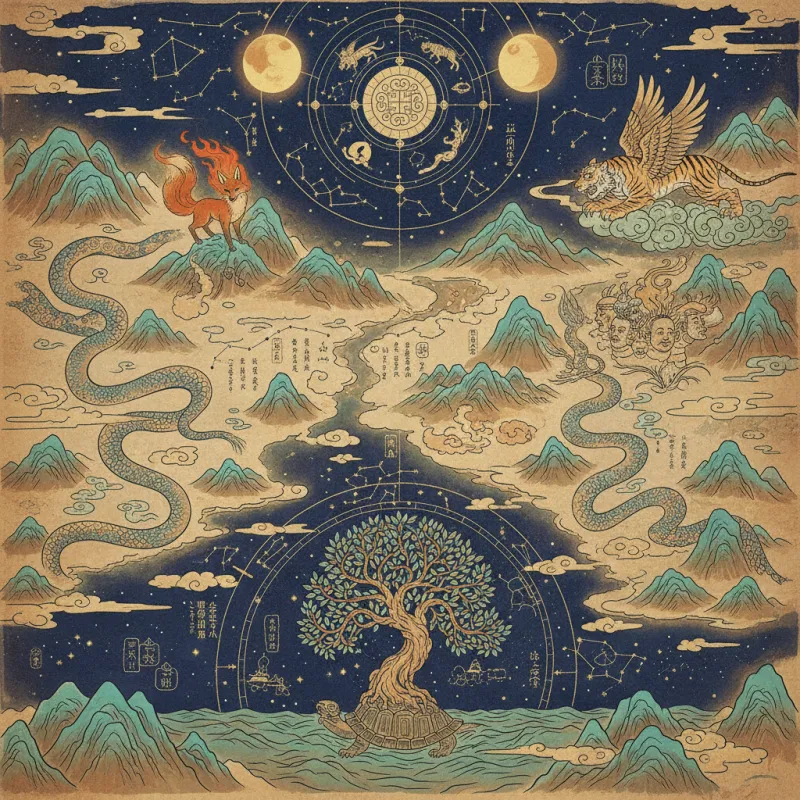
The ancient Chinese didn't just map mountains and rivers — they mapped meaning itself. When the compilers of the Shanhaijing (山海经, Shānhǎijīng, "Classic of Mountains and Seas") set out to describe the world sometime between the 4th century BCE and the early Han dynasty, they created something far stranger than a geography textbook. They built a cosmological system where distance from the center wasn't measured in li (里, Chinese miles) but in degrees of strangeness, where the edges of the known world dissolved into pure mythology, and where every mountain, river, and creature occupied a precise position in a grand metaphysical architecture.
The Center and the Periphery
The Shanhaijing's worldview operates on a deceptively simple principle: the universe is organized in concentric rings radiating outward from the Central Kingdom (中国, Zhōngguó). But this isn't just political propaganda dressed up as geography. It's a sophisticated cosmological model that maps ontological distance — how far something is from the human, the civilized, the comprehensible.
At the center lies the realm of ritual propriety, agricultural order, and Confucian virtue. Here, rivers flow predictably, mountains have proper names, and creatures behave according to their nature. Move outward, and the world begins to shimmer with strangeness. Rivers run uphill. Mountains float in the air. Animals speak human languages or possess multiple heads. By the time you reach the outermost regions described in the Haiwai Jing (海外经, "Classic of Regions Beyond the Seas"), you've entered a realm where the normal rules of reality simply don't apply.
This isn't primitive thinking — it's a deliberate philosophical statement. The Shanhaijing argues that the cosmos itself has a moral and metaphysical gradient. Civilization isn't just a human achievement; it's a cosmological position. The further you travel from the center, the closer you get to the raw, unprocessed stuff of creation itself.
The Five Sacred Mountains and Cosmic Architecture
The text's treatment of the Five Sacred Mountains (五岳, Wǔyuè) reveals how geography and cosmology interlock. These aren't just prominent peaks — they're cosmic pillars that literally hold up the sky. Mount Tai (泰山, Tàishān) in the east, Mount Hua (华山, Huàshān) in the west, Mount Heng (衡山, Héngshān) in the south, another Mount Heng (恒山, Héngshān, different character) in the north, and Mount Song (嵩山, Sōngshān) in the center form a quincunx pattern that mirrors the structure of the cosmos itself.
Each mountain corresponds to a direction, a season, an element, a color, and a set of associated creatures and deities. This isn't arbitrary symbolism — it's a systematic attempt to map the invisible forces that structure reality. When the Shanhaijing describes Mount Kunlun (昆仑山, Kūnlún Shān) as the axis mundi connecting heaven and earth, it's making a cosmological claim: there are places where the membrane between worlds grows thin, where the divine and mortal realms touch.
The text describes Kunlun with obsessive precision: its height (11,000 li plus 114 paces and 2 feet 6 inches), its terraced structure, the jade trees growing on its slopes, the immortals who dwell there. This specificity isn't meant to help you find the mountain — it's meant to establish its reality as a cosmological fact. Kunlun exists not primarily as a physical location but as a necessary feature of a properly ordered universe.
The Wilderness and the Monstrous
The Dahuang Jing (大荒经, "Classic of the Great Wilderness") sections push the cosmology to its logical extreme. Here, at the edges of the world, we encounter beings that challenge every category: the Xing Tian (刑天, Xíng Tiān), a headless giant who fights with his nipples as eyes and his navel as a mouth; the Kuafu (夸父, Kuāfù), who chased the sun until he died of thirst and whose abandoned walking stick became a forest; the Queen Mother of the West (西王母, Xīwángmǔ), a tiger-toothed, leopard-tailed deity who guards the peaches of immortality.
These aren't random monsters. Each represents a specific type of cosmological transgression or transformation. Xing Tian embodies the principle that vital force (qi, 气) can persist even when the body is destroyed. Kuafu demonstrates the catastrophic consequences of challenging cosmic order. The Queen Mother guards the boundary between mortal and immortal realms — her monstrous features mark her as a liminal being, neither fully human nor fully divine.
The Shanhaijing's monsters are cosmological markers. They tell you where you are in the universe's metaphysical geography. When you encounter a creature with human face and bird body, you know you've crossed into a realm where the categories that structure civilized life no longer hold. The text is essentially saying: "Here be dragons" — but meaning it literally and philosophically.
Water, Mountains, and the Flow of Cosmic Energy
The Shanhaijing obsessively catalogs rivers and mountains, but not as a modern geographer would. Instead, it traces the flow of cosmic energy (qi) through the landscape. Rivers aren't just water flowing downhill — they're channels through which vital force moves through the world. Mountains aren't just elevated terrain — they're nodes where qi accumulates and concentrates.
This explains the text's seemingly bizarre descriptions of rivers that flow upward or mountains that produce strange minerals and creatures. These aren't errors or fantasies — they're attempts to map the invisible energetic structure underlying the visible world. When the Shanhaijing tells you that a certain mountain produces jade, cinnabar, and three-headed birds, it's describing a location where cosmic forces manifest in particularly concentrated or unusual ways.
The text's treatment of the Four Seas (四海, Sìhǎi) — the bodies of water that bound the known world in each cardinal direction — reveals this cosmological thinking most clearly. These aren't just oceans; they're the ultimate boundaries where the ordered cosmos dissolves into primordial chaos. Beyond them lie the lands of the immortals, the dwelling places of gods, and the sources of cosmic renewal. The seas are simultaneously barriers and thresholds, protecting the human realm while connecting it to the divine.
Time, Space, and Mythic History
The Shanhaijing's cosmology doesn't just organize space — it organizes time. The text is filled with references to mythic events: the great flood tamed by Yu the Great (大禹, Dàyǔ), the rebellion of Gong Gong (共工, Gònggōng) who smashed Mount Buzhou and tilted the world, the creation of humans by Nüwa (女娲, Nǚwā). These aren't just stories — they're cosmological explanations for why the world is the way it is.
The text suggests that the current cosmic order is the result of a series of catastrophes and repairs. The world was once different — more perfect, more directly connected to the divine. Through various disasters (often caused by rebellious gods or heroes who overreached), that original order was damaged. The current world, with its strange creatures and anomalous geography, bears the scars of that mythic history.
This gives the Shanhaijing's cosmology a temporal dimension. The strange creatures and impossible geography aren't just spatially distant — they're temporally distant, remnants of earlier cosmic epochs. When you travel to the periphery, you're not just moving through space; you're moving backward through time, toward the raw materials of creation itself. This connects directly to ideas explored in the concept of mythic time and the role of catastrophe in Chinese cosmology.
A Living Cosmology
What makes the Shanhaijing's cosmology remarkable is that it was never purely theoretical. This was a practical map meant to be used — not for physical navigation, but for ritual, political, and spiritual purposes. Emperors consulted it when planning sacrifices to mountain and river deities. Shamans used it to navigate the spirit world. Scholars studied it to understand the structure of reality itself.
The text's influence persisted for millennia, shaping how Chinese culture understood the relationship between center and periphery, civilization and wilderness, human and divine. Even today, when we talk about China as the "Middle Kingdom," we're invoking the cosmological principle at the heart of the Shanhaijing: that there is a center to the world, and that distance from that center is measured not just in miles but in meaning.
The Shanhaijing doesn't just describe the world — it argues for a particular way of being in the world. It suggests that the universe has an inherent structure, that position matters, that the strange and monstrous aren't aberrations but necessary features of a complete cosmos. In mapping the universe, the ancient compilers of this text created something more than a geography. They created a cosmology that still resonates, still challenges, still invites us to see the world as a place of infinite strangeness radiating outward from wherever we happen to stand.
Related Reading
- The Complete Guide to Shanhai Jing: China's Book of Mythical Creatures
- Pangu and the Cosmic Egg: The Chinese Creation Myth
- Kunlun Mountain: The Axis of the Chinese Cosmos
- The Four Divine Beasts: Guardians of the Compass
- Nüwa Repairs the Sky: Saving the World
- The Peoples of the Shanhaijing: Foreign Nations at the Edge of the World
- Exploring the Myths of Serpents in the Shanhaijing: Creatures of Power and Mystery
- Exploring the Enigmatic Mountains and Creatures of the Shanhaijing