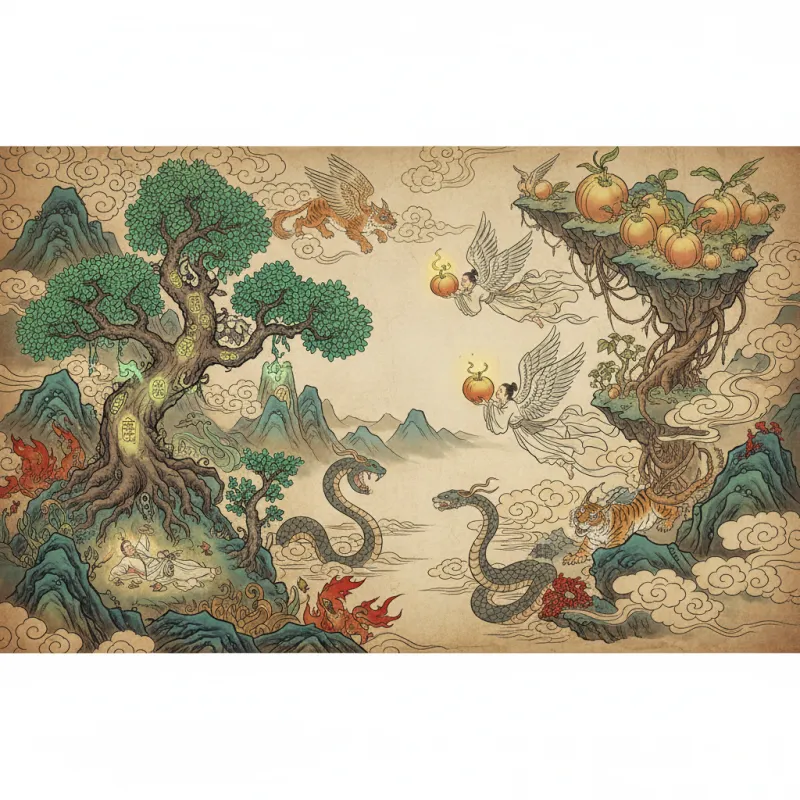
Picture this: you're hiking through an ancient Chinese mountain range, and you stumble upon a tree dripping what looks suspiciously like blood. Your guide casually mentions it cures death. A few valleys over, there's a fruit that'll let you fly — not metaphorically, but actually soar through the air like a bird. Welcome to the botanical fever dream that is the Shanhaijing (山海经 Shānhǎi Jīng, Classic of Mountains and Seas), where the plant life is just as unhinged as the nine-tailed foxes and human-faced owls.
The Text That Treats Magic Like Taxonomy
Compiled between the 4th century BCE and the early Han dynasty, the Shanhaijing reads like a field guide written by someone who ate the wrong mushrooms — except it's delivered with the dry, bureaucratic precision of a government survey. "In the mountains of X, there grows a tree called Y. Its leaves are Z-shaped. Eating its fruit prevents death." No fanfare, no mythology, just facts. This matter-of-fact tone is what makes the text so delightfully bizarre. The authors weren't trying to write fantasy; they genuinely believed (or wanted readers to believe) they were documenting real geography and natural history.
The plant entries follow a rigid formula: location, physical description, name, and effect. This systematic approach suggests the compilers saw these botanical oddities as no different from, say, a particularly venomous snake or a mountain rich in jade. The Shanhaijing contains roughly 120 plant species, and about a third of them have properties that would make pharmaceutical companies weep with envy — or terror.
Trees That Laugh at Death
The most coveted plants in the Shanhaijing are the death-defying ones, and they come in several flavors. The jianmu tree (建木 jiànmù, "Establishing Wood") grows on Mount Duguang and serves as a literal stairway to heaven — its branches reach into the celestial realm, allowing gods and shamans to climb between worlds. But that's just infrastructure. For personal immortality, you want the real heavy hitters.
The text describes a tree on Mount Kunlun whose fruit, when eaten, grants immunity to death. Not longevity — immunity. The distinction matters. Chinese immortality traditions generally recognize several types: physical immortality (your body doesn't decay), spiritual immortality (your soul persists), and what we might call "functional immortality" (you live so long it doesn't matter). The Shanhaijing plants seem to offer the first kind, which is both the most desirable and most suspicious.
Then there's the mysterious tree whose sap runs red like blood. The text notes this with the same casual tone you'd use to mention a tree with unusually large leaves. Modern scholars have tried to rationalize this — maybe it's the dragon's blood tree (Dracaena), which does produce red resin — but the Shanhaijing version explicitly states the sap can revive the dead when applied to corpses. That's several steps beyond what any Dracaena can manage.
Fruits of Flight and Other Aerial Ambitions
If immortality seems too ambitious, how about flight? The Shanhaijing describes multiple plants that grant temporary or permanent ability to fly. The most famous is a fruit found on Mount Yiwang that, when consumed, allows humans to soar through the air. The text doesn't specify duration, side effects, or whether you need to flap your arms, which seems like an oversight.
This obsession with flight makes cultural sense. Early Chinese cosmology was deeply concerned with vertical movement — ascending to heaven, descending to the underworld, shamanic soul journeys. The ability to fly wasn't just convenient transportation; it was spiritual mobility. Compare this to the mythical creatures that serve as divine messengers, many of which are winged precisely because they need to traverse cosmic realms.
Another plant grants the ability to walk on water, which is technically not flight but occupies the same category of "defying physics for fun." The text places this plant in the southern regions, which tracks with the Shanhaijing's general pattern of putting the weirdest stuff in the peripheries — the further from the Central Plains, the stranger things get.
The Invisible Herb and Other Tactical Botanicals
Not all magical plants are about transcendence. Some are refreshingly practical, in a "how to commit the perfect crime" sort of way. The Shanhaijing mentions an herb that renders the consumer invisible. The text doesn't moralize about this — no warnings about using invisibility responsibly or only in emergencies. It's just another plant property, like "reduces fever" or "causes diarrhea."
There's also a grass that, when worn, protects against weapons. This one actually has parallels in later Chinese martial arts fiction, where protective herbs and medicines become standard equipment for wandering heroes. The wuxia genre owes a debt to the Shanhaijing's matter-of-fact acceptance that plants can do impossible things.
The text describes several plants with more sinister applications. One flower's scent is lethal to anyone who smells it — a botanical assassination tool. Another plant causes anyone who eats it to become confused and lose their way, which sounds like a medieval roofie. The Shanhaijing doesn't judge; it just catalogs. This moral neutrality is part of what makes the text so fascinating. It's not a morality tale or a cautionary fable. It's a reference work that happens to include murder flowers.
The Geography of Impossibility
The Shanhaijing's plants aren't randomly distributed. There's a clear geographic logic: the most powerful and bizarre plants grow in the most remote and dangerous locations. Mount Kunlun, the cosmic axis mundi in Chinese mythology, hosts the greatest concentration of miracle plants. The further you get from civilization, the weirder the botany becomes.
This pattern reflects ancient Chinese geographic imagination, which saw the world as concentric circles of decreasing civilization and increasing strangeness. The Central Plains were orderly and known; the peripheries were chaotic and full of marvels. The Shanhaijing's plant geography maps this worldview perfectly. Want a plant that cures death? Better pack for a long journey to the edge of the known world.
Interestingly, some plants are described as growing in specific cardinal directions from certain mountains, suggesting the compilers (or their sources) had actual geographic information, however garbled. Modern scholars have attempted to map Shanhaijing locations onto real geography with mixed success. Some mountains are clearly identifiable; others seem to exist in a parallel dimension.
When Myth Meets Medicine
Here's where things get complicated: some Shanhaijing plants are real. The text describes ginseng, which does have medicinal properties (though not immortality). It mentions various herbs that match known Chinese medicinal plants. This mixing of real and impossible creates an interpretive nightmare. Were the compilers deliberately blending fact and fiction? Did they believe it was all real? Were some entries based on garbled reports of actual plants with exaggerated properties?
Traditional Chinese medicine has a complex relationship with the Shanhaijing. Some practitioners treat it as a legitimate (if ancient) medical text; others see it as purely mythological. The truth is probably somewhere in between. The text likely preserves genuine botanical knowledge alongside wishful thinking, shamanic visions, and pure invention.
The immortality plants are particularly interesting because they reflect real Chinese alchemical traditions. By the Han dynasty, emperors were funding expeditions to find immortality elixirs, often based on Shanhaijing-style descriptions. The first Qin emperor, Qin Shi Huang, famously sent ships to find the islands of the immortals and their life-extending plants. They never returned, which either means they found immortality or died at sea. History suggests the latter.
The Botanical Uncanny Valley
What makes the Shanhaijing's plants so unsettling isn't just their impossible properties — it's the clinical tone. If the text described these plants in flowery, mythological language, they'd feel like fairy tales. Instead, we get: "There is a tree. Its leaves are round. Its fruit prevents death." This deadpan delivery creates a cognitive dissonance that's deeply weird.
Modern fantasy literature has learned from this. The best magical systems feel real because they're presented systematically, with rules and limitations. The Shanhaijing pioneered this approach 2,000 years ago, treating magic as natural history. It's worldbuilding through bureaucracy.
The plants also reveal anxieties and desires that transcend their historical moment. Immortality, flight, invisibility, invulnerability — these are universal human wishes. The Shanhaijing's genius is presenting them not as divine gifts or moral rewards but as natural resources, if only you know where to look. It's a profoundly democratic vision of magic: anyone can access these powers, assuming they survive the journey.
Why We Still Care About Impossible Plants
The Shanhaijing's botanical catalog has influenced Chinese culture for millennia. Its plants appear in poetry, novels, paintings, and modern fantasy fiction. The text established templates — the immortality peach, the flying herb, the protective plant — that recur throughout Chinese literature. When Journey to the West's Monkey King steals the peaches of immortality, he's raiding a garden that the Shanhaijing first planted.
But beyond cultural influence, these impossible plants pose a philosophical question: what's the difference between a plant that grants immortality and one that extends life by twenty years? Between a fruit that lets you fly and one that makes you feel euphoric? The Shanhaijing's plants are exaggerations, but they're exaggerations of real botanical properties. All plants are chemical factories producing compounds that affect human biology. Some just happen to be more dramatic about it.
In our age of genetic engineering and synthetic biology, the Shanhaijing's botanical fever dreams feel less impossible and more like a research agenda. We may not have fruits that grant flight, but we have plants that produce spider silk, glow in the dark, and manufacture pharmaceuticals. The line between the Shanhaijing's impossible botany and modern bioengineering is blurrier than we'd like to admit.
The text reminds us that humans have always looked at plants and seen potential — for healing, for transformation, for transcendence. The Shanhaijing just had the audacity to write it all down as if it were real, creating a botanical catalog that's part field guide, part wish list, and entirely unforgettable. Whether its compilers believed in death-defying trees or were engaging in elaborate world-building, they created something that still captures our imagination: a world where the right plant, in the right place, can change everything.
Related Reading
- Magical Plants of the Shanhai Jing: Trees That Grant Immortality — Shanhai Perspective
- The Peaches of Immortality: The Most Famous Fruit in Chinese Mythology — Shanhai Perspective
- Unearthing the Mythical Flora in Shanhaijing: A Journey Through Legendary Plants
- Lingzhi: The Mushroom of Immortality from Myth to Medicine — Shanhai Perspective
- Mythical Plants of the Shanhaijing: Trees That Grant Immortality and Flowers That Kill — Shanhai Perspective
- Mystical Beasts of the Shanhaijing: A Journey Through Myth and Geography
- Leviathans of the Eastern Sea: Giant Sea Creatures in Chinese Myth
- Immersive Wonders of Shanhaijing: Exploring Mythical Birds and Enchanted Regions