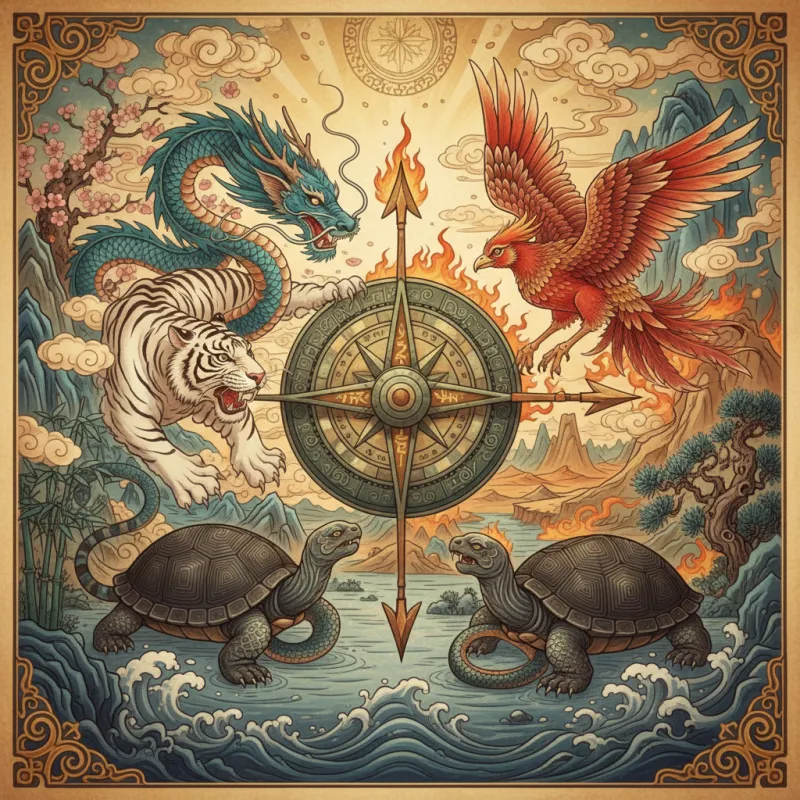
Four stone pillars stand at the corners of an ancient Chinese tomb, each carved with a creature so powerful that emperors believed their images alone could command the forces of heaven and earth. These aren't decorative flourishes—they're the Four Divine Beasts, and for over two thousand years, they've been doing the cosmic equivalent of holding up the sky while simultaneously organizing the universe into something comprehensible.
The Celestial Bureaucracy Gets Physical
The Four Divine Beasts—Qinglong 青龙 (Azure Dragon), Zhuque 朱雀 (Vermilion Bird), Baihu 白虎 (White Tiger), and Xuanwu 玄武 (Black Tortoise)—emerged during the Warring States period when Chinese cosmology was getting serious about systematizing the universe. Unlike the chaotic menagerie of creatures in the Shanhai Jing, these four represent something more refined: the marriage of astronomical observation with directional symbolism.
Here's what makes them fascinating: they're not just mythical animals. Each beast corresponds to a constellation grouping (one of the Four Symbols or Si Xiang 四象), a cardinal direction, a season, an element, and even a color. Qinglong guards the East and represents spring and wood. Zhuque takes the South with summer and fire. Baihu claims the West, autumn, and metal. Xuanwu holds down the North with winter and water. This isn't random assignment—it's a sophisticated cosmological framework that ancient Chinese astronomers used to map the night sky and organize time itself.
The Shanhai Jing mentions various dragons, birds, tigers, and turtle-snake hybrids, but it doesn't explicitly codify the Four Divine Beasts as a unified system. That crystallization happened later, during the Han Dynasty (206 BCE–220 CE), when scholars were obsessed with correlative cosmology—the idea that everything in the universe corresponds to everything else in predictable patterns. The beasts became visual shorthand for this worldview.
Qinglong: The Dragon Who Brings Rain and Chaos
The Azure Dragon isn't your friendly neighborhood lizard. In Chinese cosmology, dragons control water and weather, which means Qinglong essentially holds the power of life and death over agricultural societies. He appears in the eastern sky during spring, when farmers desperately need rain. His seven constituent constellations (Horn, Neck, Root, Room, Heart, Tail, and Winnowing Basket) stretch across a massive portion of the celestial sphere.
What's interesting is how Qinglong's symbolism evolved. Early texts treat him as a somewhat dangerous figure—dragons in Chinese mythology are powerful but not necessarily benevolent. By the Tang Dynasty (618–907 CE), however, Qinglong had been thoroughly domesticated into imperial symbolism. The emperor's throne faced south, which meant Qinglong was literally on his left hand, the position of honor. This is why you'll see Azure Dragon imagery all over imperial architecture, from the Forbidden City to provincial government buildings.
The connection between Qinglong and the concept of cosmic order runs deep. When the dragon constellation appeared in the correct position at the correct time, it signaled that the universe was functioning properly. When it didn't—well, that's when dynasties started to worry.
Zhuque: The Bird That Isn't a Phoenix
Let's clear something up: Zhuque is not a phoenix, despite what countless English translations claim. The phoenix (or fenghuang 凤凰) is a completely different creature with its own mythology and symbolism. Zhuque is specifically a vermilion-colored bird associated with fire and the southern direction. The confusion arose because both are birds, both are associated with fire, and Western translators in the 19th century didn't care much about the distinction.
Zhuque's seven constellations (Well, Ghost, Willow, Star, Extended Net, Wings, and Chariot) dominate the southern sky during summer. In ancient Chinese astronomy, the appearance of these constellations marked the hottest part of the year—which makes perfect sense given Zhuque's association with fire and the element that represents transformation and energy.
Here's where it gets culturally specific: Zhuque appears frequently in Daoist talismans and protective charms, particularly those designed to ward off evil spirits from the south. The logic was straightforward—if Zhuque guards the southern direction in the cosmic order, then invoking his image should protect your southern-facing door or wall. You can still see this practice in traditional Chinese architecture, where vermilion bird motifs appear on southern gates and entrances.
Baihu: The Tiger Who Eats Ghosts
The White Tiger is the most overtly martial of the Four Divine Beasts. While Qinglong represents imperial authority and Zhuque represents transformation, Baihu represents raw military power and the ability to destroy evil. In Han Dynasty tomb art, Baihu frequently appears devouring demons and malevolent spirits—he's not just a guardian, he's an active combatant against supernatural threats.
Baihu's association with autumn and metal isn't accidental. Autumn was traditionally the season for military campaigns (after the harvest, when soldiers were available), and metal represents weapons and warfare. The seven western constellations (Legs, Bond, Stomach, Hairy Head, Net, Turtle Beak, and Three Stars) appear in the western sky during autumn, marking the time when ancient Chinese armies would march.
What's particularly interesting is how Baihu's symbolism intersects with the concept of yin and yang. The west is associated with yin energy—darkness, death, and the setting sun. Baihu embodies this destructive aspect, but in a controlled, necessary way. He's not evil; he's the force that clears away what needs to be cleared away so new growth can occur. This is why white tiger imagery appears so frequently in military contexts and on weapons throughout Chinese history.
Xuanwu: The Turtle-Snake Hybrid Nobody Expected
Xuanwu is weird. While the other three Divine Beasts are relatively straightforward animals (dragon, bird, tiger), Xuanwu is a turtle with a snake coiled around it. Some versions show them as separate creatures, others as a single hybrid entity. The name itself—"Dark Warrior" or "Mysterious Warrior"—doesn't immediately suggest "turtle and snake," which has led to centuries of scholarly debate about the symbolism.
The most compelling explanation connects Xuanwu to ancient Chinese observations about turtle and snake mating. Early naturalists noticed turtles and snakes together during mating season and concluded (incorrectly) that they were interbreeding. This biological misunderstanding became mythologized into Xuanwu, representing the union of two creatures and, by extension, the union of yin and yang, heaven and earth, male and female.
Xuanwu's seven northern constellations (Dipper, Ox, Girl, Emptiness, Rooftop, Encampment, and Wall) appear during winter, the season of maximum yin energy. The north was considered the direction of death and darkness in Chinese cosmology, which is why Xuanwu became associated with protection against malevolent forces. During the Song Dynasty (960–1279 CE), Xuanwu worship became so popular that the emperor Zhenzong actually renamed the deity to Zhenwu 真武 (True Warrior) because "Xuan" sounded too similar to his personal name—a classic case of imperial ego reshaping mythology.
From Astronomy to Architecture
The Four Divine Beasts didn't stay confined to astronomical charts and philosophical texts. They became deeply embedded in Chinese material culture, particularly in architecture and urban planning. The ideal Chinese city was oriented with gates facing the four cardinal directions, each protected by its corresponding Divine Beast. Chang'an (modern Xi'an), the Tang Dynasty capital, was laid out according to this principle, with the Azure Dragon Gate in the east, Vermilion Bird Gate in the south, White Tiger Gate in the west, and Xuanwu Gate in the north.
This wasn't just symbolic—it was practical cosmology. By aligning the city with the Four Divine Beasts, planners believed they were harmonizing human civilization with cosmic order. The famous Xuanwu Gate Incident of 626 CE, where Li Shimin (the future Emperor Taizong) killed his brothers and seized power, happened at the northern gate precisely because Xuanwu represented military power and decisive action. The location wasn't coincidental; it was symbolically appropriate for a violent power struggle.
Tomb architecture provides even more evidence of how seriously people took the Four Divine Beasts. Han Dynasty tombs frequently feature all four beasts painted on the walls or carved into stone, positioned according to their directional correspondences. The deceased was literally surrounded by cosmic guardians, protected in death as they had been (theoretically) in life. This practice continued through subsequent dynasties, evolving in artistic style but maintaining the core symbolism.
The Beasts in Modern Context
Walk through any Chinatown in the world, and you'll still see the Four Divine Beasts. They appear on restaurant signs, in feng shui consultations, on martial arts school logos, and in countless video games and anime. The symbolism has been simplified and sometimes distorted—Qinglong becomes a generic "lucky dragon," Zhuque gets confused with the phoenix—but the core recognition remains.
What's remarkable is how these creatures, born from astronomical observation and cosmological theory over two thousand years ago, continue to resonate. They represent something fundamental about how humans organize space and time, how we create meaning from the chaos of existence. The Four Divine Beasts aren't just mythological creatures—they're a complete system for understanding the universe, packaged in forms that are memorable, powerful, and deeply satisfying to the human need for pattern and order.
The next time you see a dragon on the left side of a Chinese building or a white tiger on a martial arts uniform, remember: you're looking at a fragment of one of humanity's most sophisticated attempts to map the cosmos onto everyday life. The beasts are still guarding their directions, still organizing the universe, still doing their job after all these centuries.
Related Reading
- Shanhaijing Cosmology: How Ancient China Imagined the Universe
- Pangu and the Cosmic Egg: The Chinese Creation Myth
- Exploring Shanhaijing: Mythical Creatures and Ancient Lands of Chinese Cosmology
- The Cosmology of the Shanhaijing: How Ancient Chinese Mapped the Universe
- The Complete Guide to Shanhai Jing: China's Book of Mythical Creatures
- Unraveling the Mysteries of Shanhaijing: Mythical Creatures and Enigmatic Lands
- Kunlun Mountain: The Paradise of Immortals
- Unearthing the Cursed Beings of Shanhaijing: Myths, Creatures, and Lands