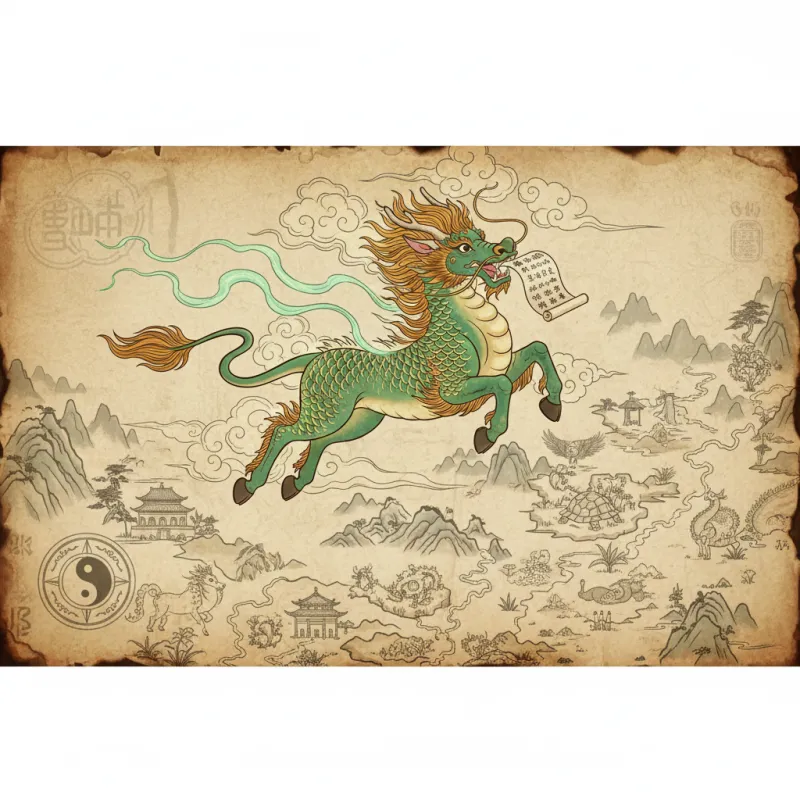
A creature so gentle it refuses to step on grass. So powerful it commands the respect of emperors. So rare its appearance signals the birth of a sage or the reign of a virtuous ruler. The Qilin (麒麟 qílín) is China's answer to the unicorn, but calling it that sells it short. This is no prancing horse with a horn. This is a composite beast wrapped in flames that don't burn, armed with antlers it never uses as weapons, walking on clouds to avoid crushing insects. The Qilin is mythology's greatest paradox: the most fearsome creature that has never harmed anything.
The Anatomy of Impossibility
The Qilin defies zoological logic. According to the Shanhaijing (山海经 Shānhǎi Jīng, Classic of Mountains and Seas) and later texts like the Shuowen Jiezi (说文解字), it sports the scaled body of a dragon, the hooves of an ox, the tail of a lion, and the magnificent antlers of a deer. Some accounts add a wolf's forehead or a fish's tail. Its body blazes with sacred fire — flames that produce no heat, no smoke, no destruction. Just pure, radiant energy.
The scales shimmer in five colors, representing the five elements: wood, fire, earth, metal, and water. This isn't decorative. The Qilin literally embodies cosmic balance. Its voice sounds like temple bells or wind chimes — musical, harmonious, never harsh. When it walks, flowers bloom in its footprints. When it appears, sweet dew falls from the sky.
But here's what makes the Qilin truly strange: despite having a horn (or sometimes two), it never uses it as a weapon. Those antlers? Purely ornamental. The scales? Not for protection — the Qilin has no enemies because it makes no enemies. It's as if someone designed the perfect war machine and programmed it to be a Buddhist monk.
The Philosophy of Absolute Gentleness
The Qilin's gentleness isn't weakness — it's a conscious choice that requires more strength than violence ever could. This creature walks on clouds and air specifically to avoid stepping on insects or crushing grass. It eats no living thing, subsisting on a vegetarian diet or, in some accounts, pure spiritual energy. Its fire doesn't burn. Its presence doesn't threaten. It is the embodiment of wuwei (无为 wúwéi) — effortless action, power held in perfect restraint.
Confucian scholars loved this about the Qilin. Here was a creature that proved virtue and power weren't opposites. The Liji (礼记 Lǐjì, Book of Rites) lists the Qilin among the four divine creatures (si ling 四灵), alongside the Dragon, Phoenix, and tortoise. But while dragons commanded storms and phoenixes ruled the skies, the Qilin simply... existed. Peacefully. Powerfully. Perfectly.
This made it the ultimate symbol for the ideal Confucian gentleman — someone who possesses great capability but exercises it with restraint, who could dominate but chooses to harmonize instead. The Qilin doesn't need to prove anything. Its mere existence is proof enough.
Messenger of Sages and Kings
The Qilin appears only during the reign of a benevolent ruler or to herald the birth of a great sage. It's mythology's quality control inspector, showing up to certify that yes, this person is the real deal.
The most famous Qilin appearance? Right before Confucius was born in 551 BCE. According to legend, a Qilin appeared to Confucius's mother, Yan Zhengzai, and spit out a jade tablet predicting her son would become "a king without a throne." The creature stayed until the birth, then vanished. Confucius himself reportedly saw a Qilin near the end of his life — hunters had captured and wounded one, not recognizing what it was. When Confucius identified it, he wept, knowing that the age of virtue was ending. He died shortly after.
During the Ming Dynasty, Admiral Zheng He's voyages to Africa brought back a giraffe in 1414. The Yongle Emperor's court immediately declared it a Qilin — the long neck, the gentle nature, the strange appearance all fit. Never mind that giraffes are, you know, real. The emperor took it as cosmic confirmation of his legitimacy. The giraffe's Chinese name today? Changlu (长鹿), "long deer," but many still call it Qilin.
The Qing Dynasty emperors embroidered Qilins on the robes of first-rank military officials. Not dragons — those were reserved for the emperor. The Qilin represented military power exercised with wisdom and restraint. A general wearing Qilin robes was saying: "I could destroy you, but I'd rather not."
The Qilin in Art and Architecture
Walk through Beijing's Forbidden City and you'll spot Qilins everywhere. They guard gates, decorate roofs, and appear in paintings. But they're not there as protectors in the traditional sense — they don't ward off evil spirits like lion dogs. They're there as symbols of the emperor's virtue. Their presence says: "This is a place of righteous rule."
Qilin statues typically show them in mid-stride, one hoof raised, head turned slightly as if listening. They're alert but not aggressive, powerful but not threatening. Artists struggled with the Qilin's contradictory nature — how do you make something look both fearsome and gentle? The solution was usually to give them fierce features (scales, flames, horns) but peaceful expressions and postures.
In traditional Chinese gardens, Qilin sculptures often appear near water features. The symbolism is deliberate: water is soft but can wear down stone, gentle but unstoppable. The Qilin embodies the same principle. Taoist philosophers would approve.
Modern Qilins: From Beer to Anime
The Qilin's influence extends far beyond ancient texts. Kirin Beer, one of Japan's most popular brands, takes its name from the Japanese pronunciation of Qilin (kirin). The company's logo features a stylized Qilin, and their marketing emphasizes quality and refinement — very on-brand for a creature that represents excellence.
In contemporary fantasy, the Qilin appears in everything from video games to novels, though often stripped of its pacifist nature. Fantastic Beasts: The Secrets of Dumbledore (2022) featured a Qilin that could detect purity of heart and bow to worthy leaders — a decent interpretation, though the film's Qilin looked more like a golden deer than the traditional chimeric beast.
Chinese fantasy novels, particularly in the xianxia (仙侠) genre, often feature Qilins as mounts for immortals or as guardian beasts of sacred sites. They retain their gentle nature but gain combat abilities — usually defensive or supportive rather than offensive. Even in fiction, the Qilin refuses to be a simple war beast.
Why the Qilin Matters Now
In an age that often confuses aggression with strength and volume with authority, the Qilin offers a different model. It suggests that true power doesn't need to announce itself, that the strongest position is often restraint, that you can be formidable without being destructive.
The Qilin also represents something increasingly rare: the idea that appearances can be deceiving in the opposite direction. We're used to wolves in sheep's clothing. The Qilin is a sheep in wolf's clothing — something that looks dangerous but is actually harmless. It challenges our assumptions about what power looks like and how it should be used.
Chinese culture has always valued this kind of paradox. The best swordsman is the one who never draws his blade. The wisest person is the one who knows they know nothing. The most powerful creature is the one that refuses to harm. The Qilin embodies all of these principles in one impossible, beautiful package.
The Qilin's Legacy
The Qilin appears in Chinese idioms and expressions. "Qilin among people" (rén zhōng qílín 人中麒麟) means an exceptional person, someone rare and precious. Parents hope their children will be "Qilin children" (qílín ér 麒麟儿) — prodigies destined for greatness. The phrase carries no pressure whatsoever.
In feng shui, Qilin figurines are placed in homes to attract good fortune and protect against negative energy. But unlike other protective symbols, the Qilin doesn't fight off bad luck — it simply creates an environment where bad luck doesn't want to be. It's protection through elevation rather than confrontation.
The creature also appears in traditional Chinese medicine and alchemy, where "Qilin blood" or "Qilin horn" (neither of which exist, obviously) were considered supreme ingredients. The irony is thick: trying to harm the gentlest creature in existence for medicinal purposes. Fortunately, since Qilins don't actually exist, no animals were harmed in these mythological recipes.
The Qilin remains one of Chinese mythology's most distinctive creations — a creature that could dominate but chooses not to, that could destroy but prefers to create, that walks on air to avoid stepping on grass. In a world of dragons that hoard gold and phoenixes that burn and resurrect, the Qilin stands apart. It doesn't need to prove its power. It simply is powerful, in the quietest, most profound way possible.
That's the Qilin's final lesson: the most impressive thing you can do with unlimited power is choose not to use it. The strongest flame is the one that doesn't burn. The sharpest horn is the one that never gores. The greatest beast is the one that harms nothing at all.
Related Reading
- The Four Symbols: Azure Dragon, White Tiger, Vermillion Bird & Black Tortoise
- Divine Beasts of the Shanhaijing: The Four Guardians and Beyond
- Chinese Dragons: Everything You Need to Know
- The Nine-Tailed Fox: From Divine Messenger to Demonic Seductress
- Fenghuang: The Chinese Phoenix and Its True Meaning
- Kuafu Chases the Sun: The Giant's Last Run
- Flood Myths: Noah vs Gun-Yu
- Hundun: The Faceless Creature of Chaos