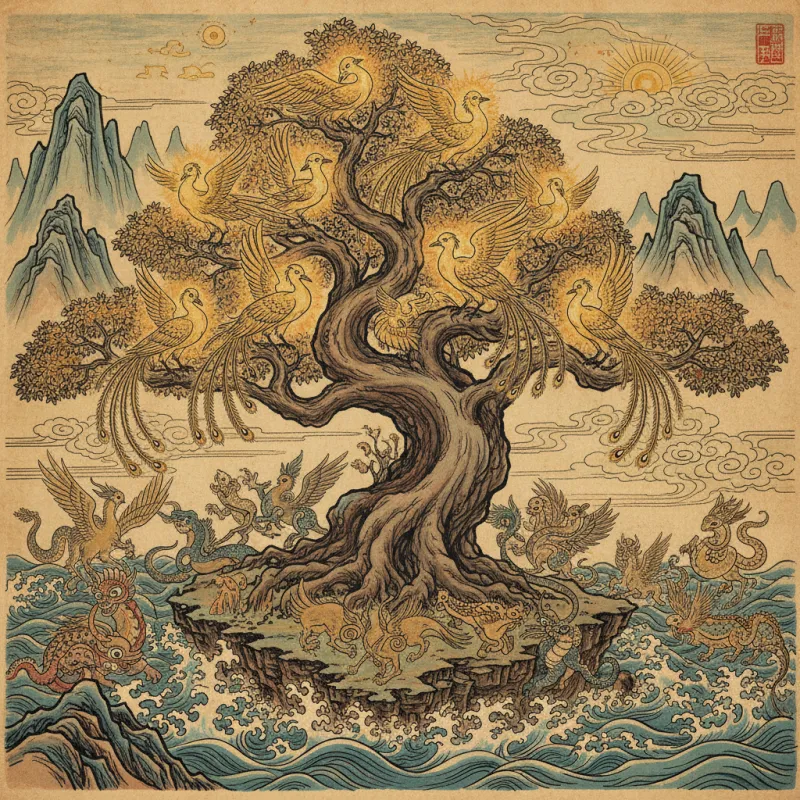
Picture this: every morning, a fresh sun climbs from the branches of an impossibly tall tree standing in the eastern ocean, while nine of its siblings wait their turn, roosting like cosmic birds in the canopy above. This isn't science fiction—it's the Fusang tree (扶桑, fúsāng), one of the most spectacular pieces of celestial architecture described in the Shanhai Jing (山海经, Shānhǎi Jīng), and a cornerstone of ancient Chinese cosmological thought that tried to answer a question every civilization has asked: where does the sun come from?
The Tree at the Edge of the World
The Shanhai Jing places the Fusang in the Eastern Sea, specifically in a location called the Tang Valley (汤谷, Tāng Gǔ)—sometimes translated as the Valley of Hot Water, which makes perfect sense when you consider it's where suns bathe before their daily journey. The text describes it as a massive tree, so tall it bridges the gap between earth and heaven, with branches thick enough to support not one but ten suns simultaneously.
What's fascinating here is the specificity. This isn't vague mythological hand-waving. The Shanhai Jing tells us that nine suns rest in the lower branches while one sun occupies the upper branches, ready to begin its journey across the sky. The tree itself is described as having a trunk so wide that two people with outstretched arms couldn't encircle it, and its leaves supposedly glow with a reddish light—perhaps an attempt by ancient observers to explain the colors of dawn.
The Fusang shares conceptual space with other mythical trees in Chinese cosmology, particularly the Jianmu Tree, which served as a ladder between heaven and earth for gods and shamans. But where Jianmu was about vertical access, Fusang was about cosmic function—it was infrastructure for the universe's most important daily operation.
The Ten Suns and Their Disastrous Day Off
The Fusang tree's most famous moment in Chinese mythology comes from the story of the ten suns, which explains why we now have only one sun instead of ten. According to the myth, the ten suns were the children of the goddess Xihe (羲和, Xīhé), who served as their charioteer. Each day, she would escort one sun across the sky in her chariot while the other nine rested in the Fusang tree, waiting their turn.
This system worked perfectly until the ten suns, apparently bored with the routine, decided to all go out at once. The result was catastrophic. With ten suns blazing simultaneously in the sky, the earth began to scorch. Rivers dried up, crops withered, and people suffered terribly. The legendary archer Hou Yi (后羿, Hòu Yì) was called upon to solve the crisis, and he shot down nine of the ten suns with his bow, leaving only one to continue the daily journey.
What I find compelling about this myth is how it functions on multiple levels. On the surface, it's an origin story explaining why we have one sun. But dig deeper, and you see ancient Chinese thinking about balance, duty, and the consequences of abandoning one's role in the cosmic order. The suns weren't evil—they were just young and reckless, wanting to play together. Their punishment was permanent, and the sole surviving sun learned a harsh lesson about responsibility.
Fusang as a Real Place: When Myth Meets Geography
Here's where things get genuinely interesting: some ancient Chinese scholars believed Fusang was a real place. During the Han Dynasty (206 BCE - 220 CE), the term "Fusang" began appearing in geographical texts not as mythology but as an actual location far to the east of China, possibly referring to Japan or even, according to some wildly speculative theories, the Americas.
The Book of Liang (梁书, Liáng Shū), compiled in the 7th century CE, contains an account by a Buddhist monk named Hui Shen (慧深, Huì Shēn) who claimed to have visited a land called Fusang in 499 CE, located 20,000 li east of China. His description includes details about the people, their customs, and their government—none of which sound particularly mythological. This has led to centuries of debate about whether Hui Shen actually reached the Americas, though most modern scholars are skeptical.
What's undeniable is that "Fusang" became a poetic name for the far east, for the lands of the rising sun, and for the liminal space where the known world ended and mystery began. It's similar to how Western culture used "Ultima Thule" or "Cathay"—names that started as real places but accumulated so much mythological weight that they became more symbol than location.
The Symbolism of Dawn and Renewal
The Fusang tree's location in the east isn't arbitrary. In Chinese cosmology, east is the direction of spring, birth, and new beginnings. The Five Phases system associates east with wood and the color green (or sometimes blue-green), which aligns perfectly with the Fusang being a tree. The daily emergence of the sun from the Fusang represents not just the start of a new day but the eternal cycle of renewal that keeps the universe functioning.
This is why the Fusang appears in so much classical Chinese poetry as a metaphor for hope, new starts, and imperial power. When a poet writes about "the sun rising from Fusang," they're not just describing dawn—they're invoking the entire mythological framework of cosmic order, divine mandate, and the promise that no matter how dark the night, the sun will return.
The Tang Dynasty poet Li Bai (李白, Lǐ Bái, 701-762 CE) references Fusang in several poems, using it to represent both literal eastern lands and metaphorical new beginnings. In his poem "Dreaming of Wandering in Tianmu," he writes of flying past Fusang, placing it in a dreamscape that blends geography and mythology so thoroughly that separating them becomes impossible.
The Tree's Botanical Identity: Mulberry or Hibiscus?
Scholars have long debated what actual tree species the Fusang might represent, if any. The character 扶 (fú) means "to support" or "to help," while 桑 (sāng) means mulberry. This has led some to interpret Fusang as a "supporting mulberry" or a mulberry tree that holds up the suns.
However, in modern Chinese, "fusang" (扶桑) also refers to the hibiscus flower, specifically Hibiscus rosa-sinensis. This creates an interesting linguistic puzzle: did the mythological tree give its name to the flower, or did the flower's name get retroactively applied to the myth? The hibiscus connection might come from the flower's association with the sun—hibiscus blooms are often bright red or orange, and they open with the sunrise.
The mulberry interpretation has its own appeal, though. Mulberry trees were economically crucial in ancient China because they fed silkworms, making them symbols of prosperity and civilization. A cosmic mulberry tree supporting the suns would represent the universe itself supporting human civilization—a neat piece of symbolic logic.
Fusang in Contemporary Culture
The Fusang tree hasn't faded into obscurity. It appears regularly in modern Chinese fantasy literature, video games, and television shows, often as a location of great power or a source of solar energy. The tree shows up in games like Genshin Impact and novels in the xianxia (仙侠, xiānxiá) genre, where it's frequently depicted as a cultivation resource or a gateway to higher realms.
What's changed is the interpretation. Modern retellings often emphasize the Fusang's role as a power source rather than a resting place, reflecting contemporary concerns with energy and resources. The ten suns become ten sources of power that must be managed carefully—a metaphor that resonates differently in an age of climate change and resource depletion than it did in ancient agricultural societies worried about drought.
Japanese culture has also adopted the Fusang, using it as a poetic name for Japan itself (since Japan lies to the east of China). This usage appears in classical Japanese literature and continues in some contexts today, creating an interesting cultural exchange where a Chinese mythological location becomes a real-world geographical reference.
The Enduring Mystery of the Eastern Tree
What makes the Fusang tree so enduring isn't just its spectacular imagery—though the picture of ten suns roosting in a tree like cosmic chickens is undeniably striking. It's the way the myth captures something fundamental about how humans relate to the sun. We need it, we fear it, and we've always wondered where it goes at night and where it comes from in the morning.
The Fusang tree provided an answer that satisfied both practical and poetic needs. It explained the sun's daily journey while also creating a rich symbolic framework for thinking about order, duty, and renewal. The fact that the tree stood at the edge of the known world, in the mysterious east where anything seemed possible, only added to its power as a mythological concept.
Today, we know the sun doesn't rest in a tree between its daily journeys. But the Fusang remains valuable not as astronomy but as a window into how ancient Chinese thinkers constructed their universe—not through cold equations but through stories that made the cosmos feel comprehensible, meaningful, and even beautiful. In that sense, the Fusang tree is still doing its job: supporting our understanding, even if it's no longer supporting the sun.
Related Reading
- The Geography of the Shanhaijing: Mapping a World That Does Not Exist
- The Four Seas and the Shape of the Ancient Chinese World
- Sacred Rivers in Chinese Mythology: The Yellow River and the Yangtze
- Weak Water: The River Nothing Can Cross
- Kunlun Mountain: The Paradise of Immortals
- Hetu and Luoshu: The Cosmic Diagrams
- Exploring the Myths of Serpents in the Shanhaijing: Creatures of Power and Mystery
- Hundun: The Faceless Creature of Chaos